Sunday, March 15, 2009

Non-action and the Great Harmony

We have seen in The Power of Non-action that non-action refers to an action that is not motivated by selfish desires but is inspired by universal truths and values. We also saw that the more an action is ego-less, the more power it has and the more support it receives from the powers that be. In No action is lost we lifted the cover on the significance and the power of all our thoughts, all our words and all our actions however secret because we are all interconnected as beings of consciousness. Our thoughts, words, and actions have an impact in the world and for the future in ways and degrees beyond our power to comprehend. The anonymous commentator of Tao Te King – Livre du Tao et de sa Vertu (Éditions Dervy) sums up these themes in this unforgettable and revealing passage (my translation from the French):

Without a doubt none of our actions is lost. It would be vain to regret our long and apparently useless labours, our false manoeuvres, the dead ends into which we have stumbled. All these efforts, all these attempts are integrated into the universal life where they have their usefulness and distant consequences – but the arc that they describe to bring us back to the Center is all the wider the more our intention was self-seeking. Inversely, the work that is realised in the serenity of detachment shortens, for he that accomplishes it as for all that it touches, the path of return to the Tao, and cooperates in a direct and immediate way in the Great Harmony.

Selfish thoughts, words and actions insomuch as they are harmful to others (or ourselves) go against the Tao and receive no help or support from it. They have little power, little scope, temporary consequences. Inversely, disinterested thoughts words and actions that nurture, help and bring peace to others and to ourselves accord with the Tao and participate in its power.
Of course we can’t always be saints and we are never always selfish villains. We are always a mixture. An interplay of contradictions. Always the opposites are struggling within us for expression. That’s what makes us human. Shake-speare (De Vere) put it this way:

The web of our life is of a mingled yarn, good and ill together; our virtues would be proud if our faults whipped them not, and our crimes would despair if they were not cherished by our virtues.

Which will predominate in us? The faults of our lower selves or the virtues of our higher selves? As human beings, we have the power to reason and to choose and we make our choices every day, thousands of times, moment by moment. And that is the eternal game of life.
.
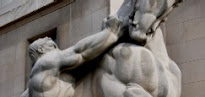
Photo by Lucia Pizarro Coma

Friday, March 13, 2009

No action is for nothing

Following up my post The Power of Non-action, where we saw that the less an action is selfish, the more power it has, here is another quote from the commentary of Tao Te King – Livre du Tao et de sa Vertu (Éditions Dervy). This quote, which I find delivers its message with a great poetic power, underscores the far-reaching effects of all our actions, even selfish ones. All the more reason to beware. (Translated from the French by me.) As you read it, remember the importance of sincerity.

What I do in secret, me, a tiny being lost in the world, I imagine does not affect anyone else; that what I do stays between me and me; that I can bury it, if I wish, in the silence of an abolished past. Not at all. The past is not inert. The past is a life that continues into the present. The past is a blade whose tip is the present, and the tip of the blade, thrust forward by the momentum of what has been, penetrates into the future to determine what shall be.
Every being, at every moment, acts in a way that saves him or loses him. Thus, every being, at every moment, acts in a way that saves or loses his circle, his family, his profession, his city, the civilisation around him, to a degree that none can know precisely and which is all the more worrisome to a good conscience.
If one thing is certain today, it is the universal solidarity of things and beings in all domains and in all ways. R. P. Sertillanges, Voix françaises, 24 January 1941

We find the same ideas expressed in this quote, from the same book, except the author goes further than mere actions and includes words and even thoughts as having an impact on the outside world:

Nothing is limited in nature; all worlds penetrate each other and all beings are interconnected: each of our words goes much further than the walls of the room where we pronounce them but which seems however to stop them; each of our thoughts, even secret, can be the cause of many things which will forever remain unknown to us. Dr. Marc Haven, Chiromancie dans ‘La Paix Universelle’, No. du 15 juillet 1906

As I was thinking about and writing this post, I stumbled upon (my, my isn’t that a coincidence?) this interesting video Consciousness drives the universe. The video makes the case for a holographic universe, which would explain the interconnectedness of everything.
I remember reading about the split personality of light, how when scientists looked for particles they found particles and when they looked for waves they found waves. What they saw depended on what they were looking for. Do we create reality? This video draws some far-reaching conclusions from there, but I throw it out for your own judgment. One thing I feel: what the scientists are discovering, the sages already knew a long time ago.

Wednesday, March 11, 2009

The Power of Non-action

Non-action? Non-action! What new-age rubbish is this? you say. We have to act! We have to take action! Well, yes and no. By non-action, I don’t mean sitting around on your butt all day. Non-action refers to the intent, the origin and the attachment to the action.
Henrik over at the awesome Positivity Blog has a great little post One timeless tip that can make your life a whole lot easier which begins with a quote from the Bhagavad Gita:

To action alone hast thou a right and never at all to its fruits; let not the fruits of action be thy motive; neither let there be in thee any attachment to inaction.

Henrik goes on to expose the benefits (less stress, less effort, better effort and more enjoyment) of letting go of trying to control the results of your actions and just focusing on enjoying the process. This is very true and reminds me of a story (yes, I have a story for everything):

A man went to see a famous martial arts master and asked him how long it would take to become a black belt.
“Ten years” said the master.
“What if I train very hard seven days a week, night and day, month after month, how long then?”
“Twenty years” came the reply.
“Twenty years! Why ten years more? Why so long?”
“With one eye on the destination, you have only one eye left for the path.”

How true. Most of the time, as Henrik points out, we have one eye on the destination and this makes the process more difficult than it need be. But there is more, much more, to the power of non-action.
I came across Henrik's quote from the Bhagavad Gita myself many years ago in the Dervy Edition (French) of the Tao Te Ching, Tao Te King - Livre du Tao et de sa Vertu. In the extensive commentary there is a section on the theme of non-action as found in the Tao Te Ching.

To master action, we must keep our independence with regard to it. Now, we are only free with regard to a thing when we have contracted no debt toward it and we expect nothing from it. The Sage “produces without appropriating to himself, works without expecting anything, accomplishes works of merit without becoming attached to them, and precisely because he doesn’t become attached to them, they endure… because he does not pursue selfish goals, he realises to perfection everything he undertakes.”

The power of non-action is in subordinating our constant selfish desires which produce only grasping, fearful, temporary actions to actions that come from, shall we say, our higher selves.

For as long as man claims the I and Mine, his works will be as nothing. When all love for the I and Mine is dead, then the works of the Lord will be accomplished. Kabir, Poems VI

The effort to possess, forces man to identify himself with the objects of his possession. What he possesses is a part of him, to such a degree that if something is taken away from him or if he loses it, he feels as if a part of himself has been taken away. This is truly slavery; man may imagine that he possesses things, in reality they possess him. Van der Leeuw

The point is that the more an action is selfish, the less power it has. The more an action is good for everyone, good for the community, universally good, the more it will have the support of the universe, the Tao, God. The more, in other words, it will be non-action, the spontaneous work of the Spirit. (So I must be resigned to not getting what I want? Not at all. As Confucius said: He who wishes to secure the good of others has already secured his own). And if you think this is an idea only to be found in Chinese philosophy, look more closely, you will find parallels in all philosophies and religions.

That thou mayest have pleasure in everything, seek pleasure in nothing.
That thou mayest know everything, seek to know nothing.
That thou mayest possess all things, seek to possess nothing.
That thou mayest be everything, seek to be nothing. Saint John of the Cross

Thy lot or portion of life is seeking after thee; therefore be at rest from seeking after it.
Caliph Ali

So lift up your thoughts, lift up your motives, enlighten yourself with the knowledge to be found in this very blog, and you will harness the power of non-action. (Or not, if you know what I mean).
.
If you liked this post, please Stumble, Digg or otherwise share it with the 'SHARE' button below (mouse over it for options). Thanks!
.
Photo from Wikimedia: Krishna displays his Vishvarupa (Universal Form) to Arjuna on the battlefield of Kurukshetra

Discover The Tale of Genji, the 11th Century classic of Japan (click image)

Discover The Tale of Genji, the 11th Century classic of Japan (click image)
Kiyomizudera Temple has a large veranda looking out over Kyoto and beyond