Showing posts with label Power. Show all posts

Monday, November 30, 2009

Courage - committing to a higher purpose

We come to the end of my posts on courage, for now. It was revealing to me to ponder the nature of courage and its importance. I never thought about it much before. Now I see that it makes ALL the difference. I see that courage is the cure for many evils including sadness, despair, laziness, and of course fear. Just think of the word 'discouragement’: the taking away of our courage takes away all our power and brings us low in spirit. To raise our spirit up we must find a goal, a principle, a reason to put BEFORE our sadness, our jadedness, or our comfort - that is the definition of courage. Then we will harness the power of courage in our lives.

Everything good in my life is a result of chances I took, goals I worked for, sacrifices I made. And the reverse is true: what is lacking is a result of chances I did not take, bold efforts I did not make, fears I did not break. When I feel down or in a rut or blocked, I know now with absolute certainty that it is my courage which is flagging.

I am reminded of a quote of W.H. Murray speaking of the power of courage from his book The Scottish Himalayan Expedition:

… when I said that nothing had been done I erred in one important matter. We had definitely committed ourselves and were halfway out of our ruts. We had put down our passage money— booked a sailing to Bombay. This may sound too simple, but is great in consequence. Until one is committed, there is hesitancy, the chance to draw back, always ineffectiveness. Concerning all acts of initiative (and creation) there is one elementary truth… that the moment one definitely commits oneself, then providence moves too. All sorts of things occur to help one that would never otherwise have occurred. A whole stream of events issues from the decision, raising in one’s favour all manner of unforeseen incidents and meetings and material assistance which no man could have dreamed would have come his way. I have learned a deep respect for one of Goethe’s couplets:

Whatever you can do or dream you can, begin it. Boldness has genius, power and magic in it.

I know now that to get what I want from life I will have to cultivate more courage than I have been doing. I will have to get more buddy buddy on a daily basis with courage. There is no substitute. Nothing else will do the job. Then and only then may I one day get to change my blog name to Healed Philosophy.

You are only as strong as your purpose, therefore let us choose reasons to act that are big, bold, righteous and eternal. Barry Munro

Who dares nothing, need hope for nothing. Johann Friedrich Von Schiller

Whether you be man or woman you will never do anything in this world without courage. It is the greatest quality of the mind next to honour. James Allen

Life shrinks or expands in proportion to one's courage. Anais Nin

Great things are done more through courage than through wisdom. German proverb

Spiritual cowardice is not only weakness but wickedness. G.B.Gambrell

Knowledge without courage is sterile. Baltasar Gracian

Moral courage is the most valuable and usually the most absent characteristic in men. George Patton

He who loses wealth loses much; he who loses a friend loses more; but he who loses his courage loses all. Cervantes

Wealth lost - something lost; Honour lost - much lost; Courage lost - all lost. German proverb

May you live all the days of your life. Jonathan Swift

For all sad words of tongue and pen, The saddest are these, "It might have been". John Greenleaf Whittier

A great deal of talent is lost to the world for want of a little courage. Every day sends to their graves obscure men whose timidity prevented them from making a first effort. Sydney Smith

Everyone has talent. What is rare is the courage to follow that talent to the dark place it leads. Erica Jong

We could never learn to be brave and patient, if there were only joy in the world. Helen Keller

Quiet minds cannot be perplexed or frightened, but go on in fortune or misfortune at their own private pace, like a clock during a thunderstorm. Robert Louis Stevenson

Have courage for the great sorrows of life and patience for the small ones; and when you have laboriously accomplished your daily task, to sleep in peace. God is awake. Victor Hugo

Monday, October 5, 2009

Chester Cathedral - through young eyes

While in Chester last month I visited Chester Cathedral. I have also visited the cathedrals in York, Lincoln and Durham on previous visits long before I began this blog. Chester ranks up there with the most notable, tracing its founding to just after the Norman Conquest almost a thousand years ago.

Whilst I was there it just so happened that a group of pre-schoolers were visiting the cathedral. About a hundred of them were sitting on the floor of the nave right in front of the organ.

There they were, a little bundle of young lives, some still clutching their favourite teddy bears, full of innocence and hope, the joy and treasure of the community. I was reminded of a quote of Carl Sandburg:

A baby is God’s opinion that the world should go on.

They were listening attentively to a guide who was explaining to them the functioning of the great organ, and as he explained the organ’s capabilities the organist would demonstrate them. The sounds ranged from something like the low tremor of an earthquake to the airy notes of a pipe whistle soaring into realms only dogs can hear.

It was quite touching to feel at the same time the weight of the ages in these old, holy stones and the fragility of the new life in these little children. It was also pleasing to see that they had been brought to this place at such an early age to be imbued with its power.

Saturday, October 3, 2009

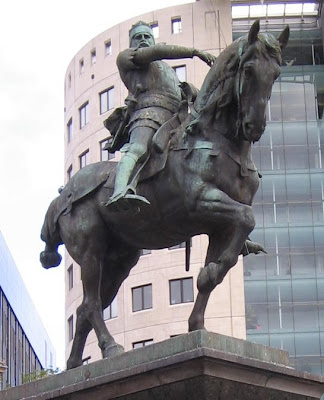
The Black Prince

As I crossed the street from Leeds Station my eye fell on a striking equestrian statue some distance on the left. I went over to have a look at it. Now I must have crossed that street a dozen times in all my trips to England but never once did I seem to notice this statue, an amazing lack of observation on my part that I cannot explain. It was a statue of the Black Prince, no less.

The Black Prince was the son of Edward III, the victor of the Battle of Crécy, where a small English army destroyed a large French one by the use of the medieval equivalent of the tactical nuclear weapon: the longbow.

The prince ‘won his spurs’ (became a knight) at the age of 16 at that battle. There is a passage in Froissart that tells us something about the way the prince won his spurs and the sang froid and hard love of Edward III.

In the morning, the day of the battle, certain Frenchmen and Germans perforce broke through the archers of the prince’s battalion, and came and fought with the men-of-arms hand to hand. Then the second battalion of the Englishmen came to succour the prince’s battalion, the which was time, for they had then much ado; and those with the prince sent a messenger to the king, who was on the little windmill hill.
Then the knight said to the king, “Sir, the Earl of Warwick and the Earl of Stafford, Sir Reginald Cobham, and other such as be about the prince your son, are fiercely fought withal, and are sore handled: wherefore they desire you that you and your battalion will come and aid them, for if the Frenchmen increase, as they doubt they will, your son and they shall have much ado.”
Then the king said, “Is my son dead, or hurt, or on the earth felled?”
“No, Sir,” said the knight, “but he is hardly matched; wherefore he hath need of your aid.”
“Well,” said the king, “return to him and to them that sent you hither, and say to them that they send no more to me, whatever adventure befalleth, as long as my son is alive; and also say to them, that they suffer him this day to win his spurs, for if God be pleased, I will that this day’s work be his, and the honour thereof, and to them that be about him.”
Then the knight returned again to them, and showed the king’s words, the which greatly encouraged them; and they repented in that they had sent to the king as they did.


Thus the Black Prince won his spurs that day and went on to defeat the French himself at the Battle at Poitiers, fulfilling all his father’s hopes for him.

And such was Edward III in a time when a good king could bring glory and prosperity to his people and a bad king utter ruin. Soon the powers of kings would be curtailed by parliament, which is in effect an insurance policy against the consequences of having a bad king. Looking at the economic mess we are in today, some might prefer taking their chances with a king.

The Black Prince is buried in Canterbury Cathedral and what seems to be (I have not been there) a magnificent gilded copper effigy rests above his tomb, portraying the prince as the epitome of the chivalric knight.

David Green (in his book The Black Prince) notes that the tomb undoubtedly retained an aura many years after the prince’s death, for Shakespeare/De Vere has the archbishop of Canterbury say to Henry V:

Look back into your mighty ancestors:
Go, my dread lord, to your great-grandsire’s tomb,
From whom you claim; invoke his warlike spirit,
And your great-uncle’s, Edward the Black Prince,
Who on the French ground play’d a tragedy,
Making defeat on the full power of France,
While his most mighty father on a hill
Stood smiling to behold his lion’s whelp
Forage in blood of French nobility.

Photo of tomb effigy from Wikimedia

Friday, June 19, 2009

Twitter and The Iranian Presidential Election

It is not the role of this blog to discuss politics, although you will find references to Obama and sincerity, the new era of responsibility and moral hazard, where politics is intertwined with philosophy as it should be. But Loaded Web has come up with an interesting way to help support the struggle of the Iranians to have their voice heard in the Iranian Presidential election. As of today, and until it is no longer necessary, you can see Loaded Web’s green triangle in the top left corner of the screen. It links to blogs and news carriers covering events in Iran and you can also get the code to put a similar green triangle on your own blog if you have one. It’s a small gesture of encouragement for the Iranian people who voted for a reformist president in their country and are protesting the alleged rigging of the ballots.
The Iranian people are using the web and Twitter on hand-held devices to communicate and organize their protests. I am sure the inventors of Twitter never imagined that they would one day be at the centre of a people’s struggle for reform and democracy. As barriers to communication fall, people widen their horizons and become harder to mislead. Let us hope that the truth prevails in Iran, sooner than later, because the writing is on the wall. Or rather, on Twitter.

See a good overview of the situation at Wikipedia: The Iranian Presidential Election

Thursday, April 9, 2009

On being a gentleman - Kinowear style

I came across a very interesting (and stylish) blog the other day: Kinowear. Kinowear is ‘one of the top men’s style blogs on the net’ and is ‘dedicated to bringing you in-depth and practical advice on men’s style, fashion, grooming and image development’. Now, I probably would not have lingered more than a second on this site but for two things: one, the featured article, How to build unstoppable confidence, which already had 9,000 views although it was published that day, was very well written and very inspiring, and two, this blog has style! It does not flash, it does not try too hard to get your attention and because it doesn’t try too hard, it succeeds.
I am not what could be called stylish. Let me rephrase that. I am not stylish. Yes, that’s better. I am guilty, along with a certain neglect of my physical fitness, of a certain neglect of dressing well. And just because here at Healing Philosophy we spend our time thinking lofty thoughts, it doesn’t mean that clothes and presentation and grooming are not important, because they are. When one fine day we have retired to the mountain to live out our days in contemplation of nature, we may no longer have need or care of style and may sit about in our PJ’s all day. But until then we live in the world, even though we try not to be of the world. We live in contact with people, and in order to exert our full share of good influence and magic (and in passing perhaps to receive a bit too) we need to be well-dressed and presentable. A gentleman is never improperly dressed, never suffers lack of respect through neglect of his appearance. On the contrary, his outer appearance is an indication of his inner quality. In my post Noble behaviour we saw:

A wise man should dress decently, and must not wear his clothes stained with grease and the like. He should not dress flashily to attract attention, nor shabbily to suffer disrespect. His garments should be modest, appropriate.

And in Sincerity - Polonius’ advice to his son we saw, through Polonius, what was probably Shake-speare’s (Edward De Vere’s) opinion about style:

Costly thy habit as thy purse can buy,
But not express'd in fancy; rich, not gaudy;
For the apparel oft proclaims the man,
And they in France of the best rank and station
Are of a most select and generous chief in that.

So I have now included Kinowear in the Guide Blogs link list, and not only for their knowledge about gentlemen’s style, but for some very good posts about the confidence and self-esteem that are the hallmark of the gentleman.

Sunday, March 29, 2009

Do it your Wei

The idea of non-action that we have been looking at in my last posts is a central doctrine of Taoist philosophy and has a particular name: Wu Wei. You can read an excellent overview at Wikipedia here.

"Wu Wei" means natural action - as planets revolve around the sun, they "do" this revolving, but without "doing" it; or as trees grow, they "do", but without "doing"…
Wu may be translated as not have or without; Wei may be translated as do, act, serve as, govern or effort. The literal meaning of Wu Wei is "without action" and is often included in the paradox wei wu wei: "action without action" or "effortless doing".

In Non-action and the Great Harmony we saw how the more an action is selfish and self-seeking the less power it has and that an action that is spontaneous, unselfish and is done for its own sake without anticipating an interested result, such an action is more in accord with the Tao, the Universe, God and cooperates directly in the Great Harmony. In the Wikipedia overview this idea is expressed in this way:

Taoist philosophy recognizes that the Universe already works harmoniously according to its own ways; as a person exerts their will against or upon the world they disrupt the harmony that already exists. This is not to say that a person should not exert agency and will. Rather, it is how one acts in relation to the natural processes already extant. The how, the Tao of intention and motivation, that is key.

That is key indeed. It is easier said than done. But we can only try. Just trying is a big step in the right direction. And the very fact that you and I have now read about Wu Wei and are now consciously aware of it has set in motion forces that we do not understand and which will have ‘distant consequences’.
As I was scratching my head for an anecdote or story to illustrate the power of Wu Wei, I think I hit on a perfect one (spontaneously, you might say). It comes from ‘The Overlook Martial Arts Reader – Classic writings on philosophy and technique’ edited by Randy F. Nelson. The particular story is called … well I will tell you after, not to spoil the punch.

The author of the story, Terry Dobson, was on a train rattling through the suburbs of Tokyo. In the car were a few houswives with children, old folks going shopping. Suddenly the quiet was shattered by a big, drunken, dirty laborer getting on the train. The man was angry and violent and swung at a woman and her child who scrambled for safety. Dobson was young, fit and highly trained in Aikido. He relates how his teacher, Morihei Ueshiba, the founder of Aikido had told him many times: “Aikido is the art of reconciliation. Whoever has the mind to fight has broken his connection to the universe. If you try to dominate people, you are already defeated.” Dobson tried hard to follow the precepts. But here was a golden, legitimate opportunity to save the innocent by destroying the guilty. He stood up.

Seeing me stand up, the drunk recognized a chance to focus his rage. “Aha!” he roared. “A foreigner! You need a lesson in Japanese manners!”
I held on lightly to the commuter strap overhead and gave him a slow look of disgust and dismissal. I planned to take this turkey apart, but he had to make the first move. I wanted him mad, so I pursed my lips and blew him an insolent kiss.
“All right!” he hollered. “You’re gonna get a lesson.” He gathered himself for a rush at me.
A split second before he could move, sombody shouted “Hey!” It was earsplitting. I remember the strangely joyous, lilting quality of it – as though you and a friend had been searching diligently for something and he had suddenly stumbled upon it. “Hey!”
I wheeled to my left; the drunk spun to his right. We both stared down at a little Japanese. He must have been well into his seventies, this tiny gentleman, sitting there immaculate in his kimono. He took no notice of me, but beamed delightedly at the laborer, as though he had a most important, most welcome secret to share.
“C’mere,” the old man said in an easy vernacular, beckoning to the drunk. “C’mere and talk with me.” He waved his hand lightly.
The big man followed, as if on a string. He planted his feet belligerently in front of the old gentleman, and roared above the clacking wheels. “Why the hell should I talk to you?” The drunk now had his back to me. If his elbow moved so much as a millimeter, I’d drop him in his socks.
The old man continued to beam at the laborer. “Wat’cha been drinkin’?” he asked, his eyes sparkling with interest. “I’ve been drinking sake,” the laborer bellowed back, “and it’s none of your business!” Flecks of spittle spattered the old man.
“Oh, that’s wonderful,” the old man said, “absolutely wonderful! You see, I love sake too. Every night me and my wife (she’s 76, you know), we warm up a little bottle of sake and take it out into the garden, and we sit on an old wooden bench. We watch the sun go down, and we look to see how our persimmon tree is doing. My great-grandfather planted that tree, and we worry about whether it will recover from those ice storms we had last winter. Our tree has done better than I expected, though, especially when you consider the poor quality of the soil. It is gratifying to watch when we take our sake and go out to enjoy the evening – even when it rains!” He looked up at the laborer, eyes twinkling.
As he struggled to follow the old man’s conversation, the drunk’s face began to soften. His fists slowly unclenched. “Yeah,” he said. “I love persimmons too….” His voice trailed off.
“Yes, “ said the old man, smiling, “and I’m sure you have a wonderful wife.”
“No,” replied the laborer. “My wife died.” Very gently, swaying with the motion of the train, the big man began to sob. “I don’t got no wife, I don’t got no home, I don’t got no job. I’m so ashamed of myself.” Tears rolled down his cheeks; a spasm of despair rippled through his body.
Now it was my turn. Standing there in my well-scrubbed youthful innocence, my make-this-world-safe-for-democracy righteousness, I suddenly felt dirtier than he was.
Then the train arrived at my stop. As the doors opened, I heard the old man cluck sympathetically. “My, my,” he said, “that is a difficult predicament, indeed. Sit down here and tell me about it.”
I turned my head for one last look. The laborer was sprawled on the seat, his head in the old man’s lap. The old man was softly stroking the filthy, matted hair.
As the train pulled away, I sat down on a bench. What I had wanted to do with muscle had been accomplished with kind words. I had just seen aikido tried in combat and the essence of it was love. I would have to practice the art with an entirely different spirit. It would be a long time before I could speak about the resolution of conflict.

Now, isn’t that quite a story? What makes it particularly appropriate, is that we see the motivation of the protagonists. The young man, Dobson, is acting with an interested motive in mind (the legitimate use of his aikido skill) even though he invokes the safety of the other passengers. The old man is not: he may have the goal of defusing the situation in mind, but his action is a spontaneous one, coming directly from the heart, without guile, generous and in perfect accord with the Great Harmony. And as such it succeeds to perfection. Effortlessly. This is Wu Wei.
What I also like about this story is that the old man’s action succeeds to perfection not only with the drunk. It transforms the young man also, and will have far-reaching good effects through him and his teaching. So far-reaching, it is even reaching to me and you at this moment, decades later. Such is the power of Wu Wei.
.
(The story is called The Soft Answer)

Friday, March 20, 2009

The Art of Becoming Art

I am presently reading an enlightening book entitled The Way of the Warrior-Trader by Dr. Richard D. McCall and what he has to say on the Japanese ‘Way’ or ‘Do’ has a direct bearing on what we have recently seen in my posts on Non-action:

The Japanese word for Way is Do (pronounced ‘dough’), and refers to “a life path, occupation, or discipline that results in the refinement of the follower’s spirit, character, and inner composure.” In other words, it means that regardless of the task, discipline, or behaviour that is undertaken, it is literally transformed by the practitioner into an art form. Then, reciprocally, the art form transforms the practitioner into a work of art as well. (…)
You must first understand that before you can elevate your personal performance in any area, your performance must first be viewed as an art form, and that the pure objective of practicing this art is the refinement of your inner spirit and discipline and ultimately the unconditional enjoyment and appreciation of having done it as well as is currently possible. This pulls you away from the distraction of watching or wishing for the desired outcome … and puts your attention fully on the flawless execution of the act itself …

How well he puts it! I have practiced Karate and I am very familiar with the Way of the samurai but McCall’s phrase ‘the art form transforms the practitioner into a work of art as well’ hit me like an epiphany. A quote from Sogyal Rinpoche instantly came to mind:

To embody the transcendent is why we are here.

The outcome of our actions is not the point! Our actions are the point! If our performance was as perfect as training, talent, insight and unattachment to the outcome could make it, then the outcome is of no importance – it was beyond our control. What matters is that our performance was excellent and sincere. In this way we transcend all obstacles.
So our actions must become an art form, embodying our abilities, our talents, our qualities and taken to a higher, transcendent level by our benevolent, disinterested motives and our unattachment to the outcome.
“Let not the fruits of action be thy motive.” When you have one eye on the destination, you have only one eye left for the path. Buddha summed it up in one phrase:

It is better to travel well than to arrive.

Image from Wikimedia: Depiction of Nasu no Yoichi, legendary archer of the Battle of Yashima 1184. From a hanging scroll, Watanabe Museum, Tottori Prefecture, Japan

Sunday, March 15, 2009

Non-action and the Great Harmony

We have seen in The Power of Non-action that non-action refers to an action that is not motivated by selfish desires but is inspired by universal truths and values. We also saw that the more an action is ego-less, the more power it has and the more support it receives from the powers that be. In No action is lost we lifted the cover on the significance and the power of all our thoughts, all our words and all our actions however secret because we are all interconnected as beings of consciousness. Our thoughts, words, and actions have an impact in the world and for the future in ways and degrees beyond our power to comprehend. The anonymous commentator of Tao Te King – Livre du Tao et de sa Vertu (Éditions Dervy) sums up these themes in this unforgettable and revealing passage (my translation from the French):

Without a doubt none of our actions is lost. It would be vain to regret our long and apparently useless labours, our false manoeuvres, the dead ends into which we have stumbled. All these efforts, all these attempts are integrated into the universal life where they have their usefulness and distant consequences – but the arc that they describe to bring us back to the Center is all the wider the more our intention was self-seeking. Inversely, the work that is realised in the serenity of detachment shortens, for he that accomplishes it as for all that it touches, the path of return to the Tao, and cooperates in a direct and immediate way in the Great Harmony.

Selfish thoughts, words and actions insomuch as they are harmful to others (or ourselves) go against the Tao and receive no help or support from it. They have little power, little scope, temporary consequences. Inversely, disinterested thoughts words and actions that nurture, help and bring peace to others and to ourselves accord with the Tao and participate in its power.
Of course we can’t always be saints and we are never always selfish villains. We are always a mixture. An interplay of contradictions. Always the opposites are struggling within us for expression. That’s what makes us human. Shake-speare (De Vere) put it this way:

The web of our life is of a mingled yarn, good and ill together; our virtues would be proud if our faults whipped them not, and our crimes would despair if they were not cherished by our virtues.

Which will predominate in us? The faults of our lower selves or the virtues of our higher selves? As human beings, we have the power to reason and to choose and we make our choices every day, thousands of times, moment by moment. And that is the eternal game of life.
.
Photo by Lucia Pizarro Coma

Friday, March 13, 2009

No action is for nothing

Following up my post The Power of Non-action, where we saw that the less an action is selfish, the more power it has, here is another quote from the commentary of Tao Te King – Livre du Tao et de sa Vertu (Éditions Dervy). This quote, which I find delivers its message with a great poetic power, underscores the far-reaching effects of all our actions, even selfish ones. All the more reason to beware. (Translated from the French by me.) As you read it, remember the importance of sincerity.

What I do in secret, me, a tiny being lost in the world, I imagine does not affect anyone else; that what I do stays between me and me; that I can bury it, if I wish, in the silence of an abolished past. Not at all. The past is not inert. The past is a life that continues into the present. The past is a blade whose tip is the present, and the tip of the blade, thrust forward by the momentum of what has been, penetrates into the future to determine what shall be.
Every being, at every moment, acts in a way that saves him or loses him. Thus, every being, at every moment, acts in a way that saves or loses his circle, his family, his profession, his city, the civilisation around him, to a degree that none can know precisely and which is all the more worrisome to a good conscience.
If one thing is certain today, it is the universal solidarity of things and beings in all domains and in all ways. R. P. Sertillanges, Voix françaises, 24 January 1941

We find the same ideas expressed in this quote, from the same book, except the author goes further than mere actions and includes words and even thoughts as having an impact on the outside world:

Nothing is limited in nature; all worlds penetrate each other and all beings are interconnected: each of our words goes much further than the walls of the room where we pronounce them but which seems however to stop them; each of our thoughts, even secret, can be the cause of many things which will forever remain unknown to us. Dr. Marc Haven, Chiromancie dans ‘La Paix Universelle’, No. du 15 juillet 1906

As I was thinking about and writing this post, I stumbled upon (my, my isn’t that a coincidence?) this interesting video Consciousness drives the universe. The video makes the case for a holographic universe, which would explain the interconnectedness of everything.
I remember reading about the split personality of light, how when scientists looked for particles they found particles and when they looked for waves they found waves. What they saw depended on what they were looking for. Do we create reality? This video draws some far-reaching conclusions from there, but I throw it out for your own judgment. One thing I feel: what the scientists are discovering, the sages already knew a long time ago.

Wednesday, March 11, 2009

The Power of Non-action

Non-action? Non-action! What new-age rubbish is this? you say. We have to act! We have to take action! Well, yes and no. By non-action, I don’t mean sitting around on your butt all day. Non-action refers to the intent, the origin and the attachment to the action.
Henrik over at the awesome Positivity Blog has a great little post One timeless tip that can make your life a whole lot easier which begins with a quote from the Bhagavad Gita:

To action alone hast thou a right and never at all to its fruits; let not the fruits of action be thy motive; neither let there be in thee any attachment to inaction.

Henrik goes on to expose the benefits (less stress, less effort, better effort and more enjoyment) of letting go of trying to control the results of your actions and just focusing on enjoying the process. This is very true and reminds me of a story (yes, I have a story for everything):

A man went to see a famous martial arts master and asked him how long it would take to become a black belt.
“Ten years” said the master.
“What if I train very hard seven days a week, night and day, month after month, how long then?”
“Twenty years” came the reply.
“Twenty years! Why ten years more? Why so long?”
“With one eye on the destination, you have only one eye left for the path.”

How true. Most of the time, as Henrik points out, we have one eye on the destination and this makes the process more difficult than it need be. But there is more, much more, to the power of non-action.
I came across Henrik's quote from the Bhagavad Gita myself many years ago in the Dervy Edition (French) of the Tao Te Ching, Tao Te King - Livre du Tao et de sa Vertu. In the extensive commentary there is a section on the theme of non-action as found in the Tao Te Ching.

To master action, we must keep our independence with regard to it. Now, we are only free with regard to a thing when we have contracted no debt toward it and we expect nothing from it. The Sage “produces without appropriating to himself, works without expecting anything, accomplishes works of merit without becoming attached to them, and precisely because he doesn’t become attached to them, they endure… because he does not pursue selfish goals, he realises to perfection everything he undertakes.”

The power of non-action is in subordinating our constant selfish desires which produce only grasping, fearful, temporary actions to actions that come from, shall we say, our higher selves.

For as long as man claims the I and Mine, his works will be as nothing. When all love for the I and Mine is dead, then the works of the Lord will be accomplished. Kabir, Poems VI

The effort to possess, forces man to identify himself with the objects of his possession. What he possesses is a part of him, to such a degree that if something is taken away from him or if he loses it, he feels as if a part of himself has been taken away. This is truly slavery; man may imagine that he possesses things, in reality they possess him. Van der Leeuw

The point is that the more an action is selfish, the less power it has. The more an action is good for everyone, good for the community, universally good, the more it will have the support of the universe, the Tao, God. The more, in other words, it will be non-action, the spontaneous work of the Spirit. (So I must be resigned to not getting what I want? Not at all. As Confucius said: He who wishes to secure the good of others has already secured his own). And if you think this is an idea only to be found in Chinese philosophy, look more closely, you will find parallels in all philosophies and religions.

That thou mayest have pleasure in everything, seek pleasure in nothing.
That thou mayest know everything, seek to know nothing.
That thou mayest possess all things, seek to possess nothing.
That thou mayest be everything, seek to be nothing. Saint John of the Cross

Thy lot or portion of life is seeking after thee; therefore be at rest from seeking after it.
Caliph Ali

So lift up your thoughts, lift up your motives, enlighten yourself with the knowledge to be found in this very blog, and you will harness the power of non-action. (Or not, if you know what I mean).
.
If you liked this post, please Stumble, Digg or otherwise share it with the 'SHARE' button below (mouse over it for options). Thanks!
.
Photo from Wikimedia: Krishna displays his Vishvarupa (Universal Form) to Arjuna on the battlefield of Kurukshetra

Saturday, February 14, 2009

The Seal of Power

The Chinese way of writing in pictures has always held a beautiful mystery and a fascination for me but remains one of my unfulfilled desires for exploration and study. And as a part of the Chinese way of writing, the use of seals is perhaps the most beautiful and the most mysterious aspect.
The Chinese have been using seals for three thousand years and their use continues to this day in business and in private life. The earliest examples of seals date from the Shang Dynasty (16-11 BC) but they were in use long before. According to a Han dynasty tradition, the first seal was given to the Yellow Emperor by a yellow dragon. The significance of the seal was to confer the Mandate of Heaven on the rightful ruler of the empire. (You can read an interesting overview here).
Looking further into the background of Chinese seals, I discovered the story of the Heirloom Seal, or the Imperial Seal of China, which has all the trappings of an epic Hollywood movie. You can read about it here at Wikipedia. In short, the seal was created in 221BC and passed down through the ages as dynasties rose and fell. Wars were fought for ownership of the seal as it was believed to confer legitimacy on the regime that possessed it, and history has proven them generally right. The seal was eventually lost in the Five Dynasties and Ten Kingdoms period (907=960).
Now what has all this got to do with philosophy? Well, to me, anything that confers the Mandate of Heaven is well worth looking into! Seriously, there is a power in these things that we can appropriate for ourselves. And if you think I am full of it, I will just ask you to consider the following:
1 - He is able who thinks he is able, said Buddha. That stone, that relic, that object is sacred and holy because we say it is sacred and holy and act accordingly. That thing or that person is powerful, fearsome, hated or beloved who we believe to be so. Things and people have the power and the qualities that we ascribe to them. (See my post The power of the subconscious mind). So it is with seals.
2 - Modern-day corporations spend millions of dollars designing, publicizing and protecting their logos, a modern form of seals or heraldry. Why?
3 - Hitler knew exactly what he was doing when he appropriated the sacred swastika as his emblem for the Nazi party. In the same vein, Churchill ordered that German submarines be referred to always as ‘U-Boats’, thus ‘branding’ them as something distinct from and far more sinister than ‘our submarines’.
So how can we appropriate the power of symbols or seals in our life today?
First you need a seal. If you have ever studied Chinese painting you may already have your seal. (I am here to tell you that affixing your seal on a painting that you have just created is a thrilling yet solemn occasion). You can have a seal made online or, depending where you live, at your local Chinatown. For online virtual use, I discovered a fun little site at Chinese Tools. Here you can translate your name into Chinese characters and then copy the characters into a tool that creates your Chinese name seal. That is where I got the seal you see in my profile, meaning ‘Alex’. You can also translate a phrase, which is what I did to get the seal at the bottom of the right-hand column, which means ‘Healing philosophy’.
Once you have a seal, you can then use it as a symbol of personal power, a talisman, and an invocation. When setting goals, don’t just write them down. Sign them with your ‘seal of power’. But make sure you follow through. Treat your seal seriously. If you are not absolutely serious about completing the goal, don’t use the seal. Any failure to follow through will weaken the power of the seal. The seal will only have that power that you confer upon it through repeated successful use. But once that power is conferred, it will be embodied in the seal and seem to take on a power of its own. Increase your seal’s power by using it on everything good and beautiful that you create, on every successful project. Use it on your best letters. Sign your checks with it (OK maybe not).
Of course, all this will only resonate with you if you are into Eastern culture. If not, perhaps a heraldic symbol would work better for you, or a Christian symbol. Choose the symbol that appeals to you, one that will feel at home in your subconscious. For it is the power of the subconscious that we are invoking here, which is our link to the power of the universal. The same power that conferred the Mandate of Heaven on the Yellow Emperor.
.
Image from Wikimedia: Seal of the Mongol ruler Ilkhan Ghazan, over the last two lines of his 1302 letter to Pope Boniface VIII. The seal reads "Seal certifying the authority of his Royal Highness to establish a country and govern its people"

Tuesday, February 10, 2009

Sincerity - the new normal

Insincerity is not only a weakness, a loss of strength that can be tangibly felt, a cowardice and a disgrace, but also a dangerous evil. As we have seen, insincerity on a large scale - at a national level - has devastating effects. They are being played out globally as we speak in the aftermath of the credit bubble and will continue to be played out for some time.

Truth and fidelity are the pillars of the temple of the world; when these are broken, the fabric falls, and crushes all to pieces. Owen Feltham

Now the temple is all to be built again. The people are dazed, some are angry, all are chastened by this catastrophic, unmistakable manifestation of the power of insincerity. Some are talking about ‘the new normal’: about living within one’s means, building savings the old way, expecting a reasonable return on one’s investment, prudent and moral management. The new normal is seeming to be what we are, and being what we seem to be. The new normal is sincerity.

Now the best way in the world to seem to be anything is really to be what we would seem to be. Besides that it is many times as troublesome to make good the pretence of a good quality as to have it, and if a man have it not it is ten to one but he is discovered to want it, and then all his pains and labor to seem to have it is lost. John Tillotson

I sat at a table where were rich food and wine in abundance, and obsequious attendance, but sincerity and truth were not; and I went away hungry from the inhospitable board. Thoreau

The whole faculties of man must be exerted in order to call forth noble energies; and he who is not earnestly sincere lives in but half his being, self-mutilated, self-paralyzed. Samuel Taylor Coleridge

Loss of sincerity is loss of vital power. Christian Nestell Bovee

An insincere and evil friend is more to be feared than a wild beast; a wild beast may wound your body, but an evil friend will wound your mind. Buddha

Of all the evil spirits abroad at this hour in the world, insincerity is the most dangerous. James Anthony Froude
.
Photo by Wikimedia: The reverse of the great seal of the United States on the 1$ bill featuring an unfinished pyramid and the ‘eye of Providence’. The Latin phrase above means ‘God has favoured our undertaking’ (literally ‘he/it favors the things having been begun’) and the one below means ‘a new order of the ages’.

Monday, February 9, 2009

Sincerity - according to the Ancients

The strength of a nation derives from the integrity of the home. Confucius

Hold faithfulness and sincerity as first principles. Confucius

To practice five things under all circumstances constitutes perfect virtue; these five are gravity, generosity of soul, sincerity, earnestness, and kindness. Confucius

Sincerity is the way of heaven; to think how to be sincere is the way of man. Mencius

There is no greater delight than to be conscious of sincerity on self-examination. Mencius

The Lord is close to all who call on him, yes, to all who call on Him sincerely. Psalm 145:18

Therefore let us keep the feast, not with old leaven, neither with the leaven of malice and wickedness; but with the unleavened bread of sincerity and truth. 1 Corinthians 5:8

Of Zebulun, such as went forth to battle, expert in war, with all instruments of war, fifty thousand, which could keep rank: they were not of double heart. 1 Chronicles 12:33

Blessed is the man unto whom the Lord imputeth not iniquity, and in whose spirit there is no guile. Psalms 32:2

Friday, January 30, 2009

Sincerity and the Fate of Nations - 2

In Sincerity and the Fate of Nations we saw an example of the role of sincerity in the fate of Germany. In Invocation for a Nation we saw Carol Osborn’s powerful I Ching inspired invocation for a nation (or individual) in crisis. If we look at our historical example, does the invocation pan out?
After Germany invaded Poland, Britain declared war on Germany thus respecting their recent pledge of alliance to Poland. It was a noble decision and very bold in that a successful outcome to the war was far from certain. Britain’s lead brought similar declarations of war from Australia, New Zealand and later France, South Africa and Canada. Britain was no longer alone against the greatest military machine the world had yet seen. But things got worse quite soon. After the fall of France and the evacuation of the British Expeditionary Force from Dunkirk, there was no reason to suppose that the fall of Britain was not a question of weeks away. But the British, utterly alone in their struggle, did not give up. They found their strength in sincerity. Faith in a positive outcome never left them. Through the courage of their armed forces the threat was met. And in time help from unexpected quarters came – the New World came to the aid of the Old.
And what about Germany at the end of the war? Their industry was in ruins, the flower of their youth had fallen in a war on two fronts, and worst of all, their country was divided in two, the eastern half disappearing behind an Iron Curtain. There was virtually nothing from which the Germans could now draw strength – except in sincerity. But in their darkest hour of the soul, help came from an unexpected quarter also. A conquering enemy that had every reason to feel bitterness, was made of finer stuff: a generous United States offered economic and technical assistance to all European nations, including Germany, in the form of the Marshall Plan. The Germans, always a steadfast and hard-working people, asked for no more in order to accomplish their Economic Miracle. And many who saw those dark days lived even to see the reunification of their nation.

All that is truly meant to be mine will be returned to me in time…
I can begin anew the moment I envision the best rather than the worst possible outcome…
I can make myself receptive to new possibilities…
I see only a small patch of darkness surrounding me…but even here I can have faith…


The wisdom contained in Carol’s invocation is the truth of ages and has its roots in human nature and the forces of the universe. Let us take strength in it today.
.
.Photo by Cheryl Empey

Wednesday, January 28, 2009

Invocation for a Nation

As we saw in my last post Sincerity and the Fate of Nations, nations have their karma as do individuals. Nations feel collective guilt, anger, indignation, fear, and hatred: also pride, generosity, resolve, courage and steadfastness. Nations go through their crises of the soul as do men. At this time of national crisis, I think it would be a good time to post an invocation that helped me through my own personal crisis many years ago.
It comes from the book How would Confucius ask for a raise? by Carol Osborn. It is a beautiful invocation, poetic, sincere and powerful. It contains the wisdom of the ages, expertly condensed by Carol from the I Ching. It is a suitable invocation for any individual and any nation in a time of crisis. Read it and feel its power working on you even before you reach the end.

Invocation for New Beginnings

All that is truly meant to be mine will be returned to me in time.
Even if I fear I do not deserve it.
Even if I fear I have thrown it away.

May I remember that any moment can be a turning point.
I can begin anew the moment I envision the best rather than the worst potential outcome.

Although I find this difficult right now, I can make myself receptive to new possibilities that arise from outside my existing expectations and experiences, trusting that everything that happens to me has a purpose.

From my limited perspective, I see only the small patch of darkness surrounding me. But even here, I can have faith. For my willingness to invoke my higher self shines like a beacon of light showing the way through the darkness quenching my regret with the comforting thought:

Where else but in the dark could light shine?

Tuesday, January 27, 2009

Sincerity and the Fate of Nations

With the power of sincerity and the weakness of insincerity in mind, it is revealing to look at history and the fate of nations. Where truth is suppressed and trampled upon by dictatorship, where there is injustice and error, there is no inherent strength and the nation suffers the consequences.
At the 1919 Treaty of Versailles at end of the First World War, Germany was ‘punished’ with the imposition by the victors of excessive war reparations. The sum – 269 billion marks - was later reduced to 132 billion, which was still an astronomical amount and Germany would have been required to pay until 1984. The German people felt betrayed, and I am sure that Marshal Foch of France was speaking the minds of many in France, England and Germany when he said of the Treaty: ‘This is not a peace. It is an armistice for twenty-one years.’
The Germans found their strength in the sincerity of their grievances, expressed forcefully by Adolf Hitler, who galvanized them into a unity of purpose to right the wrongs of Versailles. The moral superiority of sincerity was on Germany’s side and the allied nations, in their heart of hearts, must have felt this and feared it. Then, as Hitler’s lust for and abuse of power increased, the moral advantage slipped away from him, and the German people in their turn must have felt their loss of strength as the justness and sincerity of their cause faded away.
Such is the strength and significance of sincerity for nations as well as for individuals. We had best beware we are sincere.
.
Image from Wikimedia: decorative Hindu swastika. The swastika is a recurring ancient and often holy symbol going back 5,000 years to the Neolithic period. It symbolises peace and harmony and can be found in many Eastern traditions, notably Buddhism.

Sunday, January 25, 2009

Sincerity - the greatest strength

Little do I know about the Qur’an (or Koran), which Wikipedia describes as the central religious text of Islam.

Muslims believe the Qur’an to be the book of divine guidance and direction for mankind, and consider the text in its original Arabic to be the literal word of God, revealed to Muhammad through the angel Gabriel over a period of twenty-three years and view the Qur’an as God’s final revelation to humanity.

Little do I know, but I am now curious to read more after I came across the following passage while doing a search about sincerity. It comes from Sincerity described in the Qur’an by Harun Yahya.

The works of Bediuzzaman Said Nursi, a renowned Islamic scholar, play an important role in guiding the Muslims who strive to attain sincerity. Bediuzzaman emphasised the need of self-purification in particular, and presented critical recommendations to true believers:

“O my brothers of the hereafter! And O my companions in the service of the Qur’an! You should know – and you do know – that in this world sincerity is the most important principle in works pertaining to the hereafter in particular; it is the greatest strength, and the most acceptable intercessor, and the firmest point of support, and the shortest way to reality, and the most acceptable prayer, and the most wondrous means of achieving one’s goal, and the highest quality, and the purest worship.”

This passage rings true to me and no doubt it would ring true to all the great minds I have quoted in my previous posts. It echoes the sentiments expressed by other religions and philosophies, as we have seen. And to me, it is another example of the universality of the wisdom contained in all spiritual traditions. They are all different faces of the same mountain.

Photo from Wikimedia

Thursday, January 22, 2009

Sincerity, I Ching, Obama

There is a hexagram dealing with sincerity in the I Ching: hexagram 61, Inner Truth. The hexagram is formed of the trigram for ‘The Gentle, Wind’ above the trigram for ‘The Joyous, Lake’.

Wind over lake: the image of INNER TRUTH

The wind blows over the lake and stirs the surface of the water. Thus visible effects of the invisible manifest themselves. The hexagram consists of firm lines above and below, while it is open in the center. This indicates a heart free of prejudices and therefore open to the truth. On the other hand, each of the two trigrams has a firm line in the middle; this indicates the force of inner truth in the influences they represent. (Wilhelm/Baynes edition of I Ching)

The visible effects of invisible forces are easily seen on the lake. They are more difficult to see elsewhere but they are nevertheless all about us. The metaphor speaks of the power of invisible spiritual forces in the world and their visible effects on it. I am reminded of this quote of Confucius:

The power of spiritual forces in the Universe – how active it is everywhere! Invisible to the eyes, and impalpable to the senses, it is inherent in all things, and nothing can escape its operation.

Nothing escapes its operation. Spiritual forces include their opposites. When integrity and sincerity are lacking, the seeds of decrease, discord and death are sown. When integrity and sincerity are present, the seeds of increase, harmony and life are sown.
Listening to President Obama’s address, I was impressed by his clear sincerity and strong appeal to spiritual values, in other words, to spiritual forces.

Whenever a feeling is voiced with truth and frankness, whenever a deed is the clear expression of sentiment, a mysterious and far-reaching influence is exerted. At first it acts on those who are inwardly receptive. But the circle grows larger and larger. The root of all influence lies in one’s own inner being: given true and vigorous expression in word and deed, its effect is great.

Each of us was affected by the words we heard in Obama’s address; some strongly, some mildly some perhaps little but nevertheless we were all were affected in some way. A feeling was voiced with truth and frankness. Who can tell what the visible effects will be? What ripples on the lake have been set in motion by this invisible force?

Words go from one’s own person and exert their influence on men. Deeds are born close at hand and become visible far away. Words and deeds are the hinge and bowstring of the superior man. As hinge and bowstring move, they bring honour or disgrace. Through words and deeds the superior man moves heaven and earth. Must one not, then, be cautious? Confucius

Saturday, January 17, 2009

Sincerity - the treasure of a land

Years ago I came across the following phrase, no doubt from the Confucian tradition:

Sincerity is the treasure of a land, and it is in sincerity that the people find their strength in times of hardship.

This impressed me greatly. It seemed so abstract, even naïve a concept to think that sincerity was the treasure of a land. It was not courage. Not fortitude. Not patience. It was not money. Not the financial system. Not industry. Not oil. It was sincerity.
The phrase had a numinous, spiritual quality to it, and I had the distinct impression of being transported back into a time when sincerity was perhaps the treasure of the land back then, but it certainly was not now. But as with many forgotten, clichéd virtues, they are as valid today as they always have been. We only need to remember them.
I could not attribute the quote to Confucius, although I did find this:

The strength of a nation derives from the integrity of the home. Confucius

Here we are not merely talking about not telling lies but a way of being. Sincerity is total or it is nothing. We must be sincere with ourselves before we can be sincere with others.

No man can produce great things who is not thoroughly sincere in dealing with himself. James Russell Lowell

Sincerity is impossible, unless it pervade the whole being, and the pretence of it saps the very foundation of character. James Russell Lowell

When we are sincere as a way of being, we are obviously our true selves, acting without guile, and the contact with the other person is direct, clear and strong. We do not waste any time or energy in scheming or appearances. We are acting in accordance with our true nature and it is here that we tap the power of the universal, or God, or the Tao, (according to your belief).

Sincerity and honesty carry one through many difficulties which all the arts he can invent would never help him through. Benjamin Stillingfleet

The Lord is close to all who call on him, yes, to all who call on Him sincerely. Psalm 145:18

Sincerity and truth are the basis of every virtue. Confucius

Of course, we may be sincere and be mistaken. The point is not to be right; the point is to be sincere. We cannot always be right, but we can always be sincere. However badly we screw up and however hard things get, if we are sincere the universe will always ‘see us right’ in the end.

Better is the wrong with sincerity, rather than the right with falsehood. Martin Farquhar Tupper

Insincerity is always weakness; sincerity even in error is strength. George H. Lewes

Sincerity is moral truth. George H. Lewes

Sincerity makes the very least person to be of more value than the most talented hypocrite. Charles Haddon Spurgeon

So as we can see, and as we shall see, sincerity is a powerful virtue that we should cultivate and value at all times. It is much more than just being truthful in our speech, although that is a large part of it. It has far-reaching consequences. And if you doubt this and would have a powerful example, you have only to look at the sub-prime mortgage collapse, the packaging of dubious mortgages into derivative securities of unknown value, the subsequent crisis of confidence in the credit markets and the financial system, and the deep global recession it has created. All this for want of sincerity.
Times of hardship have now come upon the land. Let us turn to our treasure. Let us find our strength again in sincerity.

There is no time so miserable but a man may be true. Shakespeare
.
Photo by Angelthenomad at Picasa

Monday, January 12, 2009

The Observer - I am not my anger

Following my last post The Observer Within, I wondered where I had come across the concept of the observer. I did a Google search and quickly found this talk entitled The Observer by Sri Vasudeva. Here is an excerpt that is very à propos:

In all our activities, if we look carefully, we will see that there is an observer involved. Sometimes we are so identified with the activity that we are not able to experience this observer self as distinct from the activity. In other words, we become the activity. For example, instead of seeing that there is the emotion of anger within us and being able to observe it objectively we become carried away in the feeling ‘I am angry’. If we are really observing we will experience the observer as being separate from the anger and will be able to say ‘There is anger within me’ rather than ‘I am angry’. Do you see the difference? This is extremely important to understand when seeking to experience the full or pure state of the observer. So there is a part of us that can observe the process of thinking, feeling and physical sensation whilst feeling the sense of separateness. Focusing on this observer can lead us to the Source of our being.

Vasudeva goes on to expound the great virtues of meditation in developing our awareness of the observer, since in meditation we practice observing many things – our body, our breath, our thoughts – without attaching to them. The practice of meditation then is an ideal way to get in touch with our centre, our inner, higher self: our observer.

Give attention to the observer within and seek to centre yourself in the seat of the pure observer. It is the seat of the ‘I am’ consciousness. It is the seat of your freedom and joy in the human experience. It is the seat of connectedness with your Source. Seek to live and act from this space.

Sri Vaseduva’s advice to train ourselves to see anger from an observer’s point of view rather than ‘becoming’ the anger reminds me of a Taoist practice expounded by Stephen Russell in his ‘Barefoot Doctor’s Guide to the Tao’ called ‘The Nobody Contemplation’.
Russell asks us to make a list of our possessions and say ‘I am not these possessions. I am not this house. I am not this telephone. I am not this rubber biscuit.’ Then do the same for our hopes and desires: ‘I am not that different house. I am not that personal satellite phone with built-in modem, fax and organizer…’ On to the people in our lives - ‘I am not my mother, I am not my son…’ - to our habits, addictions, aversions and phobias and finally to our body with all its aches and pains: ‘I am not my body’.

Feel it. You’re not your possessions, your desires, your people, your habits, your fears: you’re not even your body. You’re simply nobody. Revel in the freedom of it, then move out onto the street, a busy, grimy street preferably, and be nobody, absolutely no one at all. Being no one at all, you’ve nothing to lose, you’re just atoms moving in the everything, child of the Tao, and everything is yours.

Discover The Tale of Genji, the 11th Century classic of Japan (click image)

Discover The Tale of Genji, the 11th Century classic of Japan (click image)
Kiyomizudera Temple has a large veranda looking out over Kyoto and beyond