Where did all the links go? Here. Why? What is Healinks? Healinks is the links page of Healing Philosophy where you will find links to the best philosophy on the web. Go to Healinks
Whilst stirring my oatmeal in the morning I usually read my current Patrick O’Brian novel. Having just completed the series again, I was reading instead 1001 Pearls of Bible Wisdom by Malcolm Day. Regular readers know I have no qualms about posting religious insight along with the philosophical, be it from the Bible or the Talmud or the Koran. I was reading the section about forgiveness and reconciliation. All my life, I have always had a hard time understanding how Jesus could ‘die for our sins’. Why should God forgive us because Jesus died on the cross? I understood that Jesus asked God to ‘forgive them for they know not what they do’ but why should He? And it was always strange to me that, for such a central concept, I had not come across any explanations, no elaboration about why this should be.
Well, at 53, stirring my porridge one morning, I finally understood why.
The Rainbow and the Covenant
After the flood that destroyed all living things, except those taken into Noah’ ark, God made a covenant, or pledge, with humanity never to devastate the Earth again. As a reminder of his promise he placed a rainbow in the sky: ‘I have set my bow in the clouds, and it shall be a sign of the covenant…” (Genesis 9:13). The covenant was fulfilled in the Passion of Christ. Jesus straddles the divide between human wrongdoing and God’s judgment and, through the Crucifixion, enables God to be reconciled with sinful humanity. People no longer need to endure God’s wrath – their sins are forgiven.
And following this introduction we read …
… in Christ God was reconciling the world to himself, not counting their trespasses against them … 2 Corinthians 5:19
In Jesus God took on the form and condition of a man, open to fear, weakness and pain. Yet Jesus could ask God to forgive his persecutors while on the cross. Thus God could see that there was some good in man, despite his sins. Thus he was reconciled and the covenant fulfilled.
Here is an entry from my personal diary for Friday. Though it rambles on for a couple of paragraphs, the essence of it passed through my mind as a flash of insight lasting perhaps 10 seconds that struck me as I was on my way home from a reluctant evening walk. This is what I wrote about it when I got home (with very little editing). It is an example of the limited power of words to express what is in our mind.
The other day I saw a video – ‘Why is the sky dark at night? – about Olber’s paradox. It is a question that puzzled medieval astronomers: if the universe is infinite and has existed forever, the light from an infinite number of stars should fill every available spot in the night sky making it bright as day. The video explains that today we know that the universe is not infinitely old and therefore not all the light from all the stars has had time to get here. The narrator says ‘the darkness of the night sky is a characteristic that argues against infinity’.
Tonight as I was walking home from a walk (yes I wrote that), I had an insight as I remembered this video and phrase. The universe has not existed infinitely: it has a finite beginning. But the space existed. Something existed for there to be a big bang in. Where did those gases come from? Where did the space before the big bang come from? Wherever it came from is a place of higher being, higher intelligence, higher good. The paradox may argue against infinity, but it argues for God, for another essence beyond our comprehension. If we align ourselves with this essence, we align ourselves with creative powers and principles – with God – and we cannot go wrong. We will prosper. If not, we will not prosper (or not for long). In this we can rely, in this we can have faith. Not that we should expect everything to go our way without effort all the time. There can be no guaranteed results or there would be no life, no point, no merit. ‘Do not expect God to change the laws of nature for you’. But having faith is the correct attitude. Following the virtues as much as we can is the correct conduct. Courage, patience, love etc. Discipline also : discipline and courage are needed to harness virtue as the sailor harnesses the wind.
To know what one should do – for one’s health for one thing – and not do it is weak and stupid. To have gifts and not develop them – even moderate gifts that can become greater – is a terrible waste. To have the ability to understand virtue and not to follow it is against the intention of the higher essence, against the laws of nature, against the will of God.
To have faith in God is to have faith in oneself, since God is inside us. When we have faith in ourselves, we reward ourselves, as God. We allow ourselves to succeed, because in our hearts, our subconscious, we know that we have merited it by following the laws of nature and of God. And so it happens to us, according to our faith.
This is not a review of Philip Gröning’s work: to ‘review’ such a film would be as presumptuous as a book review of the Old Testament. But I will share with you here what I saw and felt in this film in order that you might wish to see and feel it also.
The Monastery of the Grande Chartreuse is considered to be one of the most ascetic monasteries in the world. In 1984, I asked them for permission to film on location. It was said that it was too early. Maybe in 10, 13 years. 16 years later I received a call from the Chartreuse. They were now ready. – Philip Gröning
‘Into Great Silence’ is a fly on the wall’s view of monastic life in the Grande Chartreuse. It is a film like nothing you have ever seen before because what it sets out to do is make visible and palpable the invisible and the impalpable. And in this it succeeds like no other film you will ever see. How do you tell the story of a life devoted to the invisible Spirit, spent largely in silent communion with God, in menial tasks performed gratefully with a pure heart?
The Lord passed by. Then a great wind tore the mountains apart and shattered the rocks before the Lord,
But He was not in the wind.
After that there was an earthquake,
But the Lord was not in the earthquake.
After that came a fire,
But the Lord was not in the fire.
After the fire came a gentle whisper. – Kings 19, 11-13
This is the first of several quotations from the Bible that occur like milestones or guiding stars along the journey of the film. And we are immediately seized by the power and poetry of those words. This feeling stays with us as their meaning is given form in the daily life of the monks.
One of the earliest scenes shows a monk preparing vegetables in the kitchen. 30 seconds of watching a monk cutting the leaves off celery. One might begin to think to oneself that the director is setting the scene, preparing us for the action to come. But, with great courage, Gröning continues to show us the monk cutting the celery. There is no action to come. This is the action. The smallest of tasks are given their due place in life. It is borne in on us that all our daily tasks are noble and a meditation if performed in the right spirit. We need to slow down and pay attention to our lives.
In my opinion there is absolutely no doubt Gröning was divinely inspired and guided throughout the making of this film. Can you imagine that all the monks’ prayers - the whole monastery’s most earnest prayers - for a happy outcome to their film project would go unanswered? Think about it. Even I feel the breath of an angel over my shoulder as I write about it.
Gröning slows us down in every successive scene and makes more and more obvious the complete disconnection between our frenzied superficial world and this timeless, peaceful world of the Spirit. At first we may feel uncomfortable. Those afraid to be alone, afraid of the void, afraid to think, or afraid to be away from their cell phones for more than 5 minutes, may feel very uncomfortable. But after a while we begin to think that this quiet life is the real life and that other frenzied life is uncomfortable.
Interspersed with the scenes of daily tasks and prayer and silent communion with God are scenes of nature, time lapses of the stars at night, camera angles of the play of shadows on the wooden floor boards, dust specks floating in the light. Scenes that ordinarily might go unnoticed are now presented to us in their own right to make us look at the visible beauty of the world and how it suggests the invisible beauty of the Spirit that created it.
Anyone who does not give up all he has cannot be my disciple.
We try to imagine what it must be to give up all we have and become a monk, a disciple. We fail. These words are old but for these monks they are new and imperative. We look on with a kind of awe. Gröning has no qualms presenting us with several series of 30-second full-face shots of the monks. Humility, kindness, simplicity, forgiveness: all manner of virtues are to be read on their faces as they look us benevolently right in the eye. One might even say God looks us right in the eye.
The ‘aha’ moments are many in this film, although they are no doubt somewhat different for each individual. I found the following quotation particularly poignant. It perhaps sums up the whole meaning of Christianity and the spiritual imperative in its two lines:
Behold I am become human. If you should not want to join me in becoming God, you would do me wrong.
‘Join me in becoming God’: that is what the monks wish to do with all their heart. And their journey, revealed to us by the inspired hand of Gröning, is very poignant and uplifting. Poignant because a life devoted to the Spirit is what we are born to and what we would desire above all things if we only knew it, but we don’t know it. Uplifting because these monks, although only men like us, have been able to choose this path and to follow where it leads.
You shall seek me and you shall find me. Because you seek me with all your heart, I will let myself be found.
I hope I have encouraged you to see this important film. I am sure it will change the way you look on your own life - perhaps at first in small, imperceptible ways - as it has changed the way I look on mine.
I will leave you with the following clip that shows many of the aspects I have discussed and has an excerpt of the beautiful Night Office at the end. (Unfortunately the presentation of the opening quotation has been modified but do not mind it: the rest is worth it).
I think, at a child's birth, if a mother could ask a fairy godmother to endow it with the most useful gift, that gift would be curiosity. Eleanor Roosevelt
On Marketwatch I saw a few lines about the ‘Vatican’s soccer playoffs’, the Clericus Cup, the ‘Vatican’s football championship, played in the shadow of St Peter’s’. This immediately brought a smile to my lips. I remembered that beautiful little film ‘The Cup’ about Buddhist soccer monks. I wondered what a game of soccer played by ordained priests looks like. Do the wingers feint left then go right or do they consider that sinful? When the centre forward is flattened in the penalty zone does he immediately jump up and assure the referee that he is alright, actually he tripped over his own foot?
My curiosity led me to Google the Clericus Cup and my eye caught a blog called Overheard in the Sacristy. The header photo immediately puts you in the frame of mind you feel when you enter a cathedral. The blog author is Father Loren Gonzales, ‘a priest of the Diocese of Phoenix AZ currently shepherding a parish in Peoria’. Here I found posts, among others, on the Clericus Cup (of course), the scientifically proven anti-depressant qualities of Frankincense, and the official church burial of the recently discovered remains of 16th century astronomer Nicolaus Copernicus, nearly 500 years after he was laid to rest in an unmarked grave, his sensational findings condemned by the Roman Catholic Church of the time. I thank my mother and fairy godmother for the curiosity and we will surely be keeping our ears open in future for what is Overheard in the Sacristy.
Today father Gonzales quite rightly dedicates a post to Memorial Day, We remember. He offers a prayer for the fallen, which I take the liberty to reproduce here.
Dear God our Father,
Your word tells us, “Unless the LORD build the house, they labor in vain who build. Unless the LORD guard the city, in vain does the guard keep watch” (Psalm 127:1).
Thank You for those who have guarded not only our cities, but our country, allies, and many other communities from unjust and unprincipled aggressors. On this Memorial Day, with a solemn and sacred spirit, we pause to remember and honor the brave men and women in our Armed Forces who gave up their lives for their fellow Americans at home and abroad. Many were young and many were married, with their loved ones praying for them back home; but they were each fighting to protect the freedom we enjoy when they were called to make the ultimate sacrifice.
Dear God, please bless our heroes and heroines with Your mercy, grace, and peace. Bless also their families and friends. May Your perpetual light shine upon them; and may their souls and the souls of all our faithful departed rest in peace. In Jesus’ name.
My mother died in November (see Saying goodbye to mother and Mother). I could not be present for the funeral in England so that day I went to Saint Joseph’s Oratory of Mount Royal. I had been meaning to go there for some time, and I am ashamed to say it took my mother’s death to get me there. I have made a point of visiting many great cathedrals on my trips to England but I know nothing of those in Montreal where I live.
So the day of my mother’s funeral found me climbing the many steps leading up to the Oratory on Montreal’s Mount Royal. The photos do not do credit to the dimensions involved. The building is huge and imposing in stature in itself quite apart from the fact that it sits on top of a mountain. The architecture of the façade is in the classic Greco-Roman style.
Climbing the steps, I feel small and fragile and humbled. At the top of the steps I turn to see the city stretched out before me, and beyond it an uninterrupted horizon of hazy hills. Yet still the Oratory towers above me. I enter.
Inside I am surprised to find escalators rising up to the next floors. Then another, and another. The escalators give the impression, not that one is rising up to heaven, but rather that one is surfacing from an underground world of base emotions into the real world of the spirit above.
Finally, I surface at the Basilica. With only images of old cathedrals in my mind, I am surprised to see the pure simple lines of this Basilica. I have little time to reflect more because I am immediately overwhelmed with sorrow and sit down in the first bench to cry.
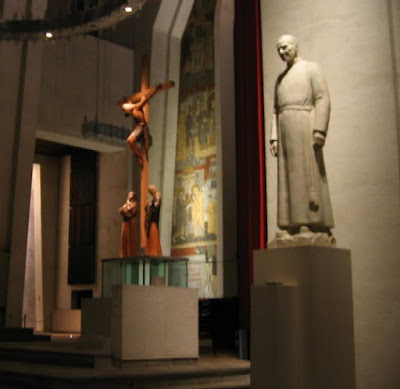
Slowly my emotions work themselves out and I sit peacefully contemplating the altar and the cross. I say a prayer for my mother. A mother and her child walk down the aisle. The mother stops and kneels and makes the sign of the cross and continues on. Eventually I get up and walk around the altar. On the wall behind is a mosaic. I read an inscription in French: ‘Joseph the Just, Holy Husband of the Virgin Mary, Guardian of the Son of God’.
On one side of the altar is a statue of Frère André, founder of the Oratory.
I linger a little, absorbing the peace that vibrates in this place. As I leave, I pass by a message engraved in one of the marble blocks that make up the walls of the Basilica. It reads:
‘Even in the heart of darkness Your hand grasps me, because for You the night illuminates as much as the day’.
While in Chester last month I visited Chester Cathedral. I have also visited the cathedrals in York, Lincoln and Durham on previous visits long before I began this blog. Chester ranks up there with the most notable, tracing its founding to just after the Norman Conquest almost a thousand years ago.
Whilst I was there it just so happened that a group of pre-schoolers were visiting the cathedral. About a hundred of them were sitting on the floor of the nave right in front of the organ.
There they were, a little bundle of young lives, some still clutching their favourite teddy bears, full of innocence and hope, the joy and treasure of the community. I was reminded of a quote of Carl Sandburg:
A baby is God’s opinion that the world should go on.
They were listening attentively to a guide who was explaining to them the functioning of the great organ, and as he explained the organ’s capabilities the organist would demonstrate them. The sounds ranged from something like the low tremor of an earthquake to the airy notes of a pipe whistle soaring into realms only dogs can hear.
It was quite touching to feel at the same time the weight of the ages in these old, holy stones and the fragility of the new life in these little children. It was also pleasing to see that they had been brought to this place at such an early age to be imbued with its power.
Yesterday I got home after a long day feeling in a somewhat black mood. And there was this message for me:
Dear Alex, I am a Christian. The Lord my God is my Master, but I do so enjoy studying and practicing teachings of Buddha, and I count your website a gift. Thank you for your energy. Clay
Not only that, but Clay has a few excellent quotations affixed to his e-mails which (all with his permission) I give you here. I was particularly touched by Washington’s quote. In fact I look on all the quotes, because of the out-of-the-blue way in which they came to me, as carrying a pertinent message. Thank you Clay.
Be still when you have nothing to say. When genuine passion moves you, say what you've got to say, and say it hot. D. H. Lawrence
Love is a force that connects us to every strand of the universe, an unconditional state that characterizes human nature, a form of knowledge that is always there for us if only we can open ourselves to it. Emily H. Sell
I will permit no man to narrow and degrade my soul by making me hate him. Booker T. Washington
You learn to speak by speaking, to study by studying, to run by running, to work by working; and just so, you learn to love God and man by loving. Begin as a mere apprentice and the very power of love will lead you on to become a master of the art. St. Francis De Sales
The place where your treasure is, is the place you will most want to be, and end up being. Matthew 6:21
The strength of a nation derives from the integrity of the home. Confucius
Hold faithfulness and sincerity as first principles. Confucius
To practice five things under all circumstances constitutes perfect virtue; these five are gravity, generosity of soul, sincerity, earnestness, and kindness. Confucius
Sincerity is the way of heaven; to think how to be sincere is the way of man. Mencius
There is no greater delight than to be conscious of sincerity on self-examination. Mencius
The Lord is close to all who call on him, yes, to all who call on Him sincerely. Psalm 145:18
Therefore let us keep the feast, not with old leaven, neither with the leaven of malice and wickedness; but with the unleavened bread of sincerity and truth. 1 Corinthians 5:8
Of Zebulun, such as went forth to battle, expert in war, with all instruments of war, fifty thousand, which could keep rank: they were not of double heart. 1 Chronicles 12:33
Blessed is the man unto whom the Lord imputeth not iniquity, and in whose spirit there is no guile. Psalms 32:2
Since my first posts on gratitude, I have noticed many visits to the site by people searching for quotes or prayers about gratitude. This is no doubt linked to the Thanksgiving holiday, which was a wholly fortuitous coincidence with regard to my posts since I do not have any great notion of the public holidays or even, I am ashamed to say, of the religious holidays. My thoughts started turning to gratitude for a very different reason (read my post Gratitude – the forgotten virtue). Be that as it may, I will perhaps make an exception for Thanksgiving in the future as a result of these posts on gratitude and my growing awareness of the essentiality of gratitude in the heart of him that would be happy. It seems to me now a very noble and worthy reason for a holiday. And another example of the wisdom of the old ways. I wish all our American cousins a very happy Thanksgiving.
Gratitude is the memory of the heart. Jean-Baptiste Massieu
Gratitude is the moral memory of mankind. Georg Simmel
Gratitude is the least of the virtues, but ingratitude is the worst of vices. Thomas Fuller
Gratitude is born in hearts that take time to count up past mercies. Charles E. Jefferson
Gratitude is the most exquisite form of courtesy. Jacques Maritain
Gratitude is a fruit of great cultivation. You do not find it among gross people. Samuel Johnson
The essence of all beautiful art, all great art, is gratitude. Nietzsche
The only people with whom you should try to get even are those who have helped you. John E. Southard
I would maintain that thanks are the highest form of thought; and that gratitude is happiness doubled by wonder. G.K.Chesterton
You say grace before meals. All right. But I say grace before the concert and the opera, and grace before the play and pantomime, and grace before I open a book, and grace before sketching, painting, swimming, fencing, boxing, walking, playing, dancing and grace before I dip the pen in the ink. G.K.Chesterton
Not what we say about our blessings, but how we use them, is the true measure of our thanksgiving. W.T. Purkiser Gratitude is the fairest blossom which springs from the soul. Henry Ward Beecher
For everything there is a season, And a time for every matter under heaven: A time to be born, and a time to die; A time to plant, and a time to pluck up what is planted; A time to kill, and a time to heal; A time to break down, and a time to build up; A time to weep, and a time to laugh; A time to mourn, and a time to dance; A time to throw away stones, and a time to gather stones together; A time to embrace, and a time to refrain from embracing; A time to seek, and a time to lose; A time to keep, and a time to throw away; A time to tear, and a time to sew; A time to keep silence, and a time to speak; A time to love, and a time to hate, A time for war, and a time for peace.
Ecclesiastes 3:1-8
There are some terrible things among this list which there is unfortunately a time for, (killing, hating and war, for example). This is hard to understand. Perhaps the author is speaking of the inevitable, unfortunate cycles in the life of man in his ignorance, rather than espousing any wise ideal. Even so, some things are not mentioned that could have been. With this in mind, here is my list of what there is no time for:
There is no time for hate (here I had to disagree!), but always a time for forgiveness; No time for anger, always a time for patience; No time for pride, always a time for humility; No time to despise, always a time to understand; No time to throw stones, always a time to correct one’s own faults; No time to ignore, always a time to listen; No time to take, always a time to give; No time to expect, always a time to be grateful; No time to divide, always a time to unite; No time to conquer, always a time to lead; No time to cause fear, always a time to smile; No time to worry, always a time to act; No time to despair, always a time to hope; No time to be afraid, always a time to help oneself.
No matter what we may think we know, we show our true selves, our real level of spiritual development, by our reaction to the bad things that happen to us. Often we rebel. Why is this happening? Why now? Why me? (I admit that my own level of spiritual development by this standard is often on a par with a potato. I’m working on it). We forget that a) this is happening because we made it happen or b) this is happening because it is a part of life and c) this happens to everyone at some point and is happening at this very moment to hundreds or thousands of other people, so why are we so special? And then of course we forget the all-important d): this is happening for a reason so we can learn from it and improve and move on to the next level. The humble person does not waste any emotional energy rebelling and bemoaning his fate. He accepts that this is happening now and what is the best thing to do, or to be? What if we were to welcome obstacles instead of resisting them? The following is my translation of a passage from Imitation de Notre Seigneur Jesus Christ:
The truly patient man does not examine who is testing him, whether it is his superior, his equal or his inferior, a good man or a bad man. But, treating all indiscriminately, he receives from God’s hand, gratefully, and as often as He likes, everything contrary that happens to him, and considers it a great benefit.
The great thing about uplifting our attitude to obstacles in this way is that we cease being victims. Whatever happens to us we can transcend through humility and patient attention. By our very nature we are equipped by God, the Tao or whatever power we recognise, to handle everything that comes our way. We managed so far didn’t we? I like the following story I came across in ‘The Discovery of Happiness’ edited by Stuart McCready:
The disciples of the Hasidic leader Rabbi Dov Ber (d.1772) were discussing the Talmudic statement that one should accept suffering with joy. “How is this possible?” they asked. Rabbi Dov Ber advised them to visit another of his disciples, Rabbi Zusya, who lived some distance away. He would explain to them how to accept suffering with joy. The disciples were pleased with this advice. All knew that Rabbi Zusya lived a life of poverty, illness, and suffering. He would surely be able to explain. When they reached the hovel in which he lived he jumped up with joy to greet them. They explained why they had come: “Our teacher told us to enquire from you how to accept suffering with joy.” Rabbi Zusya looked puzzled. “Why did he send you to me?” he asked. “God is good and sends me all I need – I have never known suffering at all. So how can I help you?”
Humility protects us from the fall that usually comes with the ‘hubris’ that follows success:
Therefore a good general effects his purpose and stops. He dares not rely upon the strength of arms; Effects his purpose and does not glory in it; Effects his purpose and does not boast of it; Effects his purpose and does not take pride in it; Effects his purpose as a regrettable necessity; Effects his purpose but does not love violence. (For) things age after reaching their prime. That (violence) would be against the Tao. And he who is against the Tao perishes young.(Tao Te Ching)
Humility is the hallmark of the man or woman, leader or not, who has matured in wisdom enough to realise these things. He is secure in himself and feels no need to put himself forward, to take credit, or to ‘blow his own trumpet’. He sees himself as only a part of a larger design and knows that every person in that design has an equally important role to play. He is content to play the role that falls naturally to him.
What each person does is never insignificant. The blade of grass needs all its energy to draw subsistence from its roots, simply to grow there, where it is, in the grass; it doesn’t strive vainly to be a banyan tree; and thus the earth obtains its charming green carpet. (Rabindranath Tagore)
Humility makes us approachable by others and we are not afraid of appearing weak by saying ‘I don’t know’ or by asking questions. We have no inflated ego to protect. Sincerity, truth and openness are the order of the day and we receive all the benefits that come with them. Not only the Tao Te Ching but all philosophies and religions espouse the merits of humility. Meister Eckhart, a famous thirteenth-century German preacher, even went this far:
If you become humble, God descends from his home and flows into you. … Therefore humility is the root of all good and all that comes with it. … All things must necessarily be accomplished in the truly humble man. He does not need to ask God, he can command God, because the height of divinity is nothing less than the depth of humility… The humble man and God are one; the humble man is master of God as well as himself, and everything possessed by angels is in the nature of the humble man; what God does, the humble man does also, and what God is he is: one life and one being; that is why our Lord has said: “Learn from me that I am gentle and humble in spirit”. (Mathew XI-29).

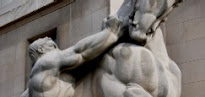


 Climbing the steps, I feel small and fragile and humbled. At the top of the steps I turn to see the city stretched out before me, and beyond it an uninterrupted horizon of hazy hills. Yet still the Oratory towers above me. I enter.
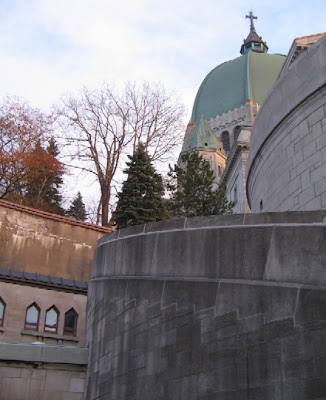 Inside I am surprised to find escalators rising up to the next floors. Then another, and another. The escalators give the impression, not that one is rising up to heaven, but rather that one is surfacing from an underground world of base emotions into the real world of the spirit above.
 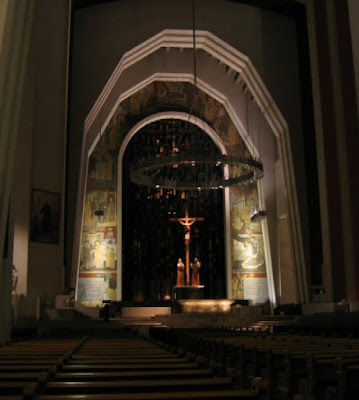 Slowly my emotions work themselves out and I sit peacefully contemplating the altar and the cross. I say a prayer for my mother. A mother and her child walk down the aisle. The mother stops and kneels and makes the sign of the cross and continues on.
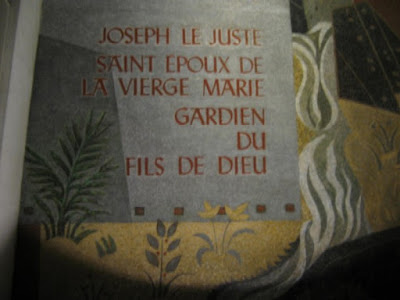 On one side of the altar is a statue of Frère André, founder of the Oratory.
 I linger a little, absorbing the peace that vibrates in this place. As I leave, I pass by a message engraved in one of the marble blocks that make up the walls of the Basilica. It reads:

 Whilst I was there it just so happened that a group of pre-schoolers were visiting the cathedral. About a hundred of them were sitting on the floor of the nave right in front of the organ.
 There they were, a little bundle of young lives, some still clutching their favourite teddy bears, full of innocence and hope, the joy and treasure of the community. I was reminded of a quote of Carl Sandburg:
 It was quite touching to feel at the same time the weight of the ages in these old, holy stones and the fragility of the new life in these little children. It was also pleasing to see that they had been brought to this place at such an early age to be imbued with its power.