Showing posts with label Morals. Show all posts

Thursday, February 3, 2011

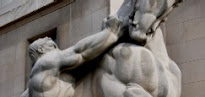
Bill Gross: America requires more than a makeover or a facelift. It needs a heart transplant

Bill Gross dons armour and sword  again and cuts a bloody swathe through the rotten financial and political system of America. We like Bill Gross.

Fifty years ago, the highest paid and most prestigious professions were that of a doctor or a 707 airline pilot who flew the “golden” route from Los Angeles to Honolulu. Today the yellow brick road begins on Wall Street or the City. Aside from supernova innovators such as Steve Jobs or Mark Zuckerberg, the money is made from securitizing things instead of booting and rebuilding America. The tallest buildings in almost every major city are banks, with tens of thousands of people shuffling and trading paper for a living. One of this country’s premier investment banks paid each of its 26,000 employees an average of $370,000 in 2010, nearly ten times the take-home pay of other American workers. Almost a quarter of the 400 wealthiest people on Forbes annual richest list make their money from money, whereas only 8% could make that claim in its first issue in 1982, and probably close to 0% when I first read my economic primer in 1966.

Financiers have lost their high ground and, if truth be told, we began to lose it a long time ago when we figured out that money was more than a medium of exchange or a poor substitute for a store of value. We figured out a turbocharged way to make money with money and proclaimed ourselves geniuses in the process. Well, we’re not. We may be categorized as “opportunists,” to be generous, but society’s “paragons” and a legitimate destination for a significant percentage of college graduates? Hardly.

This country desperately requires a rebalancing of priorities. After readjusting the compensation scales via regulation and/or free market common sense, America needs to anoint a new set of Mensans who can create something more than a cash machine and make this country competitive again in the global marketplace. We need to find a new economic Keynes or at least elect a chastened Congress that can take our structurally unemployed and give them a chance to be productive workers again. We must have a President whose idea of “centrist” policy is not to hand out presents to the right and the left and then altruistically proclaim the benefits of bipartisanship. We need a President who does more than propose “Win The Future” at annual State of the Union addresses without policy follow-up. America requires more than a makeover or a facelift. It needs a heart transplant absent the contagious antibodies of money and finance filtering through the system. It needs a Congress that cannot be bought and sold by lobbyists on K Street, whose pockets in turn are stuffed with corporate and special interest group payola. Are record corporate profits a fair price for America’s soul? A devil’s bargain more than likely.

Read the full article.

Saturday, September 25, 2010

Stop teaching handwriting in school, do not

A few weeks ago I fell on an article written by a professor proposing that we stop teaching handwriting in school. I will not link to it, but if you Google it you are sure to find it. Her son was having trouble writing certain letters at school and she found, after a brief overview of the history of writing, that the time had come to move on to electronic writing methods and she ended with a fling at writing as so much pushing of a graphite stick in various directions. When I finished reading this, if I had had immediate access to the comments section, I would certainly have written that this was the stupidest idea I had ever heard in my entire life. I might have added something like, is your son also having trouble with art at school? Perhaps we should stop teaching art as well, we have computer graphics programs now, and after all it is just so much pushing around a paintbrush in various directions.
I was quite shocked at my reaction, at the strong emotions I felt, and of course I realised that that was partly the author’s intention: to be provocative. I then decided it did not merit serious thought or a serious reply and moved on.
Since then I have noticed that my post The importance of good handwriting is quite popular and I am constantly reminded of the contrary article. I have found myself mulling it over. Then I began to think (cue heavenly light) that perhaps it fell to me to reply to the article (cue singing angels), that my entire life up to now had brought me to this moment (cue dark clouds of doubt parting), that my blog was the perfect vehicle (cue sun), and that my blog post on this subject might be read by some young impressionable mind and it would encourage him to persevere in his handwriting technique and he would go on to become a second Shakespeare who would influence an entire generation…  (OK, cut the heavenly light, angels: take 15). 
I am not a professor, nor a writer; I am just a guy with a blog but I will tell you what I think off the top of my head and you will be the judge.
I find it sad and surely irresponsible that an educator should hold such a mistaken view (and encourage others to hold it) but I suppose it is a sign of the times. There will always be people impatient for change and impatient of the old ways. I know because I have acted in that way in my time also, unfortunately. It is the lot of impatient youth.
But it seems to me that learning how to write is the basic building block of education. And no matter how easy to use and ubiquitous the electronic tablet becomes, pen and paper will always be necessary and indeed an art form. Necessary because pen and paper are (almost) always to be had - computers, tablets, electricity and batteries are not. Use those other electronic forms by all means, but handwriting has to be there to fall back on. I am not going to belabour the point, it seems so obvious to me. I am sure you can think of a hundred situations where a written message is the best or the only way.
It also seems to me reprehensible that an educator should undermine children’s resolve to learn how to write by hand and also parents’ efforts to help and encourage them. Perhaps it is more difficult for some children than others, but if we were to choose what should be taught in school on that basis where would we be? There is something to be said for the process of overcoming difficulties and personal inclination and mastering a useful skill by perseverance.
Civilization has come the long road through many a dark brutal age to the point where literacy is possible for everyone today and the suggestion to abandon the written word in school after so many have struggled and fought to bring literacy to the world would be to do them and our children a great disservice.
But my real argument has more to do with this ‘fling it down the gutter’ attitude to all the old ways of doing things. I must sound very much like the baby boomer I am as I write this, but I do assure you in my time the shoe was on the other foot as you can read in my last post about handwriting. I have evolved, my attitude has changed, for the better I hope. The computer and the advance of technology is not the secret of happiness. People are less happy today than they were 50 years ago. All the twitters and e-mails you may send your friends may be fun, but I doubt they give as much pleasure as our ancestors (parents, grand parents!) enjoyed when they received a single thoughtful (handwritten) letter.
I am not against technology or progress. I have a blog don’t I? I am simply saying that not every technological advance is necessarily an advance for human happiness. Technology has to be used wisely, usefully, reasonably. And respect for the old ways is a virtue. A well-written, thoughtful letter is an art form in itself. Where there is no art in daily life, there is no life. No life worth the living.
I am reminded of something I read about the art of the Japanese Zen garden. The author was talking about how one might apply to a (Japanese) Zen garden master to become his pupil. He gave the master’s postal address. He advised that it might take some weeks or even months to receive an answer. Zen garden masters did not have faxes, still less computers.
I am sure they are quite, quite happy without them.

Read more about the lost art of letter writing at Proverbs 31 maiden.

Image: ‘Winter’s Child’ by Lucia

Saturday, September 11, 2010

Why is the sky dark at night? - Olber's Paradox

Here is an entry from my personal diary for Friday. Though it rambles on for a couple of paragraphs, the essence of it passed through my mind as a flash of insight lasting perhaps 10 seconds that struck me as I was on my way home from a reluctant evening walk. This is what I wrote about it when I got home (with very little editing). It is an example of the limited power of words to express what is in our mind.

The other day I saw a video – ‘Why is the sky dark at night? – about Olber’s paradox. It is a question that puzzled medieval astronomers: if the universe is infinite and has existed forever, the light from an infinite number of stars should fill every available spot in the night sky making it bright as day. The video explains that today we know that the universe is not infinitely old and therefore not all the light from all the stars has had time to get here. The narrator says ‘the darkness of the night sky is a characteristic that argues against infinity’.
Tonight as I was walking home from a walk (yes I wrote that), I had an insight as I remembered this video and phrase. The universe has not existed infinitely: it has a finite beginning. But the space existed. Something existed for there to be a big bang in. Where did those gases come from? Where did the space before the big bang come from? Wherever it came from is a place of higher being, higher intelligence, higher good. The paradox may argue against infinity, but it argues for God, for another essence beyond our comprehension. If we align ourselves with this essence, we align ourselves with creative powers and principles – with God – and we cannot go wrong. We will prosper. If not, we will not prosper (or not for long). In this we can rely, in this we can have faith. Not that we should expect everything to go our way without effort all the time. There can be no guaranteed results or there would be no life, no point, no merit. ‘Do not expect God to change the laws of nature for you’. But having faith is the correct attitude. Following the virtues as much as we can is the correct conduct. Courage, patience, love etc. Discipline also : discipline and courage are needed to harness virtue as the sailor harnesses the wind.
To know what one should do – for one’s health for one thing – and not do it is weak and stupid. To have gifts and not develop them – even moderate gifts that can become greater – is a terrible waste. To have the ability to understand virtue and not to follow it is against the intention of the higher essence, against the laws of nature, against the will of God.
To have faith in God is to have faith in oneself, since God is inside us. When we have faith in ourselves, we reward ourselves, as God. We allow ourselves to succeed, because in our hearts, our subconscious, we know that we have merited it by following the laws of nature and of God. And so it happens to us, according to our faith.


Sunday, August 29, 2010

Integrity

All my life I have been very sensitive of the concept of fairness. I think I have stated before in my posts on anger that I have a very revengeful nature. Certainly if I am wronged or treated unjustly I have a hard time dealing with my anger for that person. I will remember a wrong for years. I will cut out any person who has wronged me; I will ignore them from that time onwards. (I have a long way to go on the spiritual path of forgiveness).
However, if I have deserved a criticism, if I have acted badly, if I have wronged first, that is an entirely different matter. I may grumble, mostly in anger at myself, but I am not infused with the same anger or revenge for that person. Fair is fair.
People who lie, who bear false witness, are the lowest of the low in my eyes. I can’t abide dishonesty and falsehood. Some of you reading this who know me may know what (and who) I am talking about. Anyway, this weekend I had occasion to think about integrity and the malice of those who don’t have any. I looked up some quotes. The following ones are most in tune with my own thoughts at this moment. I will no doubt write more about integrity or the lack thereof in the future. I think it is an important subject.

O, what a tangled web we weave; When first we practice to deceive!  Sir Walter Scott

He who permits himself to tell a lie once, finds it much easier to do it a second and third time, till at length it becomes habitual; he tells lies without attending to it, and truths without the world's believing him. This falsehood of the tongue leads to that of the heart, and in time depraves all its good dispositions. Thomas Jefferson

There is no vice that doth so cover a man with shame as to be found false and perfidious. Francis Bacon

If you have integrity, nothing else matters.  If you don't have integrity, nothing else matters.  Alan Simpson

He who indulges in falsehood will find the paths of paradise shut to him. Abu Bakir

It is an affront to treat falsehood with complaisance. Thomas Paine

If a man does not resent slight injustices, he will soon be called upon to face giant wrongs. Taoist tradition

'Tis better to suffer wrong than do it.  Thomas Fuller

Take care that no one hates you justly.  Publilius Syrus

If everyone were clothed with integrity, if every heart were just, frank, kindly, the other virtues would be well-nigh useless, since their chief purpose is to make us bear with patience the injustice of our fellows.  Jean-Baptiste Molière

Update: if we believe the author of this quote, then it would seem God agrees with me:

All malice has injustice at it`s end, an end achieved by violence or by fraud; while both are sins that earn the hate of heaven, since fraud belongs exclusively to man, God hates it more and, therefore, far below, the fraudulent are placed and suffer most. Dante Alighieri

Wednesday, July 21, 2010

The Importance of Good Handwriting

When I was at school in England, a long, long time ago, they taught us to write a modified form of Copperplate script. I didn’t know it was Copperplate at the time; it was simply ‘handwriting’ to me. The following image of a Copperplate script is not exactly what we wrote but not far from it neither.


This went on till I was about nine or ten. Then one day I noticed the handwriting of the boy next to me. He was, I remember, some fugitive latecomer from another school or town. He certainly did not learn how to write at my school. What was this writing? My eyes could hardly believe. No loops, no curls, no flourishes at all: capitals simplified to the extreme, as found in the newspaper, every letter reduced to its simplest expression. Here was the future! Here was progress! It was modern, efficient, avant-garde and a few other adjectives I did not know yet. It was simply ‘cool’. I adopted this knew way of handwriting in an instant. There was nothing to practice: just eliminate all this useless decoration. To give credit to my teachers, not a one made any comment to me that my handwriting had ‘changed’. Individuality was respected.

Fast forward a life time. A new respect for the old ways is quietly born of countless hours reading philosophy and history and realizing how shitty are the new ways. Comments about messages written in ‘a fine Copperplate hand’ keep cropping up in my beloved Patrick O’Brian historical novels. I begin to look at my own handwriting again. Sadly, it has not evolved since that day when I was 9 years old. What seemed to me then to be an excellent handwriting script, now appears to be lazy, superficial, without character. Strange how perceptions change so quickly, innit?

So I am here to tell you that I am absolutely relearning how to write in Copperplate script, just like they taught me at school a long, long time ago. Perhaps not entirely like. But not far from it neither.

Image 1 from scribblers

Image 2 from Wikipedia:  Detail of the log of HMS Victory kept by William Farquhar, 1854-55

Monday, July 5, 2010

Sacrifice - from the phlegmatic Michael Caine

I have often been called phlegmatic, calm, not easily angered. (I have been called a lot of other things too…)

Phlegmatic (definition from Dictionary.com)

Adj.
1. not easily excited to action or display of emotion; apathetic; sluggish.
2. self-possessed, calm, or composed.
3. of the nature of or abounding in the humour phlegm.

Synonyms
1. stoical, cool, cold, uninterested, dull, torpid. 2.  cool, collected, unruffled, placid, quiet.

When they call me phlegmatic they usually also refer to my British background, a disposition for phlegm being seen as a typically British trait. I may have some claim to that quality (some would say particularly the cold, dull and torpid part) but I have nothing in comparison to the phlegm of one of my favourite actors: Sir Michael Caine.

I recently saw him in ‘The Weather Man’ (2005) starring Nicolas Cage. It’s a very honest movie, worth your while, even important, particularly for a few lines that Caine delivers with an armour-piercing phlegm.

To get anything of value you have to sacrifice. Do you know the harder thing to do and the right thing to do are usually the same thing? Nothing that has meaning is easy. Easy doesn’t enter into grown up life.

Easy doesn’t enter into grown up life. It’s as simple as that. Most of our problems arise from that one simple fact and our inability to face up to doing the hard thing, the right thing, the thing that takes courage. The minute we stop resisting and accept that, we will start to make progress. And that’s also when we will start to become men. And women.

Here’s the clip, I found it on Youtube. Your whole life has brought you to this moment with Michael Caine.

Thursday, May 27, 2010

Yiddish proverbs - faults and virtues


A little charm and you are not ordinary.
Charm is more than beauty.
No man suffers from another's sins - he has enough of his own.
Charity and pride have different aims, yet both feed the poor.
Charity covers a multitude of sins.
Charity excuseth not cheating.
One good deed has many claimants.
Spare us what we can learn to endure.
An imaginary ailment is worse than a disease.
A living dog is better than a dead lion.
If you lie on the ground, you can't fall.
It is far easier to spot faults in another than virtues in oneself.
The girl who can't dance says the band can't play.
It is the kindness and not the harshness in the headmaster’s voice that pushes tough boys to cry.
Understanding is something we're sure the other fellow hasn't got.
Laughter is heard farther than weeping.
What soap is to the body, laughter is to the soul
Weeping makes the heart grow lighter.
One always thinks that others are happy.
Your neighbour’s apples are the sweetest.
Your pot broken seems better than my whole one.
All brides are beautiful; all the dead are pious.
If you're going to do something wrong, enjoy it!
A bad peace is better than a good war.
The soldiers fight, and the kings are heroes.
The whole world is a big town.
Measure the corn of others with your own bushel.
Make no more haste than good speed.
Show her the rudder, but don't steer her boat.
A man is not old until his regrets take the place of his dreams.
A man should live if only to satisfy his curiosity.
We have far greater compassion for another's misfortune than our pleasure in another's good fortune.
When fortune calls, offer her a chair.

Image ‘Sound of Heavens’ from Yossef Sofrim

Thursday, May 20, 2010

I Ching and mistrust in the markets

As I was watching the market mayhem today and reading about Germany’s decision to ban certain types of short selling I reflected about my recent post on I Ching hexagram 38. Opposition and how it could be applied to that decision. The markets seemed just to be regaining some poise following the announcement of the bailout for the Euro when Germany announced the ban on short selling. The markets interpreted this as a sign of panic or as a sign that the German Government knew something the market didn’t and investors promptly started selling off again. Having just written that post, I saw in this another example of misunderstanding and mistrust in a situation of ‘opposition’:

If we think, in pursuing our path, that everything is going against us, and we suspect that we are not getting the help we need, this hexagram tells us that we are mistaken; we are being helped, although we don’t realize it. We should not allow ourself to become isolated through mistrust.

The Germans would have been far better off not trying to support the Euro through ‘force’ for what they have attempted has had the opposite effect and has merely created more distrust and misunderstanding:

Fire and water never mingle. It is the same with enlightenment and worry. We cannot see with clarity as long as we are subject to restless fears. Opposition (misunderstanding) occurs because of mistrust, doubt, fear, or anxiety. Events which appear evil may provide the only means by which matters may be clarified and corrected. Before clarity can be attained mistrust must be eliminated by refusing to listen to our arguing ego.

The underlying problem, the truth of the problem, is not about controlling speculation, but about reducing debt and about the solidarity of the EEC in taking the necessary action. Address the underlying truth and there will be no need to use force.

If we are in a situation of opposition to someone because of misunderstanding, we inwardly go in opposite directions. This cannot be rectified by frontal attacks or brusqueness, or by wooing them. Mistrust bars this. We must simply go on our own way in dignity, and depend on the power of truth to gently penetrate through.

The BP Deepwater Horizon disaster - what really happened


At IKN (Inca Kola News), one of my regular financial haunts, I read this post about revelations from industry experts in the know about what really happened leading up to the explosion of BP oil rig Deepwater Horizon. In the comments section I found a link to  this article which sums up what happened in layman’s terms:

BP contracted Schlumberger (SLB) to run the Cement Bond Log (CBL) test that was the final test on the plug that was skipped. The people testifying have been very coy about mentioning this, and you’ll see why.
SLB is an extremely highly regarded (and incredibly expensive) service company. They place a high standard on safety and train their workers to shut down unsafe operations.
SLB gets out to the Deepwater Horizon to run the CBL, and they find the well still kicking heavily, which it should not be that late in the operation. SLB orders the “company man” (BP’s man on the scene that runs the operation) to dump kill fluid down the well and shut-in the well. The company man refuses. SLB in the very next sentence asks for a helo to take all SLB personel back to shore. The company man says there are no more helo’s scheduled for the rest of the week (translation: you’re here to do a job, now do it). SLB gets on the horn to shore, calls SLB’s corporate HQ, and gets a helo flown out there at SLB’s expense and takes all SLB personnel to shore.
6 hours later, the platform explodes.

What strikes me about this story is the probable role of morality in it and the consequences in the real world of moral and immoral decisions. Let me conjecture for a moment…
BP hires Schlumberger for their expertise to do a job. The Sclumberger man tells the BP man he should shut down the well because it is unsafe. Why would the BP man refuse? Schlumberger are the experts on that part of the operation. Could it be that Schlumberger has a company culture of safety first which allowed (and obliged) the Schlumberger man to refuse to work on the rig, whereas BP, as evidenced by the BP man’s decision, has a different culture?
The consequences of immoral decisions on Wall Street have no tangible, immediate, visible effects. The consequences of immoral decisions in the oil industry do: explosions, deaths, pollution, environmental disaster. Those things cannot be fixed by lowering an interest rate. Perhaps if the consequences of Wall Street immorality were a dozen dead brokers and a billion barrels of black crude floating down the streets of New York there would be a different Wall Street culture.

Image from Space Gizmo

Friday, May 14, 2010

Yiddish proverbs - money


Money is on many people’s minds at the moment. I know it is on my mind. We watch the financial crisis unfolding on TV or the internet like a slow motion train wreck. Sovereign debt crisis. Quantitive easing. Credit default swaps. Fiat currency collapse. Inflation-deflation. Moral hazard. Record gold prices.
It was much simpler in the old days (when I was a kid): you worked for money, then you spent it. Sometimes you even saved it to spend later. I agree with Paul Volcker: the last good innovation from the financial industry was the automatic teller machine. I also agree with Teddy Roosevelt:

Americanism means the virtues of courage, honour, justice, truth, sincerity, and hardihood - the virtues that made America. The things that will destroy America are prosperity-at-any-price ... the love of soft living and the get-rich-quick theory of life.

The one good thing coming out of this whole international financial quagmire is that the collective consciousness is being raised about money and morals and the responsible government necessary to achieve financial health.

You can’t expect a viable economy if the only object of government policy is to be re-elected every four years. Sir Arnold Weinstock

We need to go back to basics. When you are exhausted you still have the strength to be simple.

Here are some Yiddish proverbs passed down the generations. They were valid back then, they are valid today but nobody thinks of them.

Golden dreams make men wake hungry.
Interest on debts grows without rain.
Money buys everything but good sense.
If you have nothing to lose, you can try anything.
Once poor, never rich.
Money doesn't grow on trees.
Money is round, so it rolls away.
If I dealt in candles, the sun wouldn't set; if I dealt in shrouds, people would stop dying.
Charge nothing and you'll get a lot of customers.
Every seller praises his wares.
Life is the cheapest bargain - you get it for nothing.
What you save is, later, like something found.
A penny saved is a penny earned.
A penny is sometimes better spent than spared.
A penny is a lot of money - if you haven't got a penny.
The heaviest thing in the world is an empty pocket.
He that cannot pay, let him pray.
A heavy purse makes a light heart.
A golden key will open every lock.
It costs money to sin.              
A trade makes you a king, but robs you of your leisure.
Gold's father is dirt, yet it regards itself as noble.
Golden dishes will never turn black.
Better an ounce of luck than a pound of gold.
When luck joins in the game, cleverness scores double.
A rich man who is stingy is the worst pauper.
A rich man's foolish sayings pass for wise ones.
With money in your pocket, you are wise and you are handsome and you sing well too.
If the rich could hire someone to die for them, the poor would make a wonderful living.
The truly rich are those who enjoy what they have.
Happy poverty overcomes everything.
He who comes for the inheritance is often made to pay for the funeral.
When the father gives to his son, both laugh; when the son gives to his father, both cry.

Image from Wikipedia: silver shekel minted in Jerusalem in the First Jewish Revolt against Rome in 68 C.E.

Friday, April 16, 2010

Dark clouds over America - the fabulous Fabrice of Goldman Sachs


The dark, dark, dark side of Wall Street brought into the bright, bright, bright sunlight of day for all to see (from the New York Times):

Goldman Sachs, which emerged relatively unscathed from the financial crisis, was accused of securities fraud in a civil suit filed Friday by the Securities and Exchange Commission, which claims the bank created and sold a mortgage investment that was secretly devised to fail…
The instrument in the S.E.C. case, called Abacus 2007-AC1, was one of 25 deals that Goldman created so the bank and select clients could bet against the housing market…
As the Abacus deals plunged in value, Goldman and certain hedge funds made money on their negative bets, while the Goldman clients who bought the $10.9 billion in investments lost billions of dollars….
Goldman let Mr. [John] Paulson select mortgage bonds that he wanted to bet against [for Abacus 2007-AC1] — the ones he believed were most likely to lose value — and packaged those bonds into Abacus 2007-AC1, according to the S.E.C. complaint. Goldman then sold the Abacus deal to investors like foreign banks, pension funds, insurance companies and other hedge funds.
But the deck was stacked against the Abacus investors, the complaint contends, because the investment was filled with bonds chosen by Mr. Paulson as likely to default. Goldman told investors in Abacus marketing materials reviewed by The Times that the bonds would be chosen by an independent manager.
Mr. Paulson is not being named in the lawsuit.

A 31 year old Goldman Sachs employee (vice-president) Fabrice Tourre is named in the suit for his key role in negociating the deal with reputable capital management firm ACA (from the suit):

(Fabrice) Tourre was principally responsible for ABACUS 2007-AC1. Tourre devised the transaction, prepared the marketing materials and communicated directly with investors. Tourre knew of Paulson’s undisclosed short interest and its role in the collateral selection process. Tourre also misled ACA into believing that Paulson invested approximately $200 million in the equity of ABACUS 2007-AC1 (a long position) and, accordingly, that Paulson’s interests in the collateral section process were aligned with ACA’s when in reality Paulson’s interests were sharply conflicting.

Felix Salmon sums it up well:

The scandal here is not that Goldman was short the subprime market at the same time as marketing the Abacus deal. The scandal is that Goldman sold the contents of Abacus as being handpicked by managers at ACA when in fact it was handpicked by Paulson; and that it told ACA that Paulson had a long position in the deal when in fact he was entirely short.
Goldman Sachs has lost more than $10 billion in market capitalization today, in the wake of these revelations. Good. It can go long markets and it can go short markets. But it can’t lie to its clients. That’s well beyond the pale.

Beyond the pale indeed. What a sordid tale. Goldman Sachs may have lost $10 billion in market cap, but they have lost something even more valuable: integrity.

I found this passage in the S.E.C. suit particularly damning:

At the same time, GS&Co (Goldman Sachs) recognized that market conditions were presenting challenges to the successful marketing of CDO (collateralized debt obligation) transactions backed by mortgage-related securities. For example, portions of an email in French and English sent by (Fabrice) Tourre to a friend on January 23, 2007 stated, in English translation where applicable: “More and more leverage in the system, The whole building is about to collapse anytime now…Only potential survivor, the fabulous Fab[rice Tourre]…standing in the middle of all these complex, highly leveraged, exotic trades he created without necessarily understanding all of the implications of those monstruosities!!!”

You can say that again Fab. What a great man you are.

Read more at Naked Capitalism and Felix Salmon. Read the suit here.

Complaint: Goldman, Sachs & Co. and Fabrice TourrePhoto of Goldman Sachs tower by Tattooed JJ

Tuesday, March 16, 2010

Dark clouds over America - 3 million poor souls not worth counting

I came across the following video at one of my regular financial haunts, Danielle Park’s Juggling Dynamite. You may remember Danielle as the ethical financial advisor.

The interviewee is economist Stephen Roach. (That reminds me of a joke about economists, but I digress). Mr. Roach works for Morgan Stanley and after listening to him in this interview my opinion of Morgan Stanley has gone up a couple of notches. Mr. Roach rightly points out that the unemployment figures released recently of 9.7% take no account of the three million U.S. citizens who have given up looking for a job. “For some bizarre reason,” says Mr. Roach, “the U.S. statisticians do not count these poor souls as unemployed.” The actual unemployment rate is 11.5%.

So not only are detainees ‘not persons’, neither are the discouraged jobless. What happened to equality and justice?

Speaking of justice, Mr. Roach ironically ends his analysis with the injunction that, because of the ‘noise’ in the unemployment data, “It’s important for your viewers to keep watching the pithy commentators you get on your show for clarity, truth and justice.”

In other words, don’t expect it from your administration’s statisticians. Damn, I like that guy.

OK, here is my economist joke, but in honour to Mr. Roach, let’s make it a statistician joke instead, it’s much more à propos:

There are three kinds of government statisticians: those who can count, and those who can’t.


Saturday, March 6, 2010

I Ching - nourishing the superior

I have never, and I mean never, consulted the I Ching without it being spot on in its commentary on my problem and supplying me with extraordinarily simple but meaningful insight. So I consulted the I Ching again this week concerning certain persistent demons I wished to expunge.

Yes, I have demons. Do you think I apply effortlessly all the principles of philosophy I talk about here? Certainly not. Some of them I apply to some degree, for some length of time, with some success. Some things I have improved enormously; other things are stubbornly hard to overcome. But at least I am thinking about them. Sometimes.

So it came about this week that I asked the I Ching to shed some light on a difficult problem and as an answer it gave me hexagram 27. I / The Corners of the Mouth (Providing nourishment) changing with time into hexagram 5. Hsu / Waiting (Nourishment). That’s quite a lot of nourishment going on, you say. Or not. Or should be, as the case may be. Yes, it is.

Again, the I Ching absolutely hit the nail on the head without trying. From the Wilhelm/Baynes edition:
.
THE JUDGEMENT

THE CORNERS OF THE MOUTH.
Perseverence brings good fortune.
Pay heed to the providing of nourishment
And to what a man seeks
To fill his own mouth with.

In bestowing care and nourishment, it is important that the right people should be taken care of and that we should attend to our own nourishment in the right way…. Mencius says about this:

If we wish to know whether anyone is superior or not, we need only observe what part of his being he regards as especially important. The body has superior and inferior, important and unimportant parts. We must not injure important parts for the sake of the unimportant, nor must we injure the superior parts for the sake of the inferior. He who cultivates the inferior parts of his nature is an inferior man. He who cultivates the superior parts of his nature is a superior man.

Here of course it is not merely about nourishing the body, though it means that as well, but about nourishing the mind and the soul. As we care about what we put into our mouths and into our bodies, so we must care about what we allow to enter our minds and our souls, because what enters there will decide whether we function well and grow and thrive or not. If we are not careful what we let in, perhaps we may even get sick.
I went on to look at hexagram 5. Waiting:

All beings have need of nourishment from above. But the gift of food comes in its own time, and for this one must wait…. Waiting is not mere empty hoping. It has the inner certainty of reaching the goal. Such certainty alone gives that light which leads to success….

THE IMAGE

Clouds rise up to heaven:
The image of WAITING.
Thus the superior man eats and drinks,
Is joyous and of good cheer.

When clouds rise in the sky, it is a sign that it will rain. There is nothing to do but wait until the rain falls. It is the same in life when destiny is at work. We should not worry and seek to shape the future by interfering in things before the time is ripe. We should quietly fortify the body with food and drink and the mind with gladness and good cheer. Fate comes when it will, and thus we are ready.

Here the message of the previous hexagram is reinforced: carefully nourish the body and the mind, the important and the superior parts. This is the way to cooperate fully and efficiently with the forces at work and takes away the worry and the stress and the striving. Let the Tao take the strain.
I personally also read into these lines the message ‘stop trying to get something you haven’t paid for yet’ or ‘stop trying to jump the line for the things you desire’. In other words, wait for them, prepare for them coming, be ready, and when they come they will be yours.

So, based on the timeless wisdom of the I Ching, I made a resolution about my problem. The thing with resolutions is if you make too many that you don’t keep, they lose their power. So this one I wrote down in the form of a covenant. This resolution is too important not to keep. Now I will view everything I do through the lens of ‘is this cultivating the important and superior parts of my nature, or the opposite?’

I hope you found this helpful. I encourage you to discover the power of the I Ching for yourself. It will be one of the most important steps you will ever take.

Photo by lapie

Friday, February 12, 2010

Mending the World

Let’s take a break from the dark clouds and the doom and gloom. ‘Why are you writing about that stuff here anyway?’ you ask. ‘This is supposed to be a blog about philosophy and healing for goodness sake, I come here to get away from all that crazy stuff.’ Yep, you may have a point. But I talk about that crazy stuff because it is a consequence of bad philosophy. Just like for an individual, when a country and an economy are governed by short-term selfish immoral goals, bad consequences arise and suffering ensues. Eventually.
We have talked about this before: the swamp plant may grow fast and do well for a time, but it will not last. Only growth based on the firm soil of integrity is lasting and beneficial to all. What has happened in recent years is unacceptable to reasoning people and I feel winds of change are blowing and I feel a desire to give those winds of change a little help. So bear with me if I rant about bad philosophy in the world. I am reminded of this quote of many centuries ago:

Do you know, my son, with what little understanding the world is ruled? Pope Julius III (1487 – 1555)

Not many people see this blog but if only one person reads this post, who knows what tiny ripples of change may be set in motion?

So let us return to philosophy again for a moment and let me share with you a passage from an important little book I have discovered recently: Life’s Daily Blessings – Inspiring Reflections on Gratitude and Joy for Every Day, based on Jewish Wisdom by Rabbi Kerry M. Orlitzky. From compiling quotes for the blog, I have come across several Jewish proverbs and I always found them very succinct powerful and true. So when I fell on this book I was eager to learn more about the Jewish tradition. I was not disappointed. I share with you here a very appropriate passage for this blog and for this world today.

Mending the World

Blessed are You, Adonai our God, Ruler of the universe, for giving us the opportunity to mend the world. Rabbi Ron Klotz

While this is not a traditional blessing – that is, not one of the lists of blessings penned by the Rabbis to be among the one hundred that are to be said each day – it certainly contains what might be called traditional sentiments. We are each obligated to help repair the brokenness in the world, and in others. Of course, we may be simply motivated to do so because it is the right thing to do. But we also want to recognize that when we do so, we are contributing to God’s work in the world. In repairing what is broken and working to bring perfection back to the world by healing it and those who inhabit it, we are acting as channels through which God’s presence flows into the world.
The blessing that Rabbi Klotz wrote acknowledges the sacredness of such an act. It is a privilege to join with God in order to fix what is broken in the world. But the world is not alone in its need of repair. When we contribute to fixing the world, we often end up healing what may be broken in ourselves.

Friday, February 5, 2010

Dark clouds over America - Captain Bernanke and the Navy Rule

I recently read Paul B. Farrell’s article Warning: Captain Bernanke sinking the USS Titanic just before the reconfirmation of Ben Bernanke as Federal Reserve Chairman. Farrell compares Bernanke to Captain Queeg in the film ‘The Caine Mutiny’. I’m not familiar with the film but I can imagine Captain Queeg has some issues.

Worse, Obama's giving ol' Capt. Ben a second chance to pilot into new icebergs dead ahead. The Economist calls them "asset bubbles." Problem? Capt. Ben can't see through his ideological Greenspan/Reaganomics goggles, clouded by his obsessive allegiance to Wall Street's "fat cat bankers."
Nothing new: He failed to see warnings of "icebergs" back in 2007. Yes, and he'll miss any new icebergs, sink the global economy and plunge the world into the eerie depths of the Great Depression 2.

Farrell goes on to quote Jeremy Grantham in his recent letter to investors ‘Lessons Not Learned: On Redesigning Our Current Financial System.’

"Imagine the company representatives on the Titanic II design committee repeatedly pointing out that the Titanic I tragedy was a black swan event: utterly unpredictable and completely, emphatically, not caused by any failures of the ship's construction, of the company's policy, or of the captain's competence. 'No one could have seen this coming' would have been their constant refrain.'"
Sound familiar? You bet. Capt. Ben's "Titanic II design committee" would include his ol' buddies, Alan Greenspan, Henry Paulson, Lawrence Summers and Tim Geithner. "Their response would have been to spend their time pushing for more and improved lifeboats," says Grantham.

I have liked Jeremy Grantham ever since I saw him in this far-reaching interview at Wealthtrack after the meltdown last year (which I encourage you to watch in its entirety to get valuable insight into what has happened in this crisis, including utter condemnation of Greenspan and his protégé Bernanke). My favourite Grantham quote from the interview is this:

Interviewer: New rules of investing: is permanent bullishness about equities out?

I certainly hope it’s out. I like to say that in the short term we learn an enormous amount from these crises, and in the intermediate term we learn a little, and in the long term we learn absolutely nothing.

So a ‘nearly dysfunctional Congress’ dominated by special interests has plucked the Captain of the Titanic from the sea and has promptly given him command of a new ship. ‘Is that wise?’ you may ask. By pure coincidence I came across the following from (Warren Buffet’s partner) Charlie Munger’s book ‘Poor Charlie’s Almanac’:

I like the Navy’s system. If you’re a captain in the Navy and you’ve been up for twenty-four hours straight and have to go to sleep and you turn the ship over to a competent first mate in tough conditions and he takes the ship aground – clearly through no fault of yours – they don’t court-martial you, but your naval career is over.
You can say, ‘That’s too tough. That’s not law school. That’s not due process.’ Well, the Navy model is better in its context than would be the law school model. The Navy model really forces people to pay attention when conditions are tough – because they know that there’s no excuse.
It doesn’t matter why your ship goes aground, your career is over. Nobody’s interested in your fault. It’s just a rule that we happen to have – for the good of all, all effects considered.
I like some rules like that. I think that civilization works better with some of these no-fault rules. But that stuff tends to be anathema around law schools. ‘It’s not due process. You’re not really searching for justice.’
Well, I am searching for justice when I argue for the Navy rule – for the justice of fewer ships going aground.

Well, in the case of Captain Bernanke the Navy rule would doubly apply: the Captain was at the helm of his ship the whole time and was fully responsible for running the ship aground. The Captain would have been court-martialed, found guilty and dismissed the service. Next case. Instead, here we are again with the same captain, doomed to live through the whole scenario again. As Grantham points out, in the long term we learn absolutely nothing.


Image from Jeremy Gilby.com

Saturday, January 16, 2010

Dark clouds over America - the annual tribute

I have been reading ‘The Essays of Warren Buffet: Lessons for Corporate America’. There is much gold to be mined here by the moral philosopher. Here is one important theme: the transfer of wealth from the US to the rest of the world.

In 2003 Buffet wrote:

(I)n recent years our country’s trade deficit has been force-feeding huge amounts of claims on, and ownership in, America to the rest of the world. For a time, foreign appetite for these assets readily absorbed the supply. Late in 2002, however, the world started choking on this diet, and the dollar’s value began to slide against the major currencies.

In 2004:

Last year we had $1.15 trillion of such honest–to-God trade and the more of this, the better. But, as noted, our country also purchased an additional $618 billion in goods and services from the rest of the world that was unreciprocated. This is a staggering figure and one that has important consequences.
The balancing item to this one-way pseudo-trade … is a transfer of wealth from the US to the rest of the world. … This force-feeding of American wealth to the rest of the world is now proceeding at the rate of $1.8 billion daily, an increase of 20% since I wrote to you last year. Consequently, other countries and their citizens now own a net of about $3 trillion of the US. A decade ago their net ownership was negligible.

Buffet goes on to project that a decade from now (in 2014) net foreign ownership of the US would amount to about $11 trillion and at 5% interest, the US would need to spend $.55 trillion annually to ‘service’ this foreign investment. With a GDP of about $18 trillion, 3% of GDP would go to the rest of the world as 'annual tribute’ for financing Americans’ overindulgences.

If the US were running a $.6 trillion current-account (trade) surplus, commentators worldwide would violently condemn our policy, viewing it as an extreme form of ‘mercantilism’…
Our spendthrift behaviour won’t, however, be tolerated indefinitely. And though it's impossible to forecast just when and how the trade problem will be resolved, it’s improbable that the resolution will foster an increase in the value of our currency relative to that of our trading partners.

In 2005 the situation continued to worsen and in 2006 Buffet notes another ‘milestone' in the deteriorating financial health of the US:

Already the prediction I made last year about one fall-out from our spending binge has come true: The ‘investment income' account of our country – positive in every previous year since 1915 – turned negative in 2006. Foreigners earned more on their US investments than we do on our investments abroad. In effect, we’ve used up our bank account and turned to our credit card. And, like everyone who gets in hock, the US will now experience ‘reverse compounding’ as we pay ever-increasing amounts of interest on interest.

This situation will only change if the US ‘massively under consumes and begins to run consistent and large trade surpluses’.

Buffet points out that the huge US budget deficits do not transfer wealth. Only when we buy more than we sell is wealth transferred to the net seller.

However, when we also borrow money to buy more than we sell, we are hastening our financial demise, and that is what we see today.

And let us not even mention what road we are taking if we don’t even borrow but merely print the money out of thin air…

I leave you with this video about the opening of the world’s tallest skyscraper in Dubai, the ‘Burj Dubai’. It is an impressive architectural achievement and a proud symbol of Dubai’s economic power. But while I watched in awe, I couldn’t help thinking that I was witnessing possibly the most spectacular manifestation of the transfer of wealth out of the US.

Friday, January 8, 2010

Dark clouds over America - Bill Gross: What has become of the American nation?

Thank you to Shocked Investor for the heads up on the publication of Bill Gross’s new Economic Outlook for 2010.
Bill Gross is managing director of Pimco ‘a leading global investment management firm with more than 1,200 employees in offices in Newport Beach, New York, Amsterdam, Singapore, Tokyo, London, Sydney, Munich, Toronto and Hong Kong.’
This is the same Pimco that recently announced it would be a net seller of UK Government bonds this year and that it would reduce its holdings of American treasury debt (see this post at The Market Ticker).

Shocked Investor comments ‘You’d think something is about to give.’ Since being so shocked, he’s so cool about everything now.

Here is the beginning of Bill Gross’s Economic Outlook 2010 (my bold letters):

Quixotic journeys often make for great literature, but by definition are rarely productive. I am, after all, referring to windmills here - not their 21st century creation, but their 17th century chasing. Futility, not productivity, was the ultimate fate of Cervantes' man from La Mancha. So it is with hesitation, although quixotic obsession, that I plunge headlong into a discussion of American politics, healthcare legislation, resultant budget deficits and - finally - their potential effect on financial markets. There will be windmills aplenty in the next few pages and not much good can come of these opinions or my tilting in their direction. Still, I mount my steed, lance in hand, and ride forward.

Question: What has become of the American nation? Conceived with the vision of liberty and justice for all, we have descended in the clutches of corporate and other special interests to a second world state defined by K Street instead of Independence Square. Our government doesn't work anymore, or perhaps more accurately, when it does, it works for special interests and not the American people. Washington consistently stoops to legislate 10,000-page perversions of healthcare, regulatory reform, defence, and budgetary mandates overflowing with earmarks that serve a monied minority as opposed to an all-too-silent majority. You don't have to be Don Quixote to believe that legislators - and Presidents - often do not work for the benefit of their constituents: A recent NBC News/Wall Street Journal poll reported that over 65% of Americans trust their government to do the right thing "only some of the time" and a stunning 19% said "never." What most politicians apparently are working for is to perpetuate their power - first via district gerrymandering, and then second by around-the-clock campaigning financed by special interest groups. If, by chance, they're ever voted out of office, they have a home just down the street - at K Street - with six-figure incomes as a starting wage.

Read the full report here.

Thursday, January 7, 2010

Dark clouds over America - what happened to the Vision?

You have to go deeper than the mainstream media to get an idea of what is really going on in the US. If you listen to the mainstream media you may think that now is the time to get back into the market, the recession is behind us, the government has handled the crisis well and has the situation in hand and things are looking up. If you believe all this I urge you to visit some of the blogs and sites that I follow.

Remember my post last year, A Vision for America , about President Obama’s inaugural speech? Remember these lines?

As we stand at this crossroads of history, the eyes of all people in all nations are once again upon us, watching to see what we do with this moment, waiting for us to lead.
(…)
It is time to put in place tough, new commonsense rules of the road so that our financial market rewards drive and innovation and punishes shortcuts and abuse…

What happened? Via Danielle Park’s Juggling Dynamite I found this article at Rolling Stone by Matt Taibbi:

Barack Obama ran for president as a man of the people, standing up to Wall Street as the global economy melted down in that fateful fall of 2008. He pushed a tax plan to soak the rich, ripped NAFTA for hurting the middle class and tore into John McCain for supporting a bankruptcy bill that sided with wealthy bankers "at the expense of hardworking Americans." (…)What inspired supporters who pushed him to his historic win was the sense that a genuine outsider was finally breaking into an exclusive club, that walls were being torn down, that things were, for lack of a better or more specific term, changing.

Then he got elected.

What's taken place in the year since Obama won the presidency has turned out to be one of the most dramatic political about-faces in our history. Elected in the midst of a crushing economic crisis brought on by a decade of orgiastic deregulation and unchecked greed, Obama had a clear mandate to rein in Wall Street and remake the entire structure of the American economy. What he did instead was ship even his most marginally progressive campaign advisers off to various bureaucratic Siberias, while packing the key economic positions in his White House with the very people who caused the crisis in the first place. This new team of bubble-fattened ex-bankers and laissez-faire intellectuals then proceeded to sell us all out, instituting a massive, trickle-up bailout and systematically gutting regulatory reform from the inside.


Read the full article Obama’s Big Sellout.

For knowledgeable and detailed information and no punches pulled commentary and insight on the financial crisis and government’s action and non action in the face of it, you must read Karl Denninger’s The Market Ticker. For a great overview of 2009 and what 2010 holds (not pretty) do yourself a favour and read Where we are, where we’re heading 2010. Here is an excerpt:

If you take nothing else away from this Year in Review Ticker, it should be that singular chart above and a decent understanding of what it means:

To come back into equilibrium, assuming we do not decrease debt in the system at all, we would have to shrink GDP by about 20%. But shrinking GDP means that money available to pay down debt would also decrease which would generate even more defaults.

This is how deflationary depressions happen - years, even decades of playing Ponzi by layering debt upon debt. Bernanke and Geithner, along with President Obama, are well-aware of these facts which is why they are all pounding the table demanding that banks "loan more."

The problem with such a prescription is that the wise person won't borrow, for he knows what's coming. The unwise has no collateral to pledge, and thus can't borrow.

If the government forces (either by persuasion or legislation) lending to those who can't pay they only extend the Ponzi and in doing so make the inevitable collapse WORSE.

Before you get a headache, I will just leave you with a video I found through this post at Shocked Investor. It closes the loop on the opportunity that existed for Obama and that he seemed poised to seize in his inaugural address to reform the banking industry. Instead we are simply back where we started but when this bubble bursts there will be no more stimulus, no more money and no more bubbles to save us.

The eyes of all people in all nations are upon the US alright but what they see, including these eyes, is not good.

Bill Moyers speaking to Simon Johnson of the Peterson Institute for International Finance and representative Marcy Kaptur:


Discover The Tale of Genji, the 11th Century classic of Japan (click image)

Discover The Tale of Genji, the 11th Century classic of Japan (click image)
Kiyomizudera Temple has a large veranda looking out over Kyoto and beyond