Showing posts with label Sincerity. Show all posts

Wednesday, May 19, 2010

I Ching, therefore I Pod - Hexagram 38. Opposition

In my post I Ching for I Pod I told you about a great I Pod application for the I Ching from Flat Earth Studios. And I recently used it to consult the I Ching about that nasty bit of untruthfulness that I encountered at work and that angered me enormously. As I told you before, I have never consulted the I Ching without it being spot on in the pertinence of its advice. But this time I was more amazed than ever, as the answer it gave me was Hexagram 38, Opposition. Here is the text from the translation I use in this app (one of many), A Guide to the I Ching, by Carol K. Anthony (italics are mine):

This hexagram is synonymous with misunderstanding. Opposition arises from misconceptions. Either we misunderstood the Sage, or Fate, or the meaning of life, or the cosmic order of values, or ourself or others. People go in opposition to the correct way because they misunderstand the great truths that would liberate them from their fear to follow it.
If we think, in pursuing our path, that everything is going against us, and we suspect that we are not getting the help we need, this hexagram tells us that we are mistaken; we are being helped, although we don’t realize it. We should not allow ourself to become isolated through mistrust.
Fire and water never mingle. It is the same with enlightenment and worry. We cannot see with clarity as long as we are subject to restless fears. Opposition (misunderstanding) occurs because of mistrust, doubt, fear, or anxiety. Events which appear evil may provide the only means by which matters may be clarified and corrected. Before clarity can be attained mistrust must be eliminated by refusing to listen to our arguing ego.
If we are in a situation of opposition to someone because of misunderstanding, we inwardly go in opposite directions. This cannot be rectified by frontal attacks or brusqueness, or by wooing them. Mistrust bars this. We must simply go on our own way in dignity, and depend on the power of truth to gently penetrate through.

Sunday, May 9, 2010

Yiddish proverbs and sleepless nights

2h30 in the morning and I cannot sleep. I think of a wrong that has been done to me recently and anger wells up in me like a flood against the person responsible. I cannot reign in that rolling chariot of anger and sometimes I think that I don’t even want to. And for what? Words.
This afternoon, to take my mind off the anger, I sorted through some Yiddish proverbs that I have been planning to post on the blog. Regular readers will know that I often post quotations on the blog and in my travels I have come across a few Yiddish proverbs. I always found them very pithy, down to earth and jolting in their ability to make you see the truth. I discovered more reading Life’s Daily Blessings by Rabbi Kerry M. Orlitzky. This one for example:

If I would be like someone else, who would be like me?

I wish I had found that one when I was 15 years old and searching for my identity.

So this afternoon, as I sorted through my Yiddish proverbs, I began to think of the people who made these proverbs: all the generations of Jews who repeated these phrases to themselves and to their children so often that they became part of the Yiddish psyche. And I began to think how small my anger was. When compared to the possibilities of wrongs that one person can do to another, the wrong I had suffered was small. ‘Fleas are not lobsters.’ If you cannot sleep because of a few miserable words, what would you have done if you had lived through the Second World War for example, where wrongs done were counted in loved ones taken, imprisoned, killed?


I saw in these Yiddish proverbs, that wrongs have always been and will always be and that my wrongs are not something out of the ordinary at all. Every proverb is a witness of the experiences and wisdom of many people in times gone by. It took away some of the sting.
But still I won’t rest well until ‘the wheel turns round’ and truth comes out.

The entire world rests on the tip of the tongue.
Truth never dies, but lives a wretched life.
Truth is the safest lie.
When the light is crooked, the shadow is crooked.
Half an answer also says something.
A half-truth is a whole lie.
A word is like an arrow - both are in a hurry to strike.
A slap heals but a harsh word is remembered.
He who puts up with insult invites injury.

Tuesday, March 16, 2010

Dark clouds over America - 3 million poor souls not worth counting

I came across the following video at one of my regular financial haunts, Danielle Park’s Juggling Dynamite. You may remember Danielle as the ethical financial advisor.

The interviewee is economist Stephen Roach. (That reminds me of a joke about economists, but I digress). Mr. Roach works for Morgan Stanley and after listening to him in this interview my opinion of Morgan Stanley has gone up a couple of notches. Mr. Roach rightly points out that the unemployment figures released recently of 9.7% take no account of the three million U.S. citizens who have given up looking for a job. “For some bizarre reason,” says Mr. Roach, “the U.S. statisticians do not count these poor souls as unemployed.” The actual unemployment rate is 11.5%.

So not only are detainees ‘not persons’, neither are the discouraged jobless. What happened to equality and justice?

Speaking of justice, Mr. Roach ironically ends his analysis with the injunction that, because of the ‘noise’ in the unemployment data, “It’s important for your viewers to keep watching the pithy commentators you get on your show for clarity, truth and justice.”

In other words, don’t expect it from your administration’s statisticians. Damn, I like that guy.

OK, here is my economist joke, but in honour to Mr. Roach, let’s make it a statistician joke instead, it’s much more à propos:

There are three kinds of government statisticians: those who can count, and those who can’t.


Friday, January 8, 2010

Dark clouds over America - Bill Gross: What has become of the American nation?

Thank you to Shocked Investor for the heads up on the publication of Bill Gross’s new Economic Outlook for 2010.
Bill Gross is managing director of Pimco ‘a leading global investment management firm with more than 1,200 employees in offices in Newport Beach, New York, Amsterdam, Singapore, Tokyo, London, Sydney, Munich, Toronto and Hong Kong.’
This is the same Pimco that recently announced it would be a net seller of UK Government bonds this year and that it would reduce its holdings of American treasury debt (see this post at The Market Ticker).

Shocked Investor comments ‘You’d think something is about to give.’ Since being so shocked, he’s so cool about everything now.

Here is the beginning of Bill Gross’s Economic Outlook 2010 (my bold letters):

Quixotic journeys often make for great literature, but by definition are rarely productive. I am, after all, referring to windmills here - not their 21st century creation, but their 17th century chasing. Futility, not productivity, was the ultimate fate of Cervantes' man from La Mancha. So it is with hesitation, although quixotic obsession, that I plunge headlong into a discussion of American politics, healthcare legislation, resultant budget deficits and - finally - their potential effect on financial markets. There will be windmills aplenty in the next few pages and not much good can come of these opinions or my tilting in their direction. Still, I mount my steed, lance in hand, and ride forward.

Question: What has become of the American nation? Conceived with the vision of liberty and justice for all, we have descended in the clutches of corporate and other special interests to a second world state defined by K Street instead of Independence Square. Our government doesn't work anymore, or perhaps more accurately, when it does, it works for special interests and not the American people. Washington consistently stoops to legislate 10,000-page perversions of healthcare, regulatory reform, defence, and budgetary mandates overflowing with earmarks that serve a monied minority as opposed to an all-too-silent majority. You don't have to be Don Quixote to believe that legislators - and Presidents - often do not work for the benefit of their constituents: A recent NBC News/Wall Street Journal poll reported that over 65% of Americans trust their government to do the right thing "only some of the time" and a stunning 19% said "never." What most politicians apparently are working for is to perpetuate their power - first via district gerrymandering, and then second by around-the-clock campaigning financed by special interest groups. If, by chance, they're ever voted out of office, they have a home just down the street - at K Street - with six-figure incomes as a starting wage.

Read the full report here.

Thursday, January 7, 2010

Dark clouds over America - what happened to the Vision?

You have to go deeper than the mainstream media to get an idea of what is really going on in the US. If you listen to the mainstream media you may think that now is the time to get back into the market, the recession is behind us, the government has handled the crisis well and has the situation in hand and things are looking up. If you believe all this I urge you to visit some of the blogs and sites that I follow.

Remember my post last year, A Vision for America , about President Obama’s inaugural speech? Remember these lines?

As we stand at this crossroads of history, the eyes of all people in all nations are once again upon us, watching to see what we do with this moment, waiting for us to lead.
(…)
It is time to put in place tough, new commonsense rules of the road so that our financial market rewards drive and innovation and punishes shortcuts and abuse…

What happened? Via Danielle Park’s Juggling Dynamite I found this article at Rolling Stone by Matt Taibbi:

Barack Obama ran for president as a man of the people, standing up to Wall Street as the global economy melted down in that fateful fall of 2008. He pushed a tax plan to soak the rich, ripped NAFTA for hurting the middle class and tore into John McCain for supporting a bankruptcy bill that sided with wealthy bankers "at the expense of hardworking Americans." (…)What inspired supporters who pushed him to his historic win was the sense that a genuine outsider was finally breaking into an exclusive club, that walls were being torn down, that things were, for lack of a better or more specific term, changing.

Then he got elected.

What's taken place in the year since Obama won the presidency has turned out to be one of the most dramatic political about-faces in our history. Elected in the midst of a crushing economic crisis brought on by a decade of orgiastic deregulation and unchecked greed, Obama had a clear mandate to rein in Wall Street and remake the entire structure of the American economy. What he did instead was ship even his most marginally progressive campaign advisers off to various bureaucratic Siberias, while packing the key economic positions in his White House with the very people who caused the crisis in the first place. This new team of bubble-fattened ex-bankers and laissez-faire intellectuals then proceeded to sell us all out, instituting a massive, trickle-up bailout and systematically gutting regulatory reform from the inside.


Read the full article Obama’s Big Sellout.

For knowledgeable and detailed information and no punches pulled commentary and insight on the financial crisis and government’s action and non action in the face of it, you must read Karl Denninger’s The Market Ticker. For a great overview of 2009 and what 2010 holds (not pretty) do yourself a favour and read Where we are, where we’re heading 2010. Here is an excerpt:

If you take nothing else away from this Year in Review Ticker, it should be that singular chart above and a decent understanding of what it means:

To come back into equilibrium, assuming we do not decrease debt in the system at all, we would have to shrink GDP by about 20%. But shrinking GDP means that money available to pay down debt would also decrease which would generate even more defaults.

This is how deflationary depressions happen - years, even decades of playing Ponzi by layering debt upon debt. Bernanke and Geithner, along with President Obama, are well-aware of these facts which is why they are all pounding the table demanding that banks "loan more."

The problem with such a prescription is that the wise person won't borrow, for he knows what's coming. The unwise has no collateral to pledge, and thus can't borrow.

If the government forces (either by persuasion or legislation) lending to those who can't pay they only extend the Ponzi and in doing so make the inevitable collapse WORSE.

Before you get a headache, I will just leave you with a video I found through this post at Shocked Investor. It closes the loop on the opportunity that existed for Obama and that he seemed poised to seize in his inaugural address to reform the banking industry. Instead we are simply back where we started but when this bubble bursts there will be no more stimulus, no more money and no more bubbles to save us.

The eyes of all people in all nations are upon the US alright but what they see, including these eyes, is not good.

Bill Moyers speaking to Simon Johnson of the Peterson Institute for International Finance and representative Marcy Kaptur:


Sunday, January 3, 2010

Dark clouds over America - the Supreme Court rules detainees are not persons

One of the blogs I read for insight into the economy is Humble Student of the Markets by Cam Hui. Here I read of an alarming development in his post Two more steps toward Argentina. The original story is this, as told by Chris Floyd at Empire burlesque:

While we were all out doing our Christmas shopping, the highest court in the land quietly put the kibosh on a few more of the remaining shards of human liberty.

It happened earlier this week, in a discreet ruling that attracted almost no notice and took little time. In fact, our most august defenders of the Constitution did not have to exert themselves in the slightest to eviscerate not merely 220 years of Constitutional jurisprudence but also centuries of agonizing effort to lift civilization a few inches out of the blood-soaked mire that is our common human legacy. They just had to write a single sentence.

Here's how the bad deal went down. After hearing passionate arguments from the Obama Administration, the Supreme Court acquiesced to the president's fervent request and, in a one-line ruling, let stand a lower court decision that declared torture an ordinary, expected consequence of military detention, while introducing a shocking new precedent for all future courts to follow: anyone who is arbitrarily declared a "suspected enemy combatant" by the president or his designated minions is no longer a "person." They will simply cease to exist as a legal entity. They will have no inherent rights, no human rights, no legal standing whatsoever -- save whatever modicum of process the government arbitrarily deigns to grant them from time to time, with its ever-shifting tribunals and show trials.

Cam Hui asks what happened to ‘inalienable rights’ and compares the road that the US is now taking to that taken by Argentina:

This Supreme Court ruling sets up the preconditions for a Dirty War that Argentina saw in the late 1970s and early 1980s, where government forces made suspected left-wing guerrillas and their sympathizers “disappear”. Just as the repeal of the Glass-Steagall did not result in immediate consequences, I don’t believe that we will see the effects of this ruling overnight but the long term effects are potentially disastrous.

What about ‘Land of the free, home of the brave’? What about the Constitution?

This ruling tramples on the Constitution and one of the most powerful symbols of America. Just understand this - that Constitution was paid for by blood, not only of the Founding Fathers, but by every American soldier. Every G.I. that ever enlisted swore an oath, not to the president of the day, but to the Constitution of the United States.

When the Supreme Court of the nation that champions freedom and justice in the world comes out with a ruling like this, at the fervent request of the President of the nation, one has to take note and wonder where this is all going to lead.
Some may say that in war there are no rules. Certainly Churchill made it clear to Hitler that if he invaded Britain, the British would use all means available to them to defend themselves, the implication being biological weapons would be used. But where is the threat to the US today that faced Britain in her darkest hour?
I would say this: war can be waged without rules but the nations that wage war without rules always lose in the end. War can be waged without rules but philosophy teaches that life cannot. Such victors sow the seeds of their own ultimate destruction. Remember: sincerity is the treasure of a land and by sincerity we also understand integrity and the moral life. The US has a proud record of going to war to defend those values, now it must look in the mirror. The US does not need such a ruling, it is an act of weakness, an act of fear, and it is a shame and a disgrace to all the American men and women who have given their lives so we can enjoy freedom and justice, not just Americans but the whole world.

Yves Smith at Naked Capitalism points out that Romans of 2,000 years ago now enjoyed more rights than Americans today:

Roman citizens enjoyed a right to a trial, a right of appeal, and could not be tortured, whipped, or executed except if found guilty of treason, and anyone charged with treason could demand a trial in Rome. We have regressed more than 2000 years with this appalling ruling.

I am reminded of my recent reading of ‘The Peloponnesian War’ by Donald Kagan. The Athenians were blessed with a noble and capable leader in the form of Pericles of whom Plutarch says:

For whereas all sorts of distempers, as was to be expected, were rife in a rabble which possessed such a vast empire, he alone was so endowed by nature that he could manage each one of these cases suitably, and more than anything else he used the people's hopes and fears, like rudders, so to speak, giving timely check to their arrogance, and allaying and comforting their despair. Plutarch

While Pericles lived the Athenians kept to the noble path and could hope for victory. When he died, the war became more desperate, more brutal and hope receded. I can’t help but think that the US is in need of a Pericles today.

Saturday, July 25, 2009

Acceptance - the opposite of childish resistance

I came across this quote the other day, which reminds me of my grandmother’s saying ‘What cannot be cured, must be endured’ but rephrased in a more positive way:

What cannot be avoided, t'were childish weakness to lament or fear. Shakespeare/De Vere

Here we have acceptance in a nutshell: to be a man is to face the inevitable bravely without complaining that it should be otherwise. Shake-speare always has the knack of putting his finger on the crux of the matter, doesn’t he?
When we don’t face up to what can’t be avoided, we are in resistance mode. We are wasting energy bewailing our fate. We are hanging on to an idea of reality that doesn’t exist any more, if it ever did. We are not adapting to the situation at hand and we are not considering what the situation at hand demands of us. We are being childish instead of being men, or women. The feeling of a weight falling off your shoulders when you accept something is nothing more than the relaxing, the abandoning, of this effort of false resistance.
We saw the value of seeing clearly in Decrease and other posts about sincerity:

Decrease does not under all circumstances mean something bad. Increase and decrease come in their own time. What matters here is to understand the time and not to try to cover up poverty with empty pretence. If a time of scanty resources brings out an inner truth, one must not feel ashamed of simplicity. For simplicity is then the very thing needed to provide inner strength for further undertakings. I Ching

We tried complicated. We thought we had complicated covered. We were wrong. We got hurt. Now we have to face simple, even though we don’t want to. But the funny thing is that simple is what we need. Simple was staring us in the face all along but we didn’t want to see it. Now we have no choice but to face it - but its OK. Simple is how we move on from here. So let’s get over it. Let’s embrace it. Let’s accept it.

The survival of the fittest is the ageless law of nature, but the fittest are rarely the strong. The fittest are those endowed with the qualifications for adaptation, the ability to accept the inevitable and conform to the unavoidable, to harmonize with existing or changing conditions. Dave E. Smalley

A man shares his days with hunger, thirst, and cold, with the good times and the bad, and the first part of being a man is to understand that. Louis L’Amour

Attitude is your acceptance of the natural laws, or your rejection of the natural laws. Stuart Chase

A flower falls even though we love it. A weed grows even though we don't love it. Dogen

Nature, to be commanded, must be obeyed. Francis Bacon

Adapt or perish, now as ever, is nature's inexorable imperative. H. G. Wells

All that is necessary is to accept the impossible, do without the indispensable, and bear the intolerable. Kathleen Norris

The quickest way to change your attitude toward pain is to accept the fact that everything that happens to us has been designed for our spiritual growth. M. Scott Peck

Almost any event will put on a new face when received with cheerful acceptance. Henry S. Haskins

Everything in life that we really accept undergoes a change. So suffering must become love. That is the mystery. Katherine Mansfield

Anything in life that we don't accept will simply make trouble for us until we make peace with it. Shakti Gawain

The resistance to the unpleasant situation is the root of suffering. Ram Dass

The chief pang of most trials is not so much the actual suffering itself as our own spirit of resistance to it. Jean Nicolas Grou

To oppose something is to maintain it. Ursula K. LeGuin

If you can't fight, and you can't flee, flow. Robert Eliot

Often the prudent, far from making their destinies, succumb to them. Voltaire

The mind which renounces, once and forever, a futile hope, has its compensations in ever-growing calm. George R. Gissing

Peace of mind is that mental condition in which you have accepted the worst. Lin Yutang

Everything has its wonders, even darkness and silence, and I learn, whatever state I may be in, therein to be content. Helen Keller

Don't be sad, don't be angry, if life deceives you! Submit to your grief; your time for joy will come, believe me. Aleksandr Pushkin

The greatest evil which fortune can inflict on men is to endow them with small talents and great ambitions. Vauvenargues

The English know how to make the best of things. Their so-called muddling through is simply skill at dealing with the inevitable. Winston Churchill

Things past redress are now with me past care. Shakespeare/De Vere


I not only bow to the inevitable, I am fortified by it. Thornton Wilder

Friday, June 19, 2009

Twitter and The Iranian Presidential Election

It is not the role of this blog to discuss politics, although you will find references to Obama and sincerity, the new era of responsibility and moral hazard, where politics is intertwined with philosophy as it should be. But Loaded Web has come up with an interesting way to help support the struggle of the Iranians to have their voice heard in the Iranian Presidential election. As of today, and until it is no longer necessary, you can see Loaded Web’s green triangle in the top left corner of the screen. It links to blogs and news carriers covering events in Iran and you can also get the code to put a similar green triangle on your own blog if you have one. It’s a small gesture of encouragement for the Iranian people who voted for a reformist president in their country and are protesting the alleged rigging of the ballots.
The Iranian people are using the web and Twitter on hand-held devices to communicate and organize their protests. I am sure the inventors of Twitter never imagined that they would one day be at the centre of a people’s struggle for reform and democracy. As barriers to communication fall, people widen their horizons and become harder to mislead. Let us hope that the truth prevails in Iran, sooner than later, because the writing is on the wall. Or rather, on Twitter.

See a good overview of the situation at Wikipedia: The Iranian Presidential Election

Wednesday, May 20, 2009

Love and the Tao

Ask yourself this: do you want to be loved for who you are or because of all the efforts you made to win your love? Sooner or later, your love will find out who you really are, and then what?
If you have to try hard all the time to fascinate and beguile, you are playing a losing hand. You can’t fascinate and beguile forever. When you run out of ideas, then what?
A woman who is not in love will not be happy with a bed of silk sheets and rose petals. A woman who is in love will happily sleep on a board to be with her man.

To keep full what will overflow, better not to try. A blade too sharp cannot keep its edge. A room full of gold and precious stones cannot be guarded. Tao Te King (9)

He who walks on tiptoe cannot stay upright very long. Tao Te King (24)

He who knows how to guard well closes without a lock, and no one can open; he who knows how to tie up well uses no ties, and no one can untie. Tao Te King (27)

Be your authentic self. Sincere, natural, and real. Then if love comes along, it really is meant for you.

Wednesday, May 6, 2009

Sit on top of the world

Touch my skin and tell me what you’re thinking,
take my hand and show me where we’re going.
Lie down next to me, look into my eyes
and tell me, oh tell me what you’re seeing.
So sit on top of the world and tell me how you’re feeling,
what you feel is what I feel for you.
Take my hand and if I’m lying to you,
I’ll always be alone if I’m lying to you.

These words are the lyrics of a song that for me most completely embodies the feeling of a person in love (who is uncertain of the feelings of the beloved). They come from the song ‘Take my hand’ from Dido’s album ‘No Angel’. I will not try to comment on the beautiful musical score or the flawless voice and execution of Dido. But the words… listen to the words.
Here you have the attention, the complete attention of the person in love. The need for information, the need to know the heart of the beloved. Here you have sincerity and the grace and poetry born of sincerity. Sit on top of the world, she says – that’s how I feel about you. If only she could make you understand how she feels. She is not exaggerating - here you have the solemn invocation and vow of truth – she’ll always be alone if she’s lying to you. Later she adds ‘Take your time’. Love is patient. Take your time. Have you ever said that to someone?

From what we have seen about love thus far, we know this person is ‘in deep’. She has a beautiful love, in her head. Perhaps it will be alright. Sometimes love is reciprocated and the magic happens. We hope it works. We believe in the singer’s hope and earnestness. Sometimes we need to believe.
(If it doesn’t work, we hope a friend tells her about Anthony de Mello, and Healing Philosophy).

Tuesday, April 7, 2009

New 'Healink' - World Scripture

You may have noticed that when I give quotations about a subject they usually come from a variety of religious and philosophic traditions. This is not an accident, as I make a point to do so where possible. I feel it serves to underline the universal truth of the subject in question, as perceived by men and traditions of diverse origins. So it was extremely gratifying to discover World Scripture – A Comparative Anthology of Sacred Texts.
What I like about this site is not that it is a vast resource of sacred texts – see The Internet Sacred Text Archive and others for that – but that it draws together choice quotes from many different sources to illustrate the universal truth of what makes for a moral life. Here you will find many of the themes I have discussed: humility, patience, gratitude, anger, self-denial (non-desire), sincerity and many others that I have yet to address. If you enjoyed my posts on these subjects you will find new gems of insight on them at World Scripture.
What I also like about this site is that it has a unity and a structure. It covers all the bases. It is virtually a course of education in understanding and wisdom. It begins with ultimate reality and the purpose of human existence (a pretty good place to start) and takes you through the human condition, the major sins, salvation-liberation-enlightenment, the religious (read also ‘philosophic’) life, and it culminates in providence, society and the Kingdom of Heaven (a pretty good place to end).
Yes, it is a comparative anthology of scripture, not philosophy, but scripture in this case includes also Taoism, Buddhism, Hinduism, Shinto, African traditional religions and many others that I (and perhaps you) am not too familiar with and which bring a fresh perspective to the subject.
In short, if one day I decide not to write Healing Philosophy any more, my last post will be a link to World Scripture. They have it covered.
Here is an example of the kind of powerful quotes you will find at World Scripture. It comes from the section on Sincerity.

By the Truth I mean purity and sincerity in their highest degree. He who lacks purity and sincerity cannot move others. Therefore he who forces himself to lament, though he may sound sad, will awaken no grief. He who forces himself to be angry, though he may sound fierce, will arouse no awe. And he who forces himself to be affectionate, though he may smile, will create no air of harmony. True sadness need make no sound to awaken grief; true anger need not show itself to arouse awe; true affection need not smile to create harmony. When a man has the Truth within himself, his spirit may move among external things. That is why the Truth is to be prized!
Taoism. Chuang Tzu. 31

Wednesday, April 1, 2009

Back to Beginnings

The first promising days of Spring are here. Our hardened, light-starved souls perk up naturally with the arrival of the sun and the departure of the cold biting wind. So, we made it through another winter, we made it through to another beautiful Spring. Let us be thankful and remember to enjoy it.
There exists a very special book which I have had it in the back of my mind to tell you about for some time. And thinking about Spring brought it to mind because the seasons are a central theme of its wisdom. The book is called ‘Back to Beginnings – Reflections on the Tao’ by Huanchu Daoren, translated by Thomas Cleary. You probably never heard of him, and I only know him by the sheer luck of falling on his book in a second-hand bookstore. But I am here to tell you that there is more concentrated wisdom in this little book than in any other I know.

As soon as the plants and trees have withered, they show sprouts at the roots. Even though the order of the seasons brings freezing cold, eventually it brings back sunny energy. In the midst of purging and killing, the sense of continually renewing life is always in control. Thereby one can see the heart of heaven and earth.

The book was written around 1600 by a retired Chinese scholar and civil servant named Hong Yingming who took the Taoist name of Huanchu Daoren, which means ‘A Wayfarer Back to Beginnings’. The book is in the form of a collection of meditations on the seasons of life, on serenity, on discerning truth in a complex society and on practical ways to live in harmony with the Tao.

Wealth, status, honour, and praise that come from enlightened qualities are like flowers in the mountains, growing and blossoming naturally. Those that come from achievements in one’s career are like flowers in pots, being moved about, removed, replanted. Those that are gained by temporal power are like flowers in vases, without roots, soon to wilt.

The teachings are a synthesis of several Chinese schools of thought. In his introduction to the book, Thomas Cleary says:

In it can be seen a form of lay Taoism dating many centuries further back into history, in which the historical and sociological insights of pristine Confucianism were combined with the advanced educational and psychological knowledges and methodologies of Buddhism and Taoism.

Here is a passage supporting that assertion, and we should not be surprised to see the importance attached to sincerity, should we?

There is a true Buddha in family life; there is a real Tao in everyday activities. If people can be sincere and harmonious, promoting communication with a cheerful demeanour and friendly words, that is much better than formal meditation practice.

Perhaps the hand of the translator has something to do with it, but there is a direct, simple, easy to grasp message in each of the meditations. There is nothing obtuse or requiring extensive footnotes here. The language is plain and pertinent as if the author were living today.

The learned should be vigorous and diligent, but they should also be free-spirited. If they are too rigorous and austere, they have the death-dealing quality of autumn but lack the life-giving quality of spring. How can they develop people then?

There was a period when I carried this book around with me. Just reading one or two of the quotes in a spare minute several times a day is a sure way to keep your day in perspective. It is like taking a step back to observe events through the eyes of the ‘observer within’. Through the eyes of this great wisdom, you can see things for what they really are.

In adversity, everything that surrounds you is a kind of medicine that helps you refine your conduct, yet you are unaware of it. In pleasant situations, you are faced with weapons that will tear you apart, yet you do not realize it.

Reading these quotes again is like meeting an old friend. A wise and knowledgeable friend whose ‘adoption is tried’ and who I should ‘grapple to my soul with hoops of steel’. Now I have introduced him to you and I encourage you to do the same.

Be deferential in dealing with the world; deference is the starting line of progress. Be generous in your treatment of others; helping others is really the basis on which you help yourself.

Open a cool eye in the midst of intense activity, and you save yourself that much bitter thought. Keep an enthusiastic attitude in hard times, and you gain that much true enjoyment.

Those who turn things around by themselves do not rejoice at gain or grieve over loss; the whole world is the range they roam. Those who are themselves used by things hate it when events go against them and love it when they go their way; the slightest thing can create binding entanglements.
Whatever meets the eye is the realm of immortals for the contented, the realm of mortals for the discontented. All the bases of activity in society have life-giving potential if used well and death-dealing potential if not used well.

Tuesday, March 3, 2009

Philosophy - an essential luxury good

I read an interesting article Is philosophy a luxury good? at the Economist’s Free Exchange blog. The author notes that according to Maslow (of heirarchy of needs pyramid fame) ‘you can only ponder the state of your soul when your most basic physical and material needs have been met’. In a downturn students tend to choose programs with more practical job prospects, and universities and governements tend to cut back on the humanities.

But cutting back on humanities could be a false economy. Studying subjects like philosophy does impact critical thinking and communication skills. Intellectually diverse societies often are the very ones that tend to thrive. Amar Bhide argues that India did itself a great economic disservice by producing too many engineers. Also, law professor Anthony T. Kronman argues that economic and social upheaval only highlights the need to re-examine moral issues. But “the need for my older view of the humanities is, if anything, more urgent today,” he added, referring to the widespread indictment of greed, irresponsibility and fraud that led to the financial meltdown. In his view this is the time to re-examine “what we care about and what we value,” a problem the humanities “are extremely well-equipped to address.”

I’m with him. Of course, with someone who is hungry it is difficult to discuss anything more than the next meal. But in modern-day society hunger is not a problem, basic needs are not a problem. Philosophy is a luxury good that everyone can afford. Philosophy matters. I find it impossible to think of a time and a place where philosophy would not matter. Certainly it matters today more than ever, in the new era of responsibility.
.
Image from Wikimedia: Maslow's hierarchy of needs

Sunday, March 1, 2009

A Vision for America

As we stand at this crossroads of history, the eyes of all people in all nations are once again upon us, watching to see what we do with this moment, waiting for us to lead.

Among the eyes of all people of all nations watching President Obama’s first address to Congress were my eyes. And they saw an inspiring, charismatic leader, leading. Of course, he is a product of the times. He not only has ‘the Mandate of Heaven’, he has the mandate of an angry American people who want action and a more enlightened and effective government.

Those qualities that have made America the greatest force of progress and prosperity in human history we still possess in ample measure. What is required now is for this country to pull together, confront boldly the challenges we face, and take responsibility for our future once more… Now, if we're honest with ourselves, we'll admit that for too long we have not always met these responsibilities, as a government or as a people. I say this not to lay blame or to look backwards, but because it is only by understanding how we arrived at this moment that we'll be able to lift ourselves out of this predicament… The fact is, our economy did not fall into decline overnight. Nor did all of our problems begin when the housing market collapsed or the stock market sank.

My italics. Straight talk, honest words, sincerity! Compare Obama’s words with this from the I Ching 41st hexagram: ‘What matters here is to understand the time and not to try to cover up poverty with empty pretence’. Only when you recognize and accept the truth of a situation can you hope to correct it.

Now, I understand that when the last administration asked this Congress to provide assistance for struggling banks, Democrats and Republicans alike were infuriated by the mismanagement and the results that followed. So were the American taxpayers; so was I.
So I know how unpopular it is to be seen as helping banks right now, especially when everyone is suffering in part from their bad decisions. I promise you: I get it.
But I also know that, in a time of crisis, we cannot afford to govern out of anger or yield to the politics of the moment.

Ah yes, anger; we know about the evils of anger on this blog, but what about the politics of the moment? I am put in mind of a quote by Joseph Campbell: ‘Economics and politics are the governing powers of life today, and that’s why everything is screwy’. The governing powers of life should be universal truths, spiritual values. Of course there is need of economic discipline. But is the present method of 4-year terms of office propitious to a wise, consistent, impartial, enlightened approach to public finance? Someone said that a nation is too important to be run by politicians (maybe it was me). I don’t know the answer, but a kind of politically independent ‘Supreme Court’ of Economic Planning might be worth considering.

It is time to put in place tough, new commonsense rules of the road so that our financial market rewards drive and innovation and punishes shortcuts and abuse…

Yes, the way of the swamp plant will not be tolerated any more. A pity that we had to look over the brink into the abyss of financial meltdown to admit the problem and to gather the political resolve to do something about it. Still, we are there now. Every crisis brings its opportunity. Perhaps this recognition of the swamp plants in the system will be the positive development out of this financial crisis, the tipping point that allows us to weed out the problem. Whenever I have a personal Waterloo, I always try to look at what the lesson is and I even tell myself ‘This was a cheap lesson’. In other words, the lesson, though expensive, will allow me to avoid even costlier mistakes in the future.

The only way this century will be another American century is if we confront at last the price of our dependence on oil and the high cost of health care, the schools that aren't preparing our children and the mountain of debt they stand to inherit. That is our responsibility… I see this document differently. I see it as a vision for America, as a blueprint for our future.

Could it be that Big Oil and Big Pharma lobbyists stood in the way of energy and health care reform? Could it be that a nation as technologically advanced as the United States could not have developed advanced biofuels 10 years ago? Could not have developed electric cars 10 or 20 years ago? Could not have been the leader in solar and clean energy use decades ago? Could not have implemented universal health care reform and efficiency? ‘Economics and politics are the governing powers of life today…’

History reminds us that, at every moment of economic upheaval and transformation, this nation has responded with bold action and big ideas… Now, none of this will come without cost, nor will it be easy. But this is America. We don't do what's easy. We do what's necessary to move this country forward.

The sleeping bear has gotten a wake up call. Whether Big Oil, Big Pharma, Big whatever-you-care-to-name like it or not, there will be changes around here, oh dearie me yes. That swamp-plant special-interest mentality has bankrupted America. Energy, health care and education reform will go forward now. How sweet it is.

Finally, because we're also suffering from a deficit of trust, I am committed to restoring a sense of honesty and accountability to our budget. That is why this budget looks ahead 10 years and accounts for spending that was left out under the old rules and, for the first time, that includes the full cost of fighting in Iraq and Afghanistan.

A deficit of trust. What a telling phrase. Such a deficit is worse than a budget deficit because it undermines the moral fabric of the nation. Sincerity is the treasure of a land.

To overcome extremism, we must also be vigilant in upholding the values our troops defend, because there is no force in the world more powerful than the example of America…Those of us gathered here tonight have been called to govern in extraordinary times. It is a tremendous burden, but also a great privilege, one that has been entrusted to few generations of Americans, for in our hands lies the ability to shape our world, for good or for ill.

For all its faults, I still feel that the United States is the closest thing to a utopia that we have on earth (perhaps with the exception of Canada!) The people are generous, hard working, tolerant and courageous. It only needs a leader and a government to harness those values, that strength and channel it in an enlightened way.

These words and these stories tell us something about the spirit of the people who sent us here. They tell us that, even in the most trying times, amid the most difficult circumstances, there is a generosity, a resilience, a decency, and a determination that perseveres, a willingness to take responsibility for our future and for posterity.

Here are echoes of the I Ching again: ‘If a time of scanty resources brings out an inner truth, one must not feel ashamed of simplicity. For simplicity is then the very thing needed to provide inner strength for further undertakings’. Churchill said the same thing: ‘We shall draw from the heart of suffering itself the means of inspiration and survival.’

Obama closes his address in a charismatic appeal to a simple, basic truth and common interest: love of country.

There are surely times in the future where we will part ways. But I also know that every American who is sitting here tonight loves this country and wants it to succeed…That must be the starting point for every debate we have in the coming months and where we return after those debates are done. That is the foundation on which the American people expect us to build common ground. And if we do, if we come together and lift this nation from the depths of this crisis, if we put our people back to work and restart the engine of our prosperity, if we confront without fear the challenges of our time and summon that enduring spirit of an America that does not quit, then some day, years from now, our children can tell their children that this was the time when we performed, in the words that are carved into this very chamber, "something worthy to be remembered."

Something worthy indeed. The stakes are high. Failure is not an option. Time to roll up the sleeves and work, sincerely, for a new vision.
.
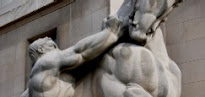
Photo from Wikimedia

Thursday, February 26, 2009

The fig tree always produces figs

There are some people, no matter how you treat them liberally, no matter how you give them no offence, they regularly have a wounding comment for you. A little, uncalled-for snide remark. Nothing that you can really take offence at and call them out for: you will immediately come off as seeming sensitive, touchy, childish. Such snide people are always quicker with the tongue than you are. But it is so unnecessary, I feel. It bothers me. I suppose I must admit I have a vindictive, judgmental tendency. And perhaps I am sensitive. But it takes a real philosophical effort for me to get past such snide comments. I have to bring myself in mind of some quotation or other. From Marcus Aurelius perhaps:

Begin the morning by saying to thyself, I shall meet with the busybody, the ungrateful, arrogant, deceitful, envious, unsocial. All these things happen to them by reason of their ignorance of what is good and evil…
Remember that as it is a shame to be surprised if the fig-tree produces figs, so it is to be surprised if the world produces such and such things of which it is productive; and for the physician and the helmsman it is a shame to be surprised if a man has a fever, or if the wind is unfavorable.

Today I came across this new-to-me quotation from the Bible in a Google search:

There is one who speaks rashly like the thrusts of a sword,
But the tongue of the wise brings healing. Proverbs 12.18

It comes from Biblos.com, and along with the different translated versions of the quote was this telling, insightful commentary on proverbs 12:16 to 12:23, through which sincerity and healing virtues run like a golden thread.

Mathew Henry’s Concise Commentary
12:16. A foolish man is soon angry, and is hasty in expressing it; he is ever in trouble and running into mischief. It is kindness to ourselves to make light of injuries and affronts, instead of making the worst of them. 17. It is good for all to dread and detest the sin of lying, and to be governed by honesty. 18. Whisperings and evil surmises, like a sword, separate those that have been dear to each other. The tongue of the wise is health, making all whole. 19. If truth be spoken, it will hold good; whoever may be disobliged, still it will keep its ground. 20. Deceit and falsehood bring terrors and perplexities. But those who consult the peace and happiness of others have joy in their own minds. 21. If men are sincerely righteous, the righteous God has engaged that no evil shall happen to them. But they that delight in mischief shall have enough of it. 22. Make conscience of truth, not only in words, but in actions. 23. Foolish men proclaim to all the folly and emptiness of their minds.

Wednesday, February 25, 2009

Paul Volcker on sincerity in finance

Paul Volcker, former Federal Reserve Board Chairman and head of President Obama’s Economic Recovery Advisory Board, began a recent speech with these words:

I really feel a sense of profound disappointment coming up here. We are having a great financial problem around the world. And finance doesn't work without some sense of trust and confidence and people meaning what they say. You take their oral word and their written word as a sign that their intentions will be carried out.

Anyone who begins his speech with an appeal to sincerity will get my attention. Obviously Mr.Volcker understands the power of sincerity and if you read the rest of his speech it becomes clear that he too believes that a fundamental lack of sincerity and integrity got the US and the world into this mess.
I encourage you to read the rest of the speech at Biiwii.com in Gary’s post Paul Volcker speaks, we should all listen.
Thank you to the noble Otto at Inca Kola News where I saw the speech in the first place in his post Paul Volcker: Yes, yes and thrice yes.
.
Image from Wikimedia

Friday, February 13, 2009

Sincerity - After Bankei had passed away

After Bankei had passed away, a blind man who lived near the master’s temple told a friend: “Since I am blind, I cannot watch a person’s face, so I must judge his character by the sound of his voice. Ordinarily when I hear someone congratulate another upon his happiness or success, I also hear a secret tone of envy. When condolence is expressed for the misfortune of another, I hear pleasure and satisfaction, as if the one condoling was really glad there was something left to gain in his own world. In all my experience, however, Bankei’s voice was always sincere. Whenever he expressed happiness, I heard nothing but happiness, and whenever he expressed sorrow, sorrow was all I heard.”

From Zen Flesh, Zen Bones by Paul Reps
Image from Chinese Tools.eu (detail)

Tuesday, February 10, 2009

Sincerity - the new normal

Insincerity is not only a weakness, a loss of strength that can be tangibly felt, a cowardice and a disgrace, but also a dangerous evil. As we have seen, insincerity on a large scale - at a national level - has devastating effects. They are being played out globally as we speak in the aftermath of the credit bubble and will continue to be played out for some time.

Truth and fidelity are the pillars of the temple of the world; when these are broken, the fabric falls, and crushes all to pieces. Owen Feltham

Now the temple is all to be built again. The people are dazed, some are angry, all are chastened by this catastrophic, unmistakable manifestation of the power of insincerity. Some are talking about ‘the new normal’: about living within one’s means, building savings the old way, expecting a reasonable return on one’s investment, prudent and moral management. The new normal is seeming to be what we are, and being what we seem to be. The new normal is sincerity.

Now the best way in the world to seem to be anything is really to be what we would seem to be. Besides that it is many times as troublesome to make good the pretence of a good quality as to have it, and if a man have it not it is ten to one but he is discovered to want it, and then all his pains and labor to seem to have it is lost. John Tillotson

I sat at a table where were rich food and wine in abundance, and obsequious attendance, but sincerity and truth were not; and I went away hungry from the inhospitable board. Thoreau

The whole faculties of man must be exerted in order to call forth noble energies; and he who is not earnestly sincere lives in but half his being, self-mutilated, self-paralyzed. Samuel Taylor Coleridge

Loss of sincerity is loss of vital power. Christian Nestell Bovee

An insincere and evil friend is more to be feared than a wild beast; a wild beast may wound your body, but an evil friend will wound your mind. Buddha

Of all the evil spirits abroad at this hour in the world, insincerity is the most dangerous. James Anthony Froude
.
Photo by Wikimedia: The reverse of the great seal of the United States on the 1$ bill featuring an unfinished pyramid and the ‘eye of Providence’. The Latin phrase above means ‘God has favoured our undertaking’ (literally ‘he/it favors the things having been begun’) and the one below means ‘a new order of the ages’.

Monday, February 9, 2009

Sincerity - according to the Ancients

The strength of a nation derives from the integrity of the home. Confucius

Hold faithfulness and sincerity as first principles. Confucius

To practice five things under all circumstances constitutes perfect virtue; these five are gravity, generosity of soul, sincerity, earnestness, and kindness. Confucius

Sincerity is the way of heaven; to think how to be sincere is the way of man. Mencius

There is no greater delight than to be conscious of sincerity on self-examination. Mencius

The Lord is close to all who call on him, yes, to all who call on Him sincerely. Psalm 145:18

Therefore let us keep the feast, not with old leaven, neither with the leaven of malice and wickedness; but with the unleavened bread of sincerity and truth. 1 Corinthians 5:8

Of Zebulun, such as went forth to battle, expert in war, with all instruments of war, fifty thousand, which could keep rank: they were not of double heart. 1 Chronicles 12:33

Blessed is the man unto whom the Lord imputeth not iniquity, and in whose spirit there is no guile. Psalms 32:2

Sunday, February 1, 2009

Sincerity - Polonius' advice to his son

Yet here, Laertes! aboard, aboard, for shame!
The wind sits in the shoulder of your sail,
And you are stay'd for. There; my blessing with thee!
And these few precepts in thy memory
See thou character. Give thy thoughts no tongue,
Nor any unproportioned thought his act.
Be thou familiar, but by no means vulgar.
Those friends thou hast, and their adoption tried,
Grapple them to thy soul with hoops of steel;
But do not dull thy palm with entertainment
Of each new-hatch'd, unfledged comrade. Beware
Of entrance to a quarrel, but being in,
Bear't that the opposed may beware of thee.
Give every man thy ear, but few thy voice;
Take each man's censure, but reserve thy judgment.
Costly thy habit as thy purse can buy,
But not express'd in fancy; rich, not gaudy;
For the apparel oft proclaims the man,
And they in France of the best rank and station
Are of a most select and generous chief in that.
Neither a borrower nor a lender be;
For loan oft loses both itself and friend,
And borrowing dulls the edge of husbandry.
This above all: to thine ownself be true,
And it must follow, as the night the day,
Thou canst not then be false to any man.
Farewell: my blessing season this in thee!

From 'Hamlet', by Shake-speare (De Vere)

Discover The Tale of Genji, the 11th Century classic of Japan (click image)

Discover The Tale of Genji, the 11th Century classic of Japan (click image)
Kiyomizudera Temple has a large veranda looking out over Kyoto and beyond