Where did all the links go? Here. Why? What is Healinks? Healinks is the links page of Healing Philosophy where you will find links to the best philosophy on the web. Go to Healinks
Whilst stirring my oatmeal in the morning I usually read my current Patrick O’Brian novel. Having just completed the series again, I was reading instead 1001 Pearls of Bible Wisdom by Malcolm Day. Regular readers know I have no qualms about posting religious insight along with the philosophical, be it from the Bible or the Talmud or the Koran. I was reading the section about forgiveness and reconciliation. All my life, I have always had a hard time understanding how Jesus could ‘die for our sins’. Why should God forgive us because Jesus died on the cross? I understood that Jesus asked God to ‘forgive them for they know not what they do’ but why should He? And it was always strange to me that, for such a central concept, I had not come across any explanations, no elaboration about why this should be.
Well, at 53, stirring my porridge one morning, I finally understood why.
The Rainbow and the Covenant
After the flood that destroyed all living things, except those taken into Noah’ ark, God made a covenant, or pledge, with humanity never to devastate the Earth again. As a reminder of his promise he placed a rainbow in the sky: ‘I have set my bow in the clouds, and it shall be a sign of the covenant…” (Genesis 9:13). The covenant was fulfilled in the Passion of Christ. Jesus straddles the divide between human wrongdoing and God’s judgment and, through the Crucifixion, enables God to be reconciled with sinful humanity. People no longer need to endure God’s wrath – their sins are forgiven.
And following this introduction we read …
… in Christ God was reconciling the world to himself, not counting their trespasses against them … 2 Corinthians 5:19
In Jesus God took on the form and condition of a man, open to fear, weakness and pain. Yet Jesus could ask God to forgive his persecutors while on the cross. Thus God could see that there was some good in man, despite his sins. Thus he was reconciled and the covenant fulfilled.
This is not a review of Philip Gröning’s work: to ‘review’ such a film would be as presumptuous as a book review of the Old Testament. But I will share with you here what I saw and felt in this film in order that you might wish to see and feel it also.
The Monastery of the Grande Chartreuse is considered to be one of the most ascetic monasteries in the world. In 1984, I asked them for permission to film on location. It was said that it was too early. Maybe in 10, 13 years. 16 years later I received a call from the Chartreuse. They were now ready. – Philip Gröning
‘Into Great Silence’ is a fly on the wall’s view of monastic life in the Grande Chartreuse. It is a film like nothing you have ever seen before because what it sets out to do is make visible and palpable the invisible and the impalpable. And in this it succeeds like no other film you will ever see. How do you tell the story of a life devoted to the invisible Spirit, spent largely in silent communion with God, in menial tasks performed gratefully with a pure heart?
The Lord passed by. Then a great wind tore the mountains apart and shattered the rocks before the Lord,
But He was not in the wind.
After that there was an earthquake,
But the Lord was not in the earthquake.
After that came a fire,
But the Lord was not in the fire.
After the fire came a gentle whisper. – Kings 19, 11-13
This is the first of several quotations from the Bible that occur like milestones or guiding stars along the journey of the film. And we are immediately seized by the power and poetry of those words. This feeling stays with us as their meaning is given form in the daily life of the monks.
One of the earliest scenes shows a monk preparing vegetables in the kitchen. 30 seconds of watching a monk cutting the leaves off celery. One might begin to think to oneself that the director is setting the scene, preparing us for the action to come. But, with great courage, Gröning continues to show us the monk cutting the celery. There is no action to come. This is the action. The smallest of tasks are given their due place in life. It is borne in on us that all our daily tasks are noble and a meditation if performed in the right spirit. We need to slow down and pay attention to our lives.
In my opinion there is absolutely no doubt Gröning was divinely inspired and guided throughout the making of this film. Can you imagine that all the monks’ prayers - the whole monastery’s most earnest prayers - for a happy outcome to their film project would go unanswered? Think about it. Even I feel the breath of an angel over my shoulder as I write about it.
Gröning slows us down in every successive scene and makes more and more obvious the complete disconnection between our frenzied superficial world and this timeless, peaceful world of the Spirit. At first we may feel uncomfortable. Those afraid to be alone, afraid of the void, afraid to think, or afraid to be away from their cell phones for more than 5 minutes, may feel very uncomfortable. But after a while we begin to think that this quiet life is the real life and that other frenzied life is uncomfortable.
Interspersed with the scenes of daily tasks and prayer and silent communion with God are scenes of nature, time lapses of the stars at night, camera angles of the play of shadows on the wooden floor boards, dust specks floating in the light. Scenes that ordinarily might go unnoticed are now presented to us in their own right to make us look at the visible beauty of the world and how it suggests the invisible beauty of the Spirit that created it.
Anyone who does not give up all he has cannot be my disciple.
We try to imagine what it must be to give up all we have and become a monk, a disciple. We fail. These words are old but for these monks they are new and imperative. We look on with a kind of awe. Gröning has no qualms presenting us with several series of 30-second full-face shots of the monks. Humility, kindness, simplicity, forgiveness: all manner of virtues are to be read on their faces as they look us benevolently right in the eye. One might even say God looks us right in the eye.
The ‘aha’ moments are many in this film, although they are no doubt somewhat different for each individual. I found the following quotation particularly poignant. It perhaps sums up the whole meaning of Christianity and the spiritual imperative in its two lines:
Behold I am become human. If you should not want to join me in becoming God, you would do me wrong.
‘Join me in becoming God’: that is what the monks wish to do with all their heart. And their journey, revealed to us by the inspired hand of Gröning, is very poignant and uplifting. Poignant because a life devoted to the Spirit is what we are born to and what we would desire above all things if we only knew it, but we don’t know it. Uplifting because these monks, although only men like us, have been able to choose this path and to follow where it leads.
You shall seek me and you shall find me. Because you seek me with all your heart, I will let myself be found.
I hope I have encouraged you to see this important film. I am sure it will change the way you look on your own life - perhaps at first in small, imperceptible ways - as it has changed the way I look on mine.
I will leave you with the following clip that shows many of the aspects I have discussed and has an excerpt of the beautiful Night Office at the end. (Unfortunately the presentation of the opening quotation has been modified but do not mind it: the rest is worth it).
I have been listening to the night mass on disc 2 of ‘Into Great Silence’ (more to come on this great work) most nights before falling asleep. I don’t know whether it is that but it has been slowly born in on me that perhaps my problem derives from a lack of faith.
When I say my problem I mean a lack of motivation, a general indifference to attacking projects (including writing posts), a tendency to wish to escape into Patrick O’Brian novels. And when I say a lack of faith I don’t necessarily mean a religious faith but it does include the notion of lacking faith that God will provide if I have faith, or The Universal Dinner Lady will provide, if you prefer the Taoist view.
This I know already. ‘According to your faith shall it be it unto you’ and so on. ‘Anything you can believe you can achieve’, the power of the subconscious, and so on. But it just came more clearly into focus the other day. And then I read this quote from a book I recently bought, ‘1001 Pearls of Bible Wisdom’ and I had something like an epiphany and a confirmation I was onto something:
O man, believe in God with all your might, for hope rests on faith, love on hope, and victory on love. – Mother Julian of Norwich
Of course, I said. Without faith – in God, in yourself, in others – hope is gone. Without hope you become indifferent, discouraged, even bitter: you have precious little love for yourself let alone others. And without love what can you have or accomplish? Nothing of meaning or lasting value, hence there can be no victory. I saw that faith is the foundation of a right attitude and I saw that it applied to me. I was in a vicious circle of demotivation and in order to break it I must begin to believe – in God, in myself and in The Universal Dinner Lady. It is all the same, for when you believe in yourself, you believe in the grace God has given you, you believe in God in you. And that is the definition of being inspired, innit?
Image: another shameless opportunistic posting of the lovely Aki Hoshino as the Universal Dinner Lady
Let’s take a break from the dark clouds and the doom and gloom. ‘Why are you writing about that stuff here anyway?’ you ask. ‘This is supposed to be a blog about philosophy and healing for goodness sake, I come here to get away from all that crazy stuff.’ Yep, you may have a point. But I talk about that crazy stuff because it is a consequence of bad philosophy. Just like for an individual, when a country and an economy are governed by short-term selfish immoral goals, bad consequences arise and suffering ensues. Eventually.
We have talked about this before: the swamp plant may grow fast and do well for a time, but it will not last. Only growth based on the firm soil of integrity is lasting and beneficial to all. What has happened in recent years is unacceptable to reasoning people and I feel winds of change are blowing and I feel a desire to give those winds of change a little help. So bear with me if I rant about bad philosophy in the world. I am reminded of this quote of many centuries ago:
Do you know, my son, with what little understanding the world is ruled? Pope Julius III (1487 – 1555)
Not many people see this blog but if only one person reads this post, who knows what tiny ripples of change may be set in motion?
So let us return to philosophy again for a moment and let me share with you a passage from an important little book I have discovered recently: Life’s Daily Blessings – Inspiring Reflections on Gratitude and Joy for Every Day, based on Jewish Wisdom by Rabbi Kerry M. Orlitzky. From compiling quotes for the blog, I have come across several Jewish proverbs and I always found them very succinct powerful and true. So when I fell on this book I was eager to learn more about the Jewish tradition. I was not disappointed. I share with you here a very appropriate passage for this blog and for this world today.
Mending the World
Blessed are You, Adonai our God, Ruler of the universe, for giving us the opportunity to mend the world. Rabbi Ron Klotz
While this is not a traditional blessing – that is, not one of the lists of blessings penned by the Rabbis to be among the one hundred that are to be said each day – it certainly contains what might be called traditional sentiments. We are each obligated to help repair the brokenness in the world, and in others. Of course, we may be simply motivated to do so because it is the right thing to do. But we also want to recognize that when we do so, we are contributing to God’s work in the world. In repairing what is broken and working to bring perfection back to the world by healing it and those who inhabit it, we are acting as channels through which God’s presence flows into the world.
The blessing that Rabbi Klotz wrote acknowledges the sacredness of such an act. It is a privilege to join with God in order to fix what is broken in the world. But the world is not alone in its need of repair. When we contribute to fixing the world, we often end up healing what may be broken in ourselves.
My mother died in November (see Saying goodbye to mother and Mother). I could not be present for the funeral in England so that day I went to Saint Joseph’s Oratory of Mount Royal. I had been meaning to go there for some time, and I am ashamed to say it took my mother’s death to get me there. I have made a point of visiting many great cathedrals on my trips to England but I know nothing of those in Montreal where I live.
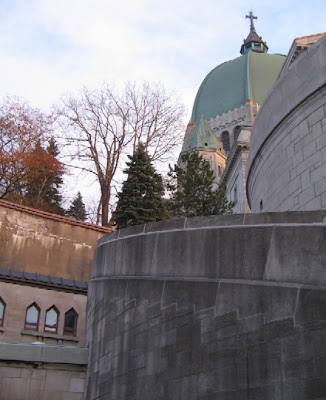
So the day of my mother’s funeral found me climbing the many steps leading up to the Oratory on Montreal’s Mount Royal. The photos do not do credit to the dimensions involved. The building is huge and imposing in stature in itself quite apart from the fact that it sits on top of a mountain. The architecture of the façade is in the classic Greco-Roman style.
Climbing the steps, I feel small and fragile and humbled. At the top of the steps I turn to see the city stretched out before me, and beyond it an uninterrupted horizon of hazy hills. Yet still the Oratory towers above me. I enter.
Inside I am surprised to find escalators rising up to the next floors. Then another, and another. The escalators give the impression, not that one is rising up to heaven, but rather that one is surfacing from an underground world of base emotions into the real world of the spirit above.
Finally, I surface at the Basilica. With only images of old cathedrals in my mind, I am surprised to see the pure simple lines of this Basilica. I have little time to reflect more because I am immediately overwhelmed with sorrow and sit down in the first bench to cry.
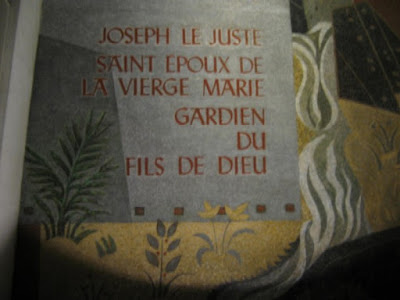
Slowly my emotions work themselves out and I sit peacefully contemplating the altar and the cross. I say a prayer for my mother. A mother and her child walk down the aisle. The mother stops and kneels and makes the sign of the cross and continues on. Eventually I get up and walk around the altar. On the wall behind is a mosaic. I read an inscription in French: ‘Joseph the Just, Holy Husband of the Virgin Mary, Guardian of the Son of God’.
On one side of the altar is a statue of Frère André, founder of the Oratory.
I linger a little, absorbing the peace that vibrates in this place. As I leave, I pass by a message engraved in one of the marble blocks that make up the walls of the Basilica. It reads:
‘Even in the heart of darkness Your hand grasps me, because for You the night illuminates as much as the day’.
While in Chester last month I visited Chester Cathedral. I have also visited the cathedrals in York, Lincoln and Durham on previous visits long before I began this blog. Chester ranks up there with the most notable, tracing its founding to just after the Norman Conquest almost a thousand years ago.
Whilst I was there it just so happened that a group of pre-schoolers were visiting the cathedral. About a hundred of them were sitting on the floor of the nave right in front of the organ.
There they were, a little bundle of young lives, some still clutching their favourite teddy bears, full of innocence and hope, the joy and treasure of the community. I was reminded of a quote of Carl Sandburg:
A baby is God’s opinion that the world should go on.
They were listening attentively to a guide who was explaining to them the functioning of the great organ, and as he explained the organ’s capabilities the organist would demonstrate them. The sounds ranged from something like the low tremor of an earthquake to the airy notes of a pipe whistle soaring into realms only dogs can hear.
It was quite touching to feel at the same time the weight of the ages in these old, holy stones and the fragility of the new life in these little children. It was also pleasing to see that they had been brought to this place at such an early age to be imbued with its power.
If I speak in the tongues of men and of angels, but have not love, I am a noisy gong or a clanging cymbal. And if I have prophetic powers, and understand all mysteries and all knowledge, and if I have all faith, so as to remove mountains, but have not love, I am nothing. If I give away all I have, and if I deliver up my body to be burned, but have not love, I gain nothing.
Love is patient and kind; love does not envy or boast; it is not arrogant or rude. It does not insist on its own way; it is not irritable or resentful; it does not rejoice at wrongdoing, but rejoices with the truth. Love bears all things, believes all things, hopes all things, endures all things.
Love never ends. As for prophecies, they will pass away; as for tongues, they will cease; as for knowledge, it will pass away. For we know in part and we prophesy in part, but when the perfect comes, the partial will pass away. When I was a child, I spoke like a child, I thought like a child, I reasoned like a child. When I became a man, I gave up childish ways. For now we see in a mirror dimly, but then face to face. Now I know in part; then I shall know fully, even as I have been fully known.
So now faith, hope, and love abide, these three; but the greatest of these is love.
1 Corinthians 13
Some translations have ‘Love never fails’ instead of ‘Love never ends’. 'Love never ends' would seem better, because sometimes love does fail, doesn’t it? But then we might ask, was it love that failed or was it something other than love? Attachment maybe? Infatuation? Perhaps love never does fail. For if it is really love, it ‘insists not on its own way’, but merely is. In that sense love can never fail. Like sincerity, love is never wrong.
Non-action? Non-action! What new-age rubbish is this? you say. We have to act! We have to take action! Well, yes and no. By non-action, I don’t mean sitting around on your butt all day. Non-action refers to the intent, the origin and the attachment to the action. Henrik over at the awesome Positivity Blog has a great little post One timeless tip that can make your life a whole lot easier which begins with a quote from the Bhagavad Gita:
To action alone hast thou a right and never at all to its fruits; let not the fruits of action be thy motive; neither let there be in thee any attachment to inaction.
Henrik goes on to expose the benefits (less stress, less effort, better effort and more enjoyment) of letting go of trying to control the results of your actions and just focusing on enjoying the process. This is very true and reminds me of a story (yes, I have a story for everything):
A man went to see a famous martial arts master and asked him how long it would take to become a black belt. “Ten years” said the master. “What if I train very hard seven days a week, night and day, month after month, how long then?” “Twenty years” came the reply. “Twenty years! Why ten years more? Why so long?” “With one eye on the destination, you have only one eye left for the path.”
How true. Most of the time, as Henrik points out, we have one eye on the destination and this makes the process more difficult than it need be. But there is more, much more, to the power of non-action. I came across Henrik's quote from the Bhagavad Gita myself many years ago in the Dervy Edition (French) of the Tao Te Ching, Tao Te King - Livre du Tao et de sa Vertu. In the extensive commentary there is a section on the theme of non-action as found in the Tao Te Ching.
To master action, we must keep our independence with regard to it. Now, we are only free with regard to a thing when we have contracted no debt toward it and we expect nothing from it. The Sage “produces without appropriating to himself, works without expecting anything, accomplishes works of merit without becoming attached to them, and precisely because he doesn’t become attached to them, they endure… because he does not pursue selfish goals, he realises to perfection everything he undertakes.”
The power of non-action is in subordinating our constant selfish desires which produce only grasping, fearful, temporary actions to actions that come from, shall we say, our higher selves.
For as long as man claims the I and Mine, his works will be as nothing. When all love for the I and Mine is dead, then the works of the Lord will be accomplished. Kabir, Poems VI
The effort to possess, forces man to identify himself with the objects of his possession. What he possesses is a part of him, to such a degree that if something is taken away from him or if he loses it, he feels as if a part of himself has been taken away. This is truly slavery; man may imagine that he possesses things, in reality they possess him. Van der Leeuw
The point is that the more an action is selfish, the less power it has. The more an action is good for everyone, good for the community, universally good, the more it will have the support of the universe, the Tao, God. The more, in other words, it will be non-action, the spontaneous work of the Spirit. (So I must be resigned to not getting what I want? Not at all. As Confucius said: He who wishes to secure the good of others has already secured his own). And if you think this is an idea only to be found in Chinese philosophy, look more closely, you will find parallels in all philosophies and religions.
That thou mayest have pleasure in everything, seek pleasure in nothing. That thou mayest know everything, seek to know nothing. That thou mayest possess all things, seek to possess nothing. That thou mayest be everything, seek to be nothing. Saint John of the Cross
Thy lot or portion of life is seeking after thee; therefore be at rest from seeking after it. Caliph Ali
So lift up your thoughts, lift up your motives, enlighten yourself with the knowledge to be found in this very blog, and you will harness the power of non-action. (Or not, if you know what I mean).
.
If you liked this post, please Stumble, Digg or otherwise share it with the 'SHARE' button below (mouse over it for options). Thanks!
.
Photo from Wikimedia: Krishna displays his Vishvarupa (Universal Form) to Arjuna on the battlefield of Kurukshetra
There are some people, no matter how you treat them liberally, no matter how you give them no offence, they regularly have a wounding comment for you. A little, uncalled-for snide remark. Nothing that you can really take offence at and call them out for: you will immediately come off as seeming sensitive, touchy, childish. Such snide people are always quicker with the tongue than you are. But it is so unnecessary, I feel. It bothers me. I suppose I must admit I have a vindictive, judgmental tendency. And perhaps I am sensitive. But it takes a real philosophical effort for me to get past such snide comments. I have to bring myself in mind of some quotation or other. From Marcus Aurelius perhaps:
Begin the morning by saying to thyself, I shall meet with the busybody, the ungrateful, arrogant, deceitful, envious, unsocial. All these things happen to them by reason of their ignorance of what is good and evil… Remember that as it is a shame to be surprised if the fig-tree produces figs, so it is to be surprised if the world produces such and such things of which it is productive; and for the physician and the helmsman it is a shame to be surprised if a man has a fever, or if the wind is unfavorable.
Today I came across this new-to-me quotation from the Bible in a Google search:
There is one who speaks rashly like the thrusts of a sword, But the tongue of the wise brings healing. Proverbs 12.18
It comes from Biblos.com, and along with the different translated versions of the quote was this telling, insightful commentary on proverbs 12:16 to 12:23, through which sincerity and healing virtues run like a golden thread.
Mathew Henry’s Concise Commentary 12:16. A foolish man is soon angry, and is hasty in expressing it; he is ever in trouble and running into mischief. It is kindness to ourselves to make light of injuries and affronts, instead of making the worst of them. 17. It is good for all to dread and detest the sin of lying, and to be governed by honesty. 18. Whisperings and evil surmises, like a sword, separate those that have been dear to each other. The tongue of the wise is health, making all whole. 19. If truth be spoken, it will hold good; whoever may be disobliged, still it will keep its ground. 20. Deceit and falsehood bring terrors and perplexities. But those who consult the peace and happiness of others have joy in their own minds. 21. If men are sincerely righteous, the righteous God has engaged that no evil shall happen to them. But they that delight in mischief shall have enough of it. 22. Make conscience of truth, not only in words, but in actions. 23. Foolish men proclaim to all the folly and emptiness of their minds.
In 2003, I returned to England to visit my family. I had not seen my parents for a long time. I was also looking forward to visiting various historic sites, but especially I was looking forward to seeing the sea. I had not seen the sea for a very long time. Not the water of a river, or even a big lake: I wanted to see The Sea, smell and taste the salt, see the waves, hear and feel the rollers crashing on the sand, pick shells on the beach, feel the breeze on my face. It was more than a desire. The more I thought about it, the more I needed to see the sea. In the plane, looking at my Green Guide, my eye fell on Whitby, right on the coast of the North Sea. The North Sea: you can’t get more sea than that. A few days later I was driving up a steep, curving road to the height of a hill on the northern side of Whitby that I thought would afford me a good view. I stepped out of the car and almost ran to the edge of the hill. The vista opened, and I stood there transfixed.
Below, a small harbour protected by a mole, a headland opposite with an old monastery, the old fishing village huddled on both sides of the harbour and then, beyond, filling the horizon, the longed-for sea. I don’t know how long I stood there, in a wondering daze, taking deep breaths of sea air. I made my way down to harbour level. There was a pier, a big, old pier stretching out into the sea with a lighthouse in the middle.
I walked along the pier to a kind of round battlement made of immense blocks of stone with the lighthouse in the centre. It was a blustery September day and the sea was choppy. The waves came crashing against the battlements like the furious assaults of some unknown enemy, only to recede before trying again.
I looked up at the lighthouse. A metal wire, a lightning conductor perhaps, led from the summit to the pier. I saw a little, old sign next to it. I had to step closer to read what it said.
See alsoWhitby revisitedand find more about England by clicking the England label.



 Climbing the steps, I feel small and fragile and humbled. At the top of the steps I turn to see the city stretched out before me, and beyond it an uninterrupted horizon of hazy hills. Yet still the Oratory towers above me. I enter.
 Inside I am surprised to find escalators rising up to the next floors. Then another, and another. The escalators give the impression, not that one is rising up to heaven, but rather that one is surfacing from an underground world of base emotions into the real world of the spirit above.
 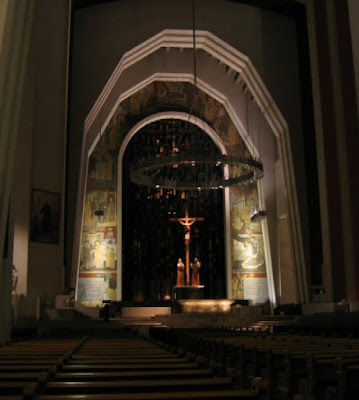 Slowly my emotions work themselves out and I sit peacefully contemplating the altar and the cross. I say a prayer for my mother. A mother and her child walk down the aisle. The mother stops and kneels and makes the sign of the cross and continues on.
 On one side of the altar is a statue of Frère André, founder of the Oratory.
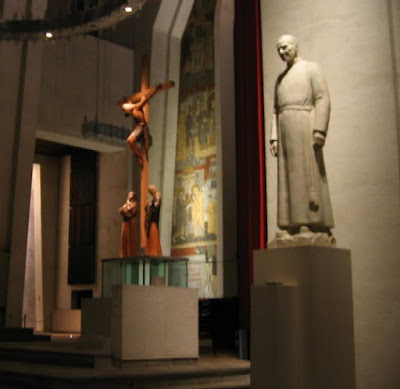 I linger a little, absorbing the peace that vibrates in this place. As I leave, I pass by a message engraved in one of the marble blocks that make up the walls of the Basilica. It reads:

 Whilst I was there it just so happened that a group of pre-schoolers were visiting the cathedral. About a hundred of them were sitting on the floor of the nave right in front of the organ.
 There they were, a little bundle of young lives, some still clutching their favourite teddy bears, full of innocence and hope, the joy and treasure of the community. I was reminded of a quote of Carl Sandburg:
 It was quite touching to feel at the same time the weight of the ages in these old, holy stones and the fragility of the new life in these little children. It was also pleasing to see that they had been brought to this place at such an early age to be imbued with its power.

 Below, a small harbour protected by a mole, a headland opposite with an old monastery, the old fishing village huddled on both sides of the harbour and then, beyond, filling the horizon, the longed-for sea.
 I walked along the pier to a kind of round battlement made of immense blocks of stone with the lighthouse in the centre. It was a blustery September day and the sea was choppy. The waves came crashing against the battlements like the furious assaults of some unknown enemy, only to recede before trying again.