Where did all the links go? Here. Why? What is Healinks? Healinks is the links page of Healing Philosophy where you will find links to the best philosophy on the web. Go to Healinks
Whilst stirring my oatmeal in the morning I usually read my current Patrick O’Brian novel. Having just completed the series again, I was reading instead 1001 Pearls of Bible Wisdom by Malcolm Day. Regular readers know I have no qualms about posting religious insight along with the philosophical, be it from the Bible or the Talmud or the Koran. I was reading the section about forgiveness and reconciliation. All my life, I have always had a hard time understanding how Jesus could ‘die for our sins’. Why should God forgive us because Jesus died on the cross? I understood that Jesus asked God to ‘forgive them for they know not what they do’ but why should He? And it was always strange to me that, for such a central concept, I had not come across any explanations, no elaboration about why this should be.
Well, at 53, stirring my porridge one morning, I finally understood why.
The Rainbow and the Covenant
After the flood that destroyed all living things, except those taken into Noah’ ark, God made a covenant, or pledge, with humanity never to devastate the Earth again. As a reminder of his promise he placed a rainbow in the sky: ‘I have set my bow in the clouds, and it shall be a sign of the covenant…” (Genesis 9:13). The covenant was fulfilled in the Passion of Christ. Jesus straddles the divide between human wrongdoing and God’s judgment and, through the Crucifixion, enables God to be reconciled with sinful humanity. People no longer need to endure God’s wrath – their sins are forgiven.
And following this introduction we read …
… in Christ God was reconciling the world to himself, not counting their trespasses against them … 2 Corinthians 5:19
In Jesus God took on the form and condition of a man, open to fear, weakness and pain. Yet Jesus could ask God to forgive his persecutors while on the cross. Thus God could see that there was some good in man, despite his sins. Thus he was reconciled and the covenant fulfilled.
Well shipmates, you are in for a little treat. You know the music vid, now know the poem vid. A beautiful, refreshing little video called ‘How to be Alone’ by Tanya Davis. My blog has a contractual obligation to post anything called ‘How to be Alone’.
I will not spoil the surprise for you by making any other comments, but you can trust me, its great.
Let’s take a break from the dark clouds and the doom and gloom. ‘Why are you writing about that stuff here anyway?’ you ask. ‘This is supposed to be a blog about philosophy and healing for goodness sake, I come here to get away from all that crazy stuff.’ Yep, you may have a point. But I talk about that crazy stuff because it is a consequence of bad philosophy. Just like for an individual, when a country and an economy are governed by short-term selfish immoral goals, bad consequences arise and suffering ensues. Eventually.
We have talked about this before: the swamp plant may grow fast and do well for a time, but it will not last. Only growth based on the firm soil of integrity is lasting and beneficial to all. What has happened in recent years is unacceptable to reasoning people and I feel winds of change are blowing and I feel a desire to give those winds of change a little help. So bear with me if I rant about bad philosophy in the world. I am reminded of this quote of many centuries ago:
Do you know, my son, with what little understanding the world is ruled? Pope Julius III (1487 – 1555)
Not many people see this blog but if only one person reads this post, who knows what tiny ripples of change may be set in motion?
So let us return to philosophy again for a moment and let me share with you a passage from an important little book I have discovered recently: Life’s Daily Blessings – Inspiring Reflections on Gratitude and Joy for Every Day, based on Jewish Wisdom by Rabbi Kerry M. Orlitzky. From compiling quotes for the blog, I have come across several Jewish proverbs and I always found them very succinct powerful and true. So when I fell on this book I was eager to learn more about the Jewish tradition. I was not disappointed. I share with you here a very appropriate passage for this blog and for this world today.
Mending the World
Blessed are You, Adonai our God, Ruler of the universe, for giving us the opportunity to mend the world. Rabbi Ron Klotz
While this is not a traditional blessing – that is, not one of the lists of blessings penned by the Rabbis to be among the one hundred that are to be said each day – it certainly contains what might be called traditional sentiments. We are each obligated to help repair the brokenness in the world, and in others. Of course, we may be simply motivated to do so because it is the right thing to do. But we also want to recognize that when we do so, we are contributing to God’s work in the world. In repairing what is broken and working to bring perfection back to the world by healing it and those who inhabit it, we are acting as channels through which God’s presence flows into the world.
The blessing that Rabbi Klotz wrote acknowledges the sacredness of such an act. It is a privilege to join with God in order to fix what is broken in the world. But the world is not alone in its need of repair. When we contribute to fixing the world, we often end up healing what may be broken in ourselves.
My mother died in November (see Saying goodbye to mother and Mother). I could not be present for the funeral in England so that day I went to Saint Joseph’s Oratory of Mount Royal. I had been meaning to go there for some time, and I am ashamed to say it took my mother’s death to get me there. I have made a point of visiting many great cathedrals on my trips to England but I know nothing of those in Montreal where I live.
So the day of my mother’s funeral found me climbing the many steps leading up to the Oratory on Montreal’s Mount Royal. The photos do not do credit to the dimensions involved. The building is huge and imposing in stature in itself quite apart from the fact that it sits on top of a mountain. The architecture of the façade is in the classic Greco-Roman style.
Climbing the steps, I feel small and fragile and humbled. At the top of the steps I turn to see the city stretched out before me, and beyond it an uninterrupted horizon of hazy hills. Yet still the Oratory towers above me. I enter.

Inside I am surprised to find escalators rising up to the next floors. Then another, and another. The escalators give the impression, not that one is rising up to heaven, but rather that one is surfacing from an underground world of base emotions into the real world of the spirit above.
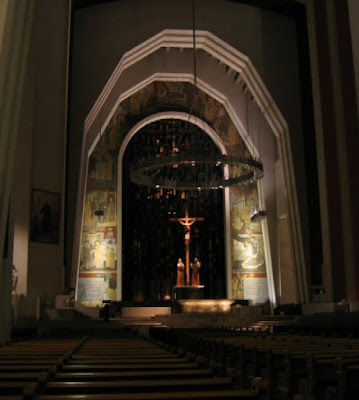
Finally, I surface at the Basilica. With only images of old cathedrals in my mind, I am surprised to see the pure simple lines of this Basilica. I have little time to reflect more because I am immediately overwhelmed with sorrow and sit down in the first bench to cry.
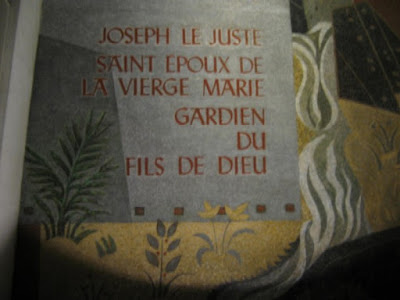
Slowly my emotions work themselves out and I sit peacefully contemplating the altar and the cross. I say a prayer for my mother. A mother and her child walk down the aisle. The mother stops and kneels and makes the sign of the cross and continues on. Eventually I get up and walk around the altar. On the wall behind is a mosaic. I read an inscription in French: ‘Joseph the Just, Holy Husband of the Virgin Mary, Guardian of the Son of God’.
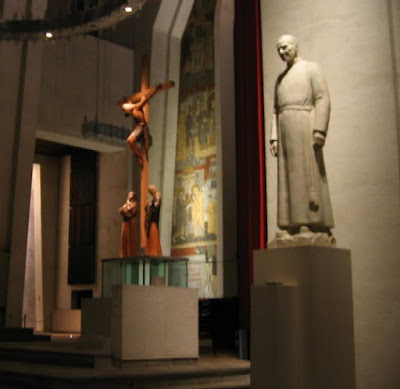
On one side of the altar is a statue of Frère André, founder of the Oratory.
I linger a little, absorbing the peace that vibrates in this place. As I leave, I pass by a message engraved in one of the marble blocks that make up the walls of the Basilica. It reads:
‘Even in the heart of darkness Your hand grasps me, because for You the night illuminates as much as the day’.
In The White Company I told you how much I liked Conan Doyle’s wonderful little tale of chivalry set during the wars between England and France in the fourteenth century. I am now reading Sir Nigel which is set slightly earlier and tells us the story of the knight of that name who we met in 'The White Company'. Conan Doyle, like that great historical writer Patrick O’Brian, is thoroughly steeped in his period and brings vividly to life the notions and morals of those distant times. I thought I would share one such insight with you because it has to do with the notion of the gentleman, which is a popular theme on this blog. The young Nigel, not yet a knight - a mere squire – yet of noble birth and brought up in the old ways, is travelling to the wars with Aylward, a longbowman and Nigel’s own squire.
That night they slept in a sordid inn, overrun with rats and with fleas, one mile south of the hamlet of Mayfield. Aylward scratched vigorously and cursed with fervour. Nigel lay without movement or sound. To the man who had learned the old rule of chivalry there were no small ills in life. It was beneath the dignity of his soul to stoop to observe them. Cold and heat, hunger and thirst, such things did not exist for the gentleman. The armour of his soul was so complete that it was proof not only against the great ills of life but even against the small ones; so the flea-bitten Nigel lay grimly still while Aylward writhed upon his couch.
Conan Doyle does not expand upon the subject more than that. It is for those who are receptive to take note. How the insight rings true. How petty are most of our discomforts and complaints, and how we undermine the nobility of our spirits by dwelling on them. Is this not a characteristic of the gentleman that he accepts hardships without complaint, that he accepts what he finds and adapts himself readily to it? His mind is focused on what is required of him as a gentleman, that is, what he must do for honour and for right and for those weaker than himself. And for these reasons he is a natural born leader and is considered of a finer essence by those who can only complain or dwell on petty things.
It is to be regretted if a party of people are together for a whole day without their conversation touching on what is right and wrong and if they take pleasure merely in shallow talk. Confucius
There is no such thing as being a gentleman at important moments; it is at unimportant moments that a man is a gentleman. At important moments he ought to be something better. G.K. Chesterton
Maximus! Maximus! Maximus! They call for you. The general who became a slave, the slave who became a gladiator, the gladiator who defied an emperor. A striking story.
Such are Commodus’ words to Maximus just before they fight in the dramatic ending of the award-winning classic Ridley Scott film ‘Gladiator’. If you have seen the film, you will remember how Maximus escapes execution by the emperor Commodus to find his family dead. He is captured by slave traders and Proximo buys him to use him as a gladiator. At first Maximus refuses to fight: he refuses to take on the role that fate has cast him in. It is beneath him, it disgusts him and he will not cooperate. But Proximo (played by the late great Oliver Reed) knows men, and he gives them this speech before their first combat:
Some of you are thinking you won't fight... and some that you can't fight. They all say that until they're out there. Listen. (‘Kill! Kill! Kill!’) Thrust this into another man's flesh. They will applaud and love you for that. And you, you may begin to love them for that. Ultimately...we're all dead men. Sadly, we cannot choose how, but we can decide how we meet that end, in order that we are remembered... as men.
At that moment Maximus ceases to resist his fate and begins to embrace it. He will still need some further motivation later and Proximo gives it to him: win the crowd and you will one day stand in front of the emperor… ‘Gladiator’ is indeed a striking story of a good, brave man who receives some cruel hard blows at the hand of fate and how he bears them nobly. Accepting the worst, he becomes fate's instrument as he avenges his family and rids Rome of a tyrant.
I thought you might like these thoughts as an introduction to what the ancients had to say about acceptance, including of course Maximus’ friend and Commodus’ father, Marcus Aurelius.
Accept the things to which fate binds you, and love the people with whom fate brings you together, but do so with all your heart. Marcus Aurelius
Adapt yourself to the things among which your lot has been cast and love sincerely the fellow creatures with whom destiny has ordained that you shall live. Marcus Aurelius
Love only what befalls you and is spun for you by fate. Marcus Aurelius
Vex not thy spirit at the course of things; they heed not thy vexation. How ludicrous and outlandish is astonishment at anything that may happen in life. Marcus Aurelius
Yet man is born unto trouble, as the sparks fly upward. The Bible
Lord grant me the serenity to accept the things I cannot change, the courage to change the things I can, and the wisdom to know the difference. Saint Francis of Assisi Who except the gods can live without any pain? Aeschylus
There is no man in this world without some manner of tribulation or anguish, though he be king or pope. Thomas a Kempis
There is only one way to happiness, and that is to cease worrying about things which are beyond the power of our will. Epictetus
Ask not that events should happen as you will, but let your will be that events should happen as they do, and you shall have peace. Epictetus
He who cannot do what he wants must make do with what he can. Terence
What it is forbidden to be put right becomes lighter by acceptance. Horace
Better to accept whatever happens. Horace
To yield, I have learned, is to come back again. Lao-Tzu
Flow with whatever may happen and let your mind be free. Stay centered by accepting whatever you are doing. This is the ultimate. Chuang-tzu
He who has calmly reconciled his life to fate ... can look fortune in the face. Boethius
Let a man accept his destiny. No pity and no tears. Euripedes
Let us train our minds to desire what the situation demands. Marcus Annaeus Seneca
The great soul surrenders itself to fate. Marcus Annaeus Seneca
What must be shall be; and that which is a necessity to him that struggles, is little more than choice to him that is willing. Marcus Annaeus Seneca
The ideal man bears the accidents of life with dignity and grace, making the best of circumstances. Aristotle
The beauty of the soul shines out when a man bears with composure one heavy mischance after another, not because he does not feel them, but because he is a man of high and heroic temper. Aristotle
Here is a rule to remember when anything tempts you to feel bitter: not ‘This is a misfortune’ but ‘To bear this worthily is good fortune.’ Marcus Aurelius
When you lose in love, things are very confusing. The joke about being the last to know is based on truth. We see what we want to see, we ignore the rest. We project our feelings of love onto our beloved and we believe that they are experiencing the same thing. Of course they are not. We don’t see the end coming. And when it hits us we are not ready. When it hit me I had to understand. I pulled out my agenda and reconstructed the play: Act 1, Act 2 and the devastating Act 3. I had to understand what happened and how it happened. In hindsight I revisited the conversations, the scenes and the places and I had to admit to myself that the signs were there, I just refused to see them. Eventually, I understood pretty much what happened and this allowed me to gain a modicum of peace of mind. Anger remained and remains still a little, if I give it any thought, in my heart if not in my head. Strange how love can turn to anger. Over time, with the help of the philosophy of Anthony de Mello and others, I understood more. Until one day I read this quote from Spinoza.
To understand all is to forgive all.
This was a powerful insight for me. I saw that the only reason I still harboured anger and hatred was because of my incomplete understanding. I saw that even if I did not have the power to understand all yet, still forgiveness would be correct. I should not deprive myself of peace of mind and the liberation of forgiveness because of my incomplete understanding.
Do not weep; do not wax indignant. Understand.
Because when you understand you can accept, and you can forgive. Marcus Aurelius helped me further along this path of understanding:
Whatever man thou meetest with, immediately say to thyself: What opinions has this man about good and bad? For if with respect to pleasure and pain and the causes of each, and with respect to fame and ignominy, death and life he has such and such opinions, it will seem nothing wonderful or strange to me, if he does such and such things; and I shall bear in mind that he is compelled to do so.
That I would lose my love was plain for others to see. I blinded myself to the possibilities. If I had been able to keep my wits about me as Marcus Aurelius suggests, I would have understood the situation as it was happening. As it was, I had to understand in hindsight, whilst sorting through my negative emotions.
Now keep looking at this unpleasant situation or person until you realize that it isn’t they that are causing the negative emotions. They are just going their way, being themselves, doing their thing whether right or wrong, good or bad. It is your computer that, thanks to your programming, insists on your reacting with negative emotions. Anthony de Mello
My love was compelled to act in the way she did. I was compelled to act in the way I did. That’s life.
To understand is to transform what is. Krishnamurti
Let me not to the marriage of true minds Admit impediments. Love is not love Which alters when it alteration finds, Or bends with the remover to remove: O no! it is an ever-fixed mark That looks on tempests and is never shaken; It is the star to every wandering bark, Whose worth's unknown, although his height be taken. Love's not Time's fool, though rosy lips and cheeks Within his bending sickle's compass come: Love alters not with his brief hours and weeks, But bears it out even to the edge of doom. If this be error and upon me proved, I never writ, nor no man ever loved.
Shake-speare (De Vere) - Sonnet 116
If you are suffering from the loss of a love, you may have found little solace in my last post Love (lost). Your reasoning mind may have found it mildly interesting but your heart will have dismissed it in an instant with a 'But you don't understand'. I quote this powerful verse from Shake-speare (De Vere) by way of saying that I do understand. When we are in love, and lose that love, there can be no solace for the heart in the short term. This has been my experience anyway. Perhaps it is a psycho-physiological trick of nature to keep couples together to ensure the survival of the species. In my case, only time (many years) has faded the memory without erasing it completely. But there is nothing bad but thinking makes it so, the bard also said. And if you are a regular reader you are familiar with the Taoist philosophy of facing up sincerely to the times and learning its lessons. There is also the Taoist philosophy that everything we are living now we created ourselves by our past actions. We are responsible for manifesting everything around us. There is the philosophy that everything we are living now is exactly appropriate for us at this moment and is exactly what we need to experience now in order to grow. There is also the philosophy that we already have everything we need here and now (gratitude) and wishing for things to be exactly the way they are now allows us to appreciate them. These are important ideas for they can help us in changing our viewpoint from that of a victim of other people’s actions to active engineers of our own experience. To activate that change of viewpoint, one of the best ways is to use affirmations. Yes, I know your heart is groaning ‘Is that all you’ve got?’ But there is untold power in the word as it becomes true for the subconscious. For the subconscious creates for us what we believe to be true and cannot tell the difference between what we experience in reality and what we concentrate on in our mind. Concentrate on sorrow or concentrate on transformation, and your subconscious will create it. Here are some powerful affirmations from ‘Manifesto’ by my favourite modern-day Taoist master, Stephen Russel.
All internal psycho-emotional discomfort evaporates now and I find myself at peace.
I acknowledge myself for having the courage and endurance to carry on.
I am cheerful no matter what.
I determine what kind of life I have – no one and nothing else.
I create my own reality according to which set of beliefs I subscribe to now. I now alter the very foundations of my reality and thus build myself a different and more useful belief structure that even now is producing magnificent results.
I take full responsibility for myself and my moment-by-moment experience of life from this moment on. I am alive.
As soon as I heard the first song from this album, I immediately said to myself it is surely ‘that fellow’ (Djivan Gasparian) who plays the duduk (wild flute) so masterfully in the soundtrack of ‘Gladiator’. I have listened to this soundtrack literally hundreds of times, the powerful music of that living genius Hans Zimmer. I heard the same poignant notes of suffering and courage. I immediately bought the album with total confidence, unheard. Well, in fact it was not Djivan Gasparian I heard but Lévon Minassian. But it is all the same, for I discovered that Minassian was a student of Gasparian, and I find that the student has become the master. Words are inadequate for describing any music, since music has a direct electrical contact to the soul, whereas words are filtered and interpreted by the mind. Yet I will try to describe the indescribable. Hearing each song for the first time, our bruised and blistered soul seems to recognise an old refrain and flows readily, willingly along with the music as if it has always known it. The music takes up its rightful place in our memory, as if this place were reserved for it. Minassian plays with utter mastery, the duduk speaks with a voice as subtle and expressive as any violin, any human. Armand Amar, the composer and arranger of these traditional Armenian folk songs, is to be highly praised. Often the voice of the duduk is placed in high relief on the background of a dark, ominous, ambient base but the often-expected digression into trendy ‘techno’ rhythms never comes. The music remains firmly rooted in the timeless and the authentic. The music speaks of suffering certainly, but it is the beautiful suffering of the brave heart. As we listen effortlessly, feeling our suffering being expressed fully and beautifully, we find strength in the music as we realise that our suffering is not unique but is the suffering of our condition, the suffering of every man, past and present and future. We realise that it is simply ‘Suffering’. And suffering is not all bad: for what is suffering except a manifestation of love? Love lost, love that cannot be, love sought and not found, loved-ones missed? There can be no suffering without love. This is all understood wordlessly through the music of this masterpiece, for it is nothing less. It is a sure, wide-open gateway to the Spirit, in the world apart.
No matter what we may think we know, we show our true selves, our real level of spiritual development, by our reaction to the bad things that happen to us. Often we rebel. Why is this happening? Why now? Why me? (I admit that my own level of spiritual development by this standard is often on a par with a potato. I’m working on it). We forget that a) this is happening because we made it happen or b) this is happening because it is a part of life and c) this happens to everyone at some point and is happening at this very moment to hundreds or thousands of other people, so why are we so special? And then of course we forget the all-important d): this is happening for a reason so we can learn from it and improve and move on to the next level. The humble person does not waste any emotional energy rebelling and bemoaning his fate. He accepts that this is happening now and what is the best thing to do, or to be? What if we were to welcome obstacles instead of resisting them? The following is my translation of a passage from Imitation de Notre Seigneur Jesus Christ:
The truly patient man does not examine who is testing him, whether it is his superior, his equal or his inferior, a good man or a bad man. But, treating all indiscriminately, he receives from God’s hand, gratefully, and as often as He likes, everything contrary that happens to him, and considers it a great benefit.
The great thing about uplifting our attitude to obstacles in this way is that we cease being victims. Whatever happens to us we can transcend through humility and patient attention. By our very nature we are equipped by God, the Tao or whatever power we recognise, to handle everything that comes our way. We managed so far didn’t we? I like the following story I came across in ‘The Discovery of Happiness’ edited by Stuart McCready:
The disciples of the Hasidic leader Rabbi Dov Ber (d.1772) were discussing the Talmudic statement that one should accept suffering with joy. “How is this possible?” they asked. Rabbi Dov Ber advised them to visit another of his disciples, Rabbi Zusya, who lived some distance away. He would explain to them how to accept suffering with joy. The disciples were pleased with this advice. All knew that Rabbi Zusya lived a life of poverty, illness, and suffering. He would surely be able to explain. When they reached the hovel in which he lived he jumped up with joy to greet them. They explained why they had come: “Our teacher told us to enquire from you how to accept suffering with joy.” Rabbi Zusya looked puzzled. “Why did he send you to me?” he asked. “God is good and sends me all I need – I have never known suffering at all. So how can I help you?”