Showing posts with label Gentleman. Show all posts

Saturday, October 3, 2009

The Black Prince

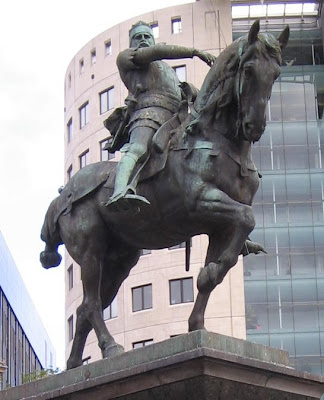
As I crossed the street from Leeds Station my eye fell on a striking equestrian statue some distance on the left. I went over to have a look at it. Now I must have crossed that street a dozen times in all my trips to England but never once did I seem to notice this statue, an amazing lack of observation on my part that I cannot explain. It was a statue of the Black Prince, no less.

The Black Prince was the son of Edward III, the victor of the Battle of Crécy, where a small English army destroyed a large French one by the use of the medieval equivalent of the tactical nuclear weapon: the longbow.

The prince ‘won his spurs’ (became a knight) at the age of 16 at that battle. There is a passage in Froissart that tells us something about the way the prince won his spurs and the sang froid and hard love of Edward III.

In the morning, the day of the battle, certain Frenchmen and Germans perforce broke through the archers of the prince’s battalion, and came and fought with the men-of-arms hand to hand. Then the second battalion of the Englishmen came to succour the prince’s battalion, the which was time, for they had then much ado; and those with the prince sent a messenger to the king, who was on the little windmill hill.
Then the knight said to the king, “Sir, the Earl of Warwick and the Earl of Stafford, Sir Reginald Cobham, and other such as be about the prince your son, are fiercely fought withal, and are sore handled: wherefore they desire you that you and your battalion will come and aid them, for if the Frenchmen increase, as they doubt they will, your son and they shall have much ado.”
Then the king said, “Is my son dead, or hurt, or on the earth felled?”
“No, Sir,” said the knight, “but he is hardly matched; wherefore he hath need of your aid.”
“Well,” said the king, “return to him and to them that sent you hither, and say to them that they send no more to me, whatever adventure befalleth, as long as my son is alive; and also say to them, that they suffer him this day to win his spurs, for if God be pleased, I will that this day’s work be his, and the honour thereof, and to them that be about him.”
Then the knight returned again to them, and showed the king’s words, the which greatly encouraged them; and they repented in that they had sent to the king as they did.


Thus the Black Prince won his spurs that day and went on to defeat the French himself at the Battle at Poitiers, fulfilling all his father’s hopes for him.

And such was Edward III in a time when a good king could bring glory and prosperity to his people and a bad king utter ruin. Soon the powers of kings would be curtailed by parliament, which is in effect an insurance policy against the consequences of having a bad king. Looking at the economic mess we are in today, some might prefer taking their chances with a king.

The Black Prince is buried in Canterbury Cathedral and what seems to be (I have not been there) a magnificent gilded copper effigy rests above his tomb, portraying the prince as the epitome of the chivalric knight.

David Green (in his book The Black Prince) notes that the tomb undoubtedly retained an aura many years after the prince’s death, for Shakespeare/De Vere has the archbishop of Canterbury say to Henry V:

Look back into your mighty ancestors:
Go, my dread lord, to your great-grandsire’s tomb,
From whom you claim; invoke his warlike spirit,
And your great-uncle’s, Edward the Black Prince,
Who on the French ground play’d a tragedy,
Making defeat on the full power of France,
While his most mighty father on a hill
Stood smiling to behold his lion’s whelp
Forage in blood of French nobility.

Photo of tomb effigy from Wikimedia

Friday, August 28, 2009

Patrick O'Brian - the greatest historical novelist of all time

Who would you say is the greatest historical novelist of all time? Novels have not been around that long: a thousand years or so if you think of the Tale of Genji, more if you include sagas and traditional tales like Homer’s Illiad. But the title is still enormous, considering the great flowering of literature in the last thousand years. The title was given by The Times to Patrick O’Brian.
Who the heck is Patrick O’Brian you say? And until 4 years ago I would have said the same thing. I have now read what insiders call the ‘Aubrey-Maturin series’ of 20 books four times. I am just starting the fifth time. (That is why I was glad to learn that there are two English translations of The Tale of Genji – if I wish I can at least re-read it with a different translation and a different nuance).

Patrick O’Brian’s serial masterpiece is set in the heyday of the age of fighting sail in the late 18th and early 19th centuries. Britain is fighting a war for her survival against Napoleon’s France and foremost in the struggle is the Royal Navy of the period. The heroes are Jack Aubrey, whose career we follow from lieutenant to master and commander to frigate captain and finally to admiral, and his ‘particular friend’ Doctor Stephen Maturin, physician, naturalist, and spy, who sails with him on most of his adventures.
Now, this is a subject (naval life) and a period (Napoleonic) that I did not feel particularly attracted to. But I am here to tell you that such is O’Brian’s genius that I could not put the books down until I had read the whole series, which took me about 5 months, a book a week. And even more, when I had finished, it wasn’t long before I felt withdrawal symptoms. More on this later.
What is O’Brian’s magic?

These novels are neither Forester nor Marryat, though O’Brian pays the respect due to both. There is adventure and there are battles. The historic furniture and vernacular you can trust absolutely because O’Brian is so steeped in his period but there is also something of his heroine, Jane Austen. He writes with her irony, humour and moral toughness, almost as she might have written of the adventures of her naval brothers. Above all, they are accessible novels, so well written that you settle into each as into a warm bath, knowing you are in good, considerate hands. In evoking so vividly what it was like to be alive then, O’Brian shows by reflection elements of what it is to be alive now, and of how we should live. He achieves that simultaneous dislocation and bridging that is the essence of all imaginative art, and is what distinguishes it from everything else.
From Alan Judd’s review ‘The Winning Post at Last’

From the first opening paragraphs of the first book, you know you are in the hands of a master. The themes are immediately evident: you know there will be authenticity and scholarship, elegance and adventure. You know there will be honour, duty, courage, and friendship. But what strikes you as the guiding light of these themes is O’Brian’s projection of the humanity of his characters in the way he uses humour. Humour is never far away, even in the midst of battle. Never a sarcastic, cynical, negative humour. Always the delightful humour of the portrayal of the characters’ sense of what is right and what is wrong, for the morality of the time. The very fact that they care what is right and what is wrong is endearing and nostalgic to us today, in our age of ‘my way or the highway,’ instant gratification, moral and philosophical poverty.

Jack Aubrey and Stephen Maturin’s initial meeting almost leads to a duel and the death of one of them. They are attending a musical evening and happen to be seated together. At the end of the first movement Jack turns to his neighbour with a smile:

The words ‘Very finely played, sir, I believe’ were formed in his gullet if not quite in his mouth when he caught the cold and indeed inimical look and heard the whisper, ‘If you really must beat the measure, sir, let me entreat you to do so in time, and not a half beat ahead’.
Jack Aubrey’s face instantly changed from friendly ingenuous communicative pleasure to an expression of somewhat baffled hostility: he could not but acknowledge he had been beating the time; and although he had certainly done so with perfect accuracy, in itself the thing was wrong. His colour mounted, he fixed his neighbour’s pale eye for a moment, said, ‘I trust…’, and the opening notes of the slow movement cut him short.

We are in the hands of a master but the scholarship and the authenticity never intrude, are always subordinated to the background. The flow of the action and the richness of the characters are ever in the forefront of our mind. We are in the hands of a master but the narrator never intrudes, never do we see his craft - oh here is a bit of character description, oh here we are setting up some tension with an antagonist, oh here is a bit of scholarly research. The narrator is forgotten, as if we are listening to an old, old friend, wise and true, knowledgeable and discerning, in whose presence we relax completely.

As we get to know the characters and life aboard ship, we settle into the surroundings and escape into this other world. That is the only way to describe the feeling, as insiders will agree. The captain’s cabin of HMS Surprise is for us almost a second home, a refuge that we can find when our real home becomes too wearing on the spirit.
It is a world closer to nature, before the industrial devolution. Ships were built by hand of wood and cordage and they were managed by hand and eye, always in a spirit of humility with regard to wind and tide. Great practical skill and knowledge of the sea and the weather were essential. The enemy could always be seen, was never anonymous, and had no great technological advantage. Skill, courage, and fortitude decided the day. And honour. Prisoners were taken and released on parole that they would not take part in the war again until exchanged with the enemies’ prisoners. They were not tortured. A man’s word of honour was everything, and so such practices were possible.

We see, indeed we almost participate in, the great friendship that develops between the main characters, a friendship based on shared hardships and dangers. They would risk their lives for each other and sometimes do. This feeling of comradeship is absent in my life at least, I don’t know about yours, and is another reason why I find a refuge in this old world, in their company.

I hope I have given you a taste of the books. There is such a wealth of beauty and delight to discover in them. I can only warn you of one thing: like all good things, they come to an end.

Image: cover of the second book of the series, a painting by Geoff Hunt

Monday, August 17, 2009

'Sir Nigel'

In The White Company I told you how much I liked Conan Doyle’s wonderful little tale of chivalry set during the wars between England and France in the fourteenth century. I am now reading Sir Nigel which is set slightly earlier and tells us the story of the knight of that name who we met in 'The White Company'.
Conan Doyle, like that great historical writer Patrick O’Brian, is thoroughly steeped in his period and brings vividly to life the notions and morals of those distant times. I thought I would share one such insight with you because it has to do with the notion of the gentleman, which is a popular theme on this blog.
The young Nigel, not yet a knight - a mere squire – yet of noble birth and brought up in the old ways, is travelling to the wars with Aylward, a longbowman and Nigel’s own squire.

That night they slept in a sordid inn, overrun with rats and with fleas, one mile south of the hamlet of Mayfield. Aylward scratched vigorously and cursed with fervour. Nigel lay without movement or sound. To the man who had learned the old rule of chivalry there were no small ills in life. It was beneath the dignity of his soul to stoop to observe them. Cold and heat, hunger and thirst, such things did not exist for the gentleman. The armour of his soul was so complete that it was proof not only against the great ills of life but even against the small ones; so the flea-bitten Nigel lay grimly still while Aylward writhed upon his couch.

Conan Doyle does not expand upon the subject more than that. It is for those who are receptive to take note. How the insight rings true. How petty are most of our discomforts and complaints, and how we undermine the nobility of our spirits by dwelling on them.
Is this not a characteristic of the gentleman that he accepts hardships without complaint, that he accepts what he finds and adapts himself readily to it? His mind is focused on what is required of him as a gentleman, that is, what he must do for honour and for right and for those weaker than himself. And for these reasons he is a natural born leader and is considered of a finer essence by those who can only complain or dwell on petty things.

It is to be regretted if a party of people are together for a whole day without their conversation touching on what is right and wrong and if they take pleasure merely in shallow talk. Confucius

There is no such thing as being a gentleman at important moments; it is at unimportant moments that a man is a gentleman. At important moments he ought to be something better. G.K. Chesterton

Saturday, June 27, 2009

Gentlemen, gentleness and greatness

I received an interesting comment today on my post On being a gentleman which I thought it would be a good idea to share with you:

I read all your posts on this subject, and it's a topic I have a deep interest in, as I was always taught that this was something to aspire to.
A few of the quotes you have mention the behaviour of great men. But while some great men were gentlemen, I would argue that few gentlemen were great men. Gentleness and great accomplishment rarely go hand in hand.
Along the same vein, a certain moral righteousness is associated with the term of gentleman. But I've come to meet many men, especially in my time in the military who are "good" men, living by their own Spartan code, but could not be called "gentlemen" in the most liberal interpretation of the term.
I associate the term now mostly as a white-collar social affectation. It may be a sign of "good breeding", but not the standard by which I judge myself or others. Personally I've always admired Kipling's view on manhood as expressed in "If". But that's just my 2 cents. Dave Oaks

Well, Dave, good comment, and you are absolutely right to have a deep interest in this subject because it is in my opinion the most important subject you could possibly think about and what you decide about it will have important consequences for you and all those around you.

Up until a few years ago, I thought I knew what a gentleman was. I also had associated the term as an upper-class social title referring to someone from the right family, well-educated, cultivated and acquainted with all rules of etiquette and letter-writing etc. Added to this, I vaguely saw my gentleman as a moral animal, who knew right from wrong and had the courage to defend his moral principles. That was about it.
I think this pretty well sums up most people’s idea of a gentleman and it is this limited definition that most people wish to refer to when they use the term. It is the limited definition that comes down to us from the Victorian era, when the term was most in use.
Then I read A Gentleman’s Code, a compilation of quotes from the East (and some from the West) edited by Philip Chew Kheng, and I saw that my previous definition of a gentleman was too narrow and above all, too culturally narrow. I say gentleman, you say wise man, he says holy man and they say good man. All cultures know the ‘gentleman’, they just don’t name him the same way. And they are not talking about a chap with a bowler hat and an umbrella. All cultures look up to the ‘gentleman’, as an ideal, as an example and even as a moral obligation.
Now, Dave says ‘Few gentlemen were great men’. I would disagree and say, within a wider definition of the gentleman, all great men were gentlemen. Of course, what do you mean by great? Noteworthy? Admirable? I would say that all gentlemen are by definition great men even if the world does not know about them. And I would say that men who were not gentlemen are by definition not great men even if everyone knows them.
‘Gentleness and great accomplishment rarely go hand in hand’. I would absolutely disagree. You need to read the Tao Te Ching. The example that immediately comes to mind is the gentleness of Ghandi in the peaceful overthrow of the British Empire in India. Then again, what do we mean by gentleness? We don’t mean spinelessness, but gentleness as in love and respect. And you can’t achieve anything without that. Not anything worthwhile. Nothing good or worthwhile was ever acheived without gentleness, in this wider sense.

The quote that really made the penny drop for me about what it means to be a gentleman is this one by Oscar Wilde:

If a man is a gentleman, he knows quite enough, and if he is not a gentleman, whatever he knows is bad for him.

Being a gentleman is not about knowing things, manners, etiquette. Nor has it anything to do with breeding. It is a moral attitude, a philosophy of life that can be practiced by people from any country and any social stratum. It is a being, not a knowing.

What do you think? I would welcome a discussion here. Anyone agree or disagree passionately?

Update 7 October 2010:

It is a grand mistake to think of being great without goodness and I pronounce it as certain that there was never a truly great man that was not at the same time truly virtuous. Benjamin Franklin

Thursday, April 9, 2009

On being a gentleman - Kinowear style

I came across a very interesting (and stylish) blog the other day: Kinowear. Kinowear is ‘one of the top men’s style blogs on the net’ and is ‘dedicated to bringing you in-depth and practical advice on men’s style, fashion, grooming and image development’. Now, I probably would not have lingered more than a second on this site but for two things: one, the featured article, How to build unstoppable confidence, which already had 9,000 views although it was published that day, was very well written and very inspiring, and two, this blog has style! It does not flash, it does not try too hard to get your attention and because it doesn’t try too hard, it succeeds.
I am not what could be called stylish. Let me rephrase that. I am not stylish. Yes, that’s better. I am guilty, along with a certain neglect of my physical fitness, of a certain neglect of dressing well. And just because here at Healing Philosophy we spend our time thinking lofty thoughts, it doesn’t mean that clothes and presentation and grooming are not important, because they are. When one fine day we have retired to the mountain to live out our days in contemplation of nature, we may no longer have need or care of style and may sit about in our PJ’s all day. But until then we live in the world, even though we try not to be of the world. We live in contact with people, and in order to exert our full share of good influence and magic (and in passing perhaps to receive a bit too) we need to be well-dressed and presentable. A gentleman is never improperly dressed, never suffers lack of respect through neglect of his appearance. On the contrary, his outer appearance is an indication of his inner quality. In my post Noble behaviour we saw:

A wise man should dress decently, and must not wear his clothes stained with grease and the like. He should not dress flashily to attract attention, nor shabbily to suffer disrespect. His garments should be modest, appropriate.

And in Sincerity - Polonius’ advice to his son we saw, through Polonius, what was probably Shake-speare’s (Edward De Vere’s) opinion about style:

Costly thy habit as thy purse can buy,
But not express'd in fancy; rich, not gaudy;
For the apparel oft proclaims the man,
And they in France of the best rank and station
Are of a most select and generous chief in that.

So I have now included Kinowear in the Guide Blogs link list, and not only for their knowledge about gentlemen’s style, but for some very good posts about the confidence and self-esteem that are the hallmark of the gentleman.

Sunday, March 29, 2009

Do it your Wei

The idea of non-action that we have been looking at in my last posts is a central doctrine of Taoist philosophy and has a particular name: Wu Wei. You can read an excellent overview at Wikipedia here.

"Wu Wei" means natural action - as planets revolve around the sun, they "do" this revolving, but without "doing" it; or as trees grow, they "do", but without "doing"…
Wu may be translated as not have or without; Wei may be translated as do, act, serve as, govern or effort. The literal meaning of Wu Wei is "without action" and is often included in the paradox wei wu wei: "action without action" or "effortless doing".

In Non-action and the Great Harmony we saw how the more an action is selfish and self-seeking the less power it has and that an action that is spontaneous, unselfish and is done for its own sake without anticipating an interested result, such an action is more in accord with the Tao, the Universe, God and cooperates directly in the Great Harmony. In the Wikipedia overview this idea is expressed in this way:

Taoist philosophy recognizes that the Universe already works harmoniously according to its own ways; as a person exerts their will against or upon the world they disrupt the harmony that already exists. This is not to say that a person should not exert agency and will. Rather, it is how one acts in relation to the natural processes already extant. The how, the Tao of intention and motivation, that is key.

That is key indeed. It is easier said than done. But we can only try. Just trying is a big step in the right direction. And the very fact that you and I have now read about Wu Wei and are now consciously aware of it has set in motion forces that we do not understand and which will have ‘distant consequences’.
As I was scratching my head for an anecdote or story to illustrate the power of Wu Wei, I think I hit on a perfect one (spontaneously, you might say). It comes from ‘The Overlook Martial Arts Reader – Classic writings on philosophy and technique’ edited by Randy F. Nelson. The particular story is called … well I will tell you after, not to spoil the punch.

The author of the story, Terry Dobson, was on a train rattling through the suburbs of Tokyo. In the car were a few houswives with children, old folks going shopping. Suddenly the quiet was shattered by a big, drunken, dirty laborer getting on the train. The man was angry and violent and swung at a woman and her child who scrambled for safety. Dobson was young, fit and highly trained in Aikido. He relates how his teacher, Morihei Ueshiba, the founder of Aikido had told him many times: “Aikido is the art of reconciliation. Whoever has the mind to fight has broken his connection to the universe. If you try to dominate people, you are already defeated.” Dobson tried hard to follow the precepts. But here was a golden, legitimate opportunity to save the innocent by destroying the guilty. He stood up.

Seeing me stand up, the drunk recognized a chance to focus his rage. “Aha!” he roared. “A foreigner! You need a lesson in Japanese manners!”
I held on lightly to the commuter strap overhead and gave him a slow look of disgust and dismissal. I planned to take this turkey apart, but he had to make the first move. I wanted him mad, so I pursed my lips and blew him an insolent kiss.
“All right!” he hollered. “You’re gonna get a lesson.” He gathered himself for a rush at me.
A split second before he could move, sombody shouted “Hey!” It was earsplitting. I remember the strangely joyous, lilting quality of it – as though you and a friend had been searching diligently for something and he had suddenly stumbled upon it. “Hey!”
I wheeled to my left; the drunk spun to his right. We both stared down at a little Japanese. He must have been well into his seventies, this tiny gentleman, sitting there immaculate in his kimono. He took no notice of me, but beamed delightedly at the laborer, as though he had a most important, most welcome secret to share.
“C’mere,” the old man said in an easy vernacular, beckoning to the drunk. “C’mere and talk with me.” He waved his hand lightly.
The big man followed, as if on a string. He planted his feet belligerently in front of the old gentleman, and roared above the clacking wheels. “Why the hell should I talk to you?” The drunk now had his back to me. If his elbow moved so much as a millimeter, I’d drop him in his socks.
The old man continued to beam at the laborer. “Wat’cha been drinkin’?” he asked, his eyes sparkling with interest. “I’ve been drinking sake,” the laborer bellowed back, “and it’s none of your business!” Flecks of spittle spattered the old man.
“Oh, that’s wonderful,” the old man said, “absolutely wonderful! You see, I love sake too. Every night me and my wife (she’s 76, you know), we warm up a little bottle of sake and take it out into the garden, and we sit on an old wooden bench. We watch the sun go down, and we look to see how our persimmon tree is doing. My great-grandfather planted that tree, and we worry about whether it will recover from those ice storms we had last winter. Our tree has done better than I expected, though, especially when you consider the poor quality of the soil. It is gratifying to watch when we take our sake and go out to enjoy the evening – even when it rains!” He looked up at the laborer, eyes twinkling.
As he struggled to follow the old man’s conversation, the drunk’s face began to soften. His fists slowly unclenched. “Yeah,” he said. “I love persimmons too….” His voice trailed off.
“Yes, “ said the old man, smiling, “and I’m sure you have a wonderful wife.”
“No,” replied the laborer. “My wife died.” Very gently, swaying with the motion of the train, the big man began to sob. “I don’t got no wife, I don’t got no home, I don’t got no job. I’m so ashamed of myself.” Tears rolled down his cheeks; a spasm of despair rippled through his body.
Now it was my turn. Standing there in my well-scrubbed youthful innocence, my make-this-world-safe-for-democracy righteousness, I suddenly felt dirtier than he was.
Then the train arrived at my stop. As the doors opened, I heard the old man cluck sympathetically. “My, my,” he said, “that is a difficult predicament, indeed. Sit down here and tell me about it.”
I turned my head for one last look. The laborer was sprawled on the seat, his head in the old man’s lap. The old man was softly stroking the filthy, matted hair.
As the train pulled away, I sat down on a bench. What I had wanted to do with muscle had been accomplished with kind words. I had just seen aikido tried in combat and the essence of it was love. I would have to practice the art with an entirely different spirit. It would be a long time before I could speak about the resolution of conflict.

Now, isn’t that quite a story? What makes it particularly appropriate, is that we see the motivation of the protagonists. The young man, Dobson, is acting with an interested motive in mind (the legitimate use of his aikido skill) even though he invokes the safety of the other passengers. The old man is not: he may have the goal of defusing the situation in mind, but his action is a spontaneous one, coming directly from the heart, without guile, generous and in perfect accord with the Great Harmony. And as such it succeeds to perfection. Effortlessly. This is Wu Wei.
What I also like about this story is that the old man’s action succeeds to perfection not only with the drunk. It transforms the young man also, and will have far-reaching good effects through him and his teaching. So far-reaching, it is even reaching to me and you at this moment, decades later. Such is the power of Wu Wei.
.
(The story is called The Soft Answer)

Wednesday, October 22, 2008

On being a gentleman - the Western view

He would be the finer gentleman who leaves the world untainted with falsehood, or dissimulation, or wantonness, or conceit. Marcus Aurelius

A man can never be a true gentleman in manner until he is a true gentleman at heart. Charles Dickens

Propriety of manners and consideration for others are the two main characteristics of a gentleman. Disraeli

The flowering of civilization is the finished man, the man of sense, of grace, of accomplishment, of social power – the gentleman. Ralph Waldo Emerson

The gentleman does not needlessly and unnecessarily remind an offender of a wrong he may have committed against him. He not only can forgive, he can forget; and he strives for that nobleness of self and mildness of character which impart sufficient strength to let the past be but the past. A true man of honour feels humbled himself when he cannot help humbling others. Robert E. Lee

The gentleman is a man of culture, a man of refinement, above all an honest man possessing that good taste which is the conscience of the mind, that conscience which is the good taste of the soul. James Russel Lowell

I am a gentleman of blood and breeding. Shakespeare

Men of courage, men of sense and men of letters are frequent; but a true gentleman is what one seldom sees. Sir Richard Steele

My experience has been that the time to test a true gentleman is to observe him when he is in contact with individuals of a race that is less fortunate than his own. Booker T. Washington


From ‘A Gentleman’s Code’ edited by Philip Chew Khen Hoe

Wednesday, October 15, 2008

On being a gentleman - Mencius

The virtue of a just and benevolent man spreads faster than an order transmitted from posting station to posting station.

A gentleman has a sensitive heart which cannot bear to see suffering in others.

The feeling of compassion is the beginning of benevolence;
The feeling of shame and self-reproach, the beginning of righteousness;
The feeling of courtesy and modesty, the beginning of propriety;
The feeling of right and wrong, the beginning of wisdom.
These four beginnings are like the four limbs of man and to deny oneself any of these potentialities is to cripple oneself.

A man has to live with himself; so he should see to it that he is always good company.

A virtuous man cannot be led into excesses when wealthy and honoured, or be deflected from his purpose when poor and obscure. Nor can he be made to bow before threats of violence.

Do not wait until next year to put an end to anything that is wrong or unrighteous now.

If others do not respond to your love with love, look into your own heart;
If others fail to respond to your attempts to teach and lead them, look into your own wisdom;
If others do not return your courtesy, look into your own motives.
In all cases, examine yourself whenever you fail to achieve your purpose.

A man has to overcome all pettiness before he can achieve greatness. He must decide what he should not do, and then he is able to concentrate on what he should do.

Even when unexpected vexations come his way, a gentleman refuses to be perturbed by them.

In making friends with others, do not rely on the advantage of your age, rank or powerful connections. Friends are chosen for their virtue, nothing else.

There is goodness out of adversity. Exhaustion, hunger, hardship, poverty, bitterness and frustration will stimulate a man’s mind, toughen his character and make good his defects.

Rectify the mistakes in others by first rectifying them in yourself.

A bad year cannot starve one who has accumulated sufficient wealth; a wicked generation cannot confound one who has laid up a full store of virtue.

If a man build up the nobler part of his nature, then the baser part cannot overcome it.


A great man forever retains the heart of a child.

From 'A Gentleman's Code', edited by Philip Chew Kheng Hoe

Wednesday, October 8, 2008

On being a gentleman - Confucius

Judging by the number of visits to my post On being a gentleman, there is a great thirst for knowledge on the subject of what it means to be one. And rightly so, since being a gentleman encompasses in one word the highest attainment of philosophy.
Here we are not interested in the men’s magazines’ idea of a gentleman: what the fashionable man is wearing, how to look like a gentleman without being one. (The rare times I have picked up one of these magazines I have been struck by the lack of moral awareness, the obsession with fashion and the latest gadgets, the low 'how to' advice on one-upmanship).
Here we are only concerned with the inner gentleman. Certainly a gentleman takes an interest in his appearance and manners in order not to offend or suffer disrespect. But he is infinitely more concerned with improving his character.
All cultures seem to have the concept of the gentleman, whether they call him in their language a great man, a holy man, a sage, or a wise man. I have one book of quotes on the Chinese view of the gentleman called ‘A Gentleman’s Code’, edited by Philip Chew Kheng Hoe. I give a selection of his quotes here, all attributed to Confucius. In another post I will give some by Mencius.

A great man feels no discomposure when others fail to appreciate his ability and integrity.

A gentleman is not concerned about others not knowing him. His great concern is his not knowing how to be an ideal gentleman.


A great man does not grieve that others do not know him; he grieves at his own lack of ability.

Be versed in ancient ideas and familiarise yourself with the new. Then may you become a worthy teacher of men.

It is moral cowardice to be faced with what is right and leave it undone.

A gentleman finds peace of mind in virtue and he covets it.

He who knows wisdom is not equal to him who loves it; and he who loves widom is not equal to him who finds delight in practising it.

A gentleman tries to banish from his bearing all traces of violence and arrogance, to remove from his actions all insincerity, to purge from his speech all vulgarity and impropriety.

If one has admirable gifts and yet is arrogant and mean, then all the rest of one’s qualities are not worth speaking of.

It is the way of the gentleman to prefer the concealment of his virtue while it daily becomes more illustrious, and it is the way of the base man to seek notoriety while he daily goes more and more to ruin.

A man is ailing if he makes no progress in virtue, learns nothing new, abandons no bad habits and corrects no mistakes.

What do you say of a person who is loved by all the good people in his neighbourhood and is hated by all the bad people in his neighbourhood?

Is not he a gentleman who repays injury with kindness and kindness with kindness?

A gentleman demands much of himself; a mean man demands much of others.

A gentleman is devoted to principles; he is not merely truthful.

In the service of his country, a gentleman places duty first and reward last.

It is bad to eat one’s fill all day long but do nothing to feed the mind.

The faults of a great man may be compared to the eclipses of the sun and moon which are seen by everyone. But when he reforms, all men gaze at him with respect.

Monday, April 7, 2008

On being a gentleman

We very rarely hear talk about what it is to be a gentleman these days. But that does not mean that gentlemen no longer exist, or that there is no longer any need to be one. In my definition, being a gentleman is simply being gentle and being a man. Or perhaps I should say it is being gentle but being a man, because often people confuse gentleness with weakness. A gentleman is gentle because it is right, not because he is weak. This is what others have to say:

We are gentlemen that neither in our hearts nor outward eyes envy the great, nor shall the low despise. Shakespeare

There is no such thing as being a gentleman at important moments; it is at unimportant moments that a man is a gentleman. At important moments he ought to be something better. G.K.Chesterton

A gentleman is one who understands and shows every mark of deference to the claims of self-love in others, and exacts it in return from them. William Hazlitt

A gentleman understands what is moral; a base man understands what is advantageous or profitable. Confucius

This is the final test of a gentleman: his respect for those who can be of no possible service to him. William Lyon Phelps

A gentleman is like the Pole star that stays in place while all the other stars pay homage to it. Confucius

Like the eclipses of the sun and moon, the mistakes of a great man are clear to everyone. But when he corrects them, all men will hold him in higher reverence. Confucius

Never cheat, but do not be soft. It is a hard world. Be harder. But, and this is the test, at the same time, obviously, be a good fellow. Gerald Sparrow

A man has to live with himself; so he should see to it that he is always good company. Mencius

If a man is a gentleman, he knows quite enough, and if he is not a gentleman, whatever he knows is bad for him. Oscar Wilde

Discover The Tale of Genji, the 11th Century classic of Japan (click image)

Discover The Tale of Genji, the 11th Century classic of Japan (click image)
Kiyomizudera Temple has a large veranda looking out over Kyoto and beyond