Showing posts with label Honour. Show all posts

Monday, May 31, 2010

Overheard in the Sacristy

I think, at a child's birth, if a mother could ask a fairy godmother to endow it with the most useful gift, that gift would be curiosity. Eleanor Roosevelt

On Marketwatch I saw a few lines about the ‘Vatican’s soccer playoffs’, the Clericus Cup, the ‘Vatican’s football championship, played in the shadow of St Peter’s’. This immediately brought a smile to my lips. I remembered that beautiful little film ‘The Cup’ about Buddhist soccer monks. I wondered what a game of soccer played by ordained priests looks like. Do the wingers feint left then go right or do they consider that sinful? When the centre forward is flattened in the penalty zone does he immediately jump up and assure the referee that he is alright, actually he tripped over his own foot?
My curiosity led me to Google the Clericus Cup and my eye caught a blog called Overheard in the Sacristy.  The header photo immediately puts you in the frame of mind you feel when you enter a cathedral. The blog author is Father Loren Gonzales, ‘a priest of the Diocese of Phoenix AZ currently shepherding a parish in Peoria’. Here I found posts, among others, on the Clericus Cup (of course), the scientifically proven anti-depressant qualities of Frankincense, and the official church burial of the recently discovered remains of 16th century astronomer Nicolaus Copernicus, nearly 500 years after he was laid to rest in an unmarked grave, his sensational findings condemned by the Roman Catholic Church of the time. I thank my mother and fairy godmother for the curiosity and we will surely be keeping our ears open in future for what is Overheard in the Sacristy.

Today father Gonzales quite rightly dedicates a post to Memorial Day, We remember. He offers a prayer for the fallen, which I take the liberty to reproduce here.

Dear God our Father,

Your word tells us, “Unless the LORD build the house, they labor in vain who build. Unless the LORD guard the city, in vain does the guard keep watch” (Psalm 127:1).

Thank You for those who have guarded not only our cities, but our country, allies, and many other communities from unjust and unprincipled aggressors. On this Memorial Day, with a solemn and sacred spirit, we pause to remember and honor the brave men and women in our Armed Forces who gave up their lives for their fellow Americans at home and abroad. Many were young and many were married, with their loved ones praying for them back home; but they were each fighting to protect the freedom we enjoy when they were called to make the ultimate sacrifice.

Dear God, please bless our heroes and heroines with Your mercy, grace, and peace. Bless also their families and friends. May Your perpetual light shine upon them; and may their souls and the souls of all our faithful departed rest in peace. In Jesus’ name.

Amen.

Sunday, January 3, 2010

Dark clouds over America - the Supreme Court rules detainees are not persons

One of the blogs I read for insight into the economy is Humble Student of the Markets by Cam Hui. Here I read of an alarming development in his post Two more steps toward Argentina. The original story is this, as told by Chris Floyd at Empire burlesque:

While we were all out doing our Christmas shopping, the highest court in the land quietly put the kibosh on a few more of the remaining shards of human liberty.

It happened earlier this week, in a discreet ruling that attracted almost no notice and took little time. In fact, our most august defenders of the Constitution did not have to exert themselves in the slightest to eviscerate not merely 220 years of Constitutional jurisprudence but also centuries of agonizing effort to lift civilization a few inches out of the blood-soaked mire that is our common human legacy. They just had to write a single sentence.

Here's how the bad deal went down. After hearing passionate arguments from the Obama Administration, the Supreme Court acquiesced to the president's fervent request and, in a one-line ruling, let stand a lower court decision that declared torture an ordinary, expected consequence of military detention, while introducing a shocking new precedent for all future courts to follow: anyone who is arbitrarily declared a "suspected enemy combatant" by the president or his designated minions is no longer a "person." They will simply cease to exist as a legal entity. They will have no inherent rights, no human rights, no legal standing whatsoever -- save whatever modicum of process the government arbitrarily deigns to grant them from time to time, with its ever-shifting tribunals and show trials.

Cam Hui asks what happened to ‘inalienable rights’ and compares the road that the US is now taking to that taken by Argentina:

This Supreme Court ruling sets up the preconditions for a Dirty War that Argentina saw in the late 1970s and early 1980s, where government forces made suspected left-wing guerrillas and their sympathizers “disappear”. Just as the repeal of the Glass-Steagall did not result in immediate consequences, I don’t believe that we will see the effects of this ruling overnight but the long term effects are potentially disastrous.

What about ‘Land of the free, home of the brave’? What about the Constitution?

This ruling tramples on the Constitution and one of the most powerful symbols of America. Just understand this - that Constitution was paid for by blood, not only of the Founding Fathers, but by every American soldier. Every G.I. that ever enlisted swore an oath, not to the president of the day, but to the Constitution of the United States.

When the Supreme Court of the nation that champions freedom and justice in the world comes out with a ruling like this, at the fervent request of the President of the nation, one has to take note and wonder where this is all going to lead.
Some may say that in war there are no rules. Certainly Churchill made it clear to Hitler that if he invaded Britain, the British would use all means available to them to defend themselves, the implication being biological weapons would be used. But where is the threat to the US today that faced Britain in her darkest hour?
I would say this: war can be waged without rules but the nations that wage war without rules always lose in the end. War can be waged without rules but philosophy teaches that life cannot. Such victors sow the seeds of their own ultimate destruction. Remember: sincerity is the treasure of a land and by sincerity we also understand integrity and the moral life. The US has a proud record of going to war to defend those values, now it must look in the mirror. The US does not need such a ruling, it is an act of weakness, an act of fear, and it is a shame and a disgrace to all the American men and women who have given their lives so we can enjoy freedom and justice, not just Americans but the whole world.

Yves Smith at Naked Capitalism points out that Romans of 2,000 years ago now enjoyed more rights than Americans today:

Roman citizens enjoyed a right to a trial, a right of appeal, and could not be tortured, whipped, or executed except if found guilty of treason, and anyone charged with treason could demand a trial in Rome. We have regressed more than 2000 years with this appalling ruling.

I am reminded of my recent reading of ‘The Peloponnesian War’ by Donald Kagan. The Athenians were blessed with a noble and capable leader in the form of Pericles of whom Plutarch says:

For whereas all sorts of distempers, as was to be expected, were rife in a rabble which possessed such a vast empire, he alone was so endowed by nature that he could manage each one of these cases suitably, and more than anything else he used the people's hopes and fears, like rudders, so to speak, giving timely check to their arrogance, and allaying and comforting their despair. Plutarch

While Pericles lived the Athenians kept to the noble path and could hope for victory. When he died, the war became more desperate, more brutal and hope receded. I can’t help but think that the US is in need of a Pericles today.

Sunday, November 22, 2009

Courage - Pericles' funeral speech

I am reading Donald Kagan’s book The Peloponnesian War which tells the story of the long death struggle between Sparta and Athens and their respective allies in the fifth century BC. It is a gripping read as is Livy’s tale of the similar struggle to come between Rome and Carthage (see Roman fortitude). The participants are evenly matched: Sparta is the greatest military power on land, but Athens is the greatest military power on the sea. (In this the war resembles the struggle between Napoleonic France and maritime Britain).

Athens is fortunate in having a great leader in the form of Pericles, ‘son of Xanthippus (a victorious general in the Persian war), the leading man in Athens at that time, and the ablest in speech and in action.’ From Thucydides, a historian and participant in the war, we learn that Pericles’ teacher, Anaxagoras, had instilled in him

…a lofty spirit and an elevated mode of speech, free from the vulgar and knavish tricks of mob-orators, but also a composed countenance that never gave way to laughter, a dignity of carriage and restraint in the arrangement of his clothing which no emotion was allowed to disturb while he was speaking, a voice that was evenly controlled, and all the other characteristics of this sort which so impressed his hearers.

Pericles persuades the Athenians that if they avoid a decisive land battle but wait patiently behind their city walls, relying on supply from the sea which they control, Sparta will realise that they are powerless and will sue for peace. It is a wise strategy but it goes against the grain of the time, especially with the impetuous young. When a Spartan army lays waste the bountiful Athenian countryside while the Athenians watch from the walls, Pericles has to (bravely) bear their accusations of timidity and cowardice. Only he can hold the Athenians in check from certain disaster.

And yet there were times when they were sorely vexed with him, and then he tightened the reins and forced them into the way of their advantage with a master's hand, for all the world like a wise physician, who treats a complicated disease of long standing occasionally with harmless indulgences to please his patient, and occasionally, too, with caustics and bitter drugs which work salvation. For whereas all sorts of distempers, as was to be expected, were rife in a rabble which possessed such a vast empire, he alone was so endowed by nature that he could manage each one of these cases suitably, and more than anything else he used the people's hopes and fears, like rudders, so to speak, giving timely check to their arrogance, and allaying and comforting their despair. Plutarch

Pericles holds back the Athenians from doing what the Spartans want them to do: come out and fight a decisive battle on their terms - on land - where they are the stronger. In this wise but ungrateful and unpopular task he reminds us of Fabius Maximus who, after Rome’s crushing defeat at Cannae, refuses all battle with the seemingly invincible Hannibal. He only shadows him with his army, a constant threat to be guarded against, letting the advantage of time in favour of the Romans do its work. (This resemblance was clear to Plutarch also: I found that he pairs Pericles and Fabius Maximus together in his Parallel Lives, see here).

Pericles bides his time and events prove him right. When funeral rights are held for those who have perished in the first year of war, the Athenians call upon him to give the eulogy as their foremost leader. His speech is not only a eulogy to the fallen Athenian brave but to all brave men. It is a tribute to courage, which puts something higher, something more important, above personal interest and personal safety: freedom and the common good.

You must every day look upon the power of your city and become her lovers, and when you have understood her greatness consider that the men who achieved it were brave and honourable and knew what was necessary when the time came for action. If they ever failed in some attempt, they were determined that, at least, their city should not be deprived of their courage and gave her the most beautiful of all offerings. For they gave their lives for the common good and thereby won for themselves the praise that never grows old and the most distinguished of all graves, not those in which they lie, but where their glory remains in eternal memory, always there at the right time to inspire speech and action. For the whole world is the burial place for brave men; not only does the epitaph inscribed on monuments in their native country commemorate them, but in lands not their own the unwritten memory; more of their spirit even than of what they have done, lives on within each person. Now it is for you to emulate them; knowing that happiness requires freedom and freedom requires courage, do not shrink from the dangers of war.

*****

Courage is what preserves our liberty, safety, life, and our homes and parents, our country and children. Courage comprises all things. Plautus

So, as you go into battle, remember your ancestors and remember your descendants. Tacitus

Happy the man who ventures boldly to defend what he holds dear. Ovid

So when the crisis is upon you, remember that God, like a trainer of wrestlers, has matched you with a tough and stalwart antagonist... that you may prove a victor at the Great Games. Epictetus

Things never go so well that one should have no fear, and never so ill that one should have no hope. Turkish proverb

To persevere, trusting in what hopes he has, is courage. The coward despairs. Euripedes

It is the bold man who every time does best, at home or abroad. Homer

In times of stress, be bold and valiant. Horace

In difficult situations, when hope seems feeble, the boldest plans are safest. Livy

He shall fare well who confronts circumstances aright. Plutarch

Image: Discurso funebre Pericles by Von Folz, from Wikipedia

Thursday, November 19, 2009

Courage - what Leonidas said

Leonidas, the son of Anaxandridas and brother to Cleomenes, when one said to him, Abating that you are king, you are no better than we, replied, But unless I had been better than you, I had not been king.

His wife Gorgo, when he went forth to Thermopylae to fight the Persian, asked him what command he left with her; and he replied, Marry brave men, and bear them brave children.

The Ephors saying, You lead but few to Thermopylae; They are many, said he, considering on what design we go.

And when they again asked him whether he had any other enterprise in his thought, he replied, I pretend to go to hinder the barbarians’ passage, but really to die fighting for the Greeks.

When he was at Thermopylae, he said to his soldiers: They report the enemy is at hand, and we lose time; for we must either beat the barbarian or die ourselves.

And to another saying, What, the flights of the Persian arrows will darken the very sun, he said, Therefore it will be pleasant for us to fight in the shade.

And another saying, What, Leonidas, do you come to fight so great a number with so few? — he returned: If you esteem number, all Greece is not able to match a small part of that army; if courage, this number is sufficient.

And to another discoursing after the same manner he said, I have enough, since they are to be killed.

When Xerxes wrote to him thus, Sir, you may forbear to fight against the Gods, but may follow my interest and be lord of all Greece, he answered: If you understood wherein consisted the happiness of life, you would not covet other men’s; but know that I would rather die for the liberty of Greece than be a monarch over my countrymen.

And Xerxes writing to him again thus, Send me thy arms, he returned, Come and take them.

When he resolved to fall upon the enemy, and his captains of the war told him he must stay till the forces of the allies had joined him, he said: Do you think all those that intend to fight are not here already? Or do you not understand that those only fight who fear and reverence their kings?

And he ordered his soldiers so to dine, as if they were to sup in another world.

And being asked why the bravest men prefer an honourable death before an inglorious life, he replied, Because they believe one is the gift of Nature, while the other is peculiarly their own.

Being desirous to save the striplings that were with him, and knowing very well that if he dealt openly with them none would accept his kindness, he gave each of them privately letters to carry to the Ephors. He desired likewise to save three of those that were grown men; but they having some notice of his design refused the letters. And one of them said, I came, sir, to be a soldier, and not a courier; and the second, I shall be a better man if here than if away; and the third, I will not be behind these, but the first in the fight.

From Plutarch’s Laconic Apophthegms; or remarkable sayings of the Spartans
Image derived from a photo from Wikimedia

Tuesday, November 17, 2009

Courage - Leonidas and the 300 Spartans

The story of the Battle of Thermopylae (literally ‘the hot gates’) is a classic tale of courage. It has recently been dramatized and brought to the wider attention of a modern audience in Zack Snyder’s film ‘300’ based on the graphic novel by Frank Miller. While it is obvious that the film (and the novel) is highly stylized, any film that strives to bring to life the great and virtuous deeds of the past will always get my thumbs up. The film lacks a ‘Saving Private Ryan’ type of realism – largely in its portrayal of the Persians as inhuman monsters - but the essential message rings true. (Compare this to Oliver Stone’s film Alexander where the subject and essential message are hopelessly misunderstood and misrepresented.)

Wikipedia has a good overview of the Battle of Thermopylae here.

It is 480 BC and the Persians under Xerxes I are marching with a huge army to invade Greece. Xerxes is eager to avenge the failure of his father Darius I’s invasion which was thwarted by the Greeks at the Battle of Marathon in 490 BC.

Unfortunately for the Spartans, the invasion comes during the sacred festival of Carneia as well as during the Olympic Games and so it would be doubly sacrilegious for them to go to war at this time. Therefore it is decided to send an advance force to hold the ‘hot gates’ until the main Spartan army can march and join them later. King Leonidas takes his personal royal bodyguard of 300 men and about 1,000 support troops and helots. They will later be joined by other small contingents of Greeks.

Leonidas and his men are under no illusions; they know they are going to their deaths. Even though the hot gates will afford them a narrow and advantageous defensive position, even though the Spartans are the Delta Force, the Royal Marines of the ancient world, the Persian army numbers in the hundreds of thousands. And the Oracle of Delphi has prophesied:

O ye men who dwell in the streets of broad Lacedaemon!
Either your glorious town shall be sacked by the children of Perseus,
Or, in exchange, must all through the whole Laconian country
Mourn for the loss of a king, descendant of great Heracles.

Thus we know that Leonidas is under no illusions and also by the fact that he gives orders that only those Spartans may come who have living sons. He asks for volunteers to replace those who do not. We also have the following from Plutarch:

And another saying, What, Leonidas, do you come to fight so great a number with so few? — he returned: If you esteem number, all Greece is not able to match a small part of that army; if courage, this number is sufficient.

And to another discoursing after the same manner he said, I have enough, since they are to be killed.

And when they again asked him whether he had any other enterprise in his thought, he replied, I pretend to go to hinder the barbarians’ passage, but really to die fighting for the Greeks.

The Spartans always esteemed courage and not numbers as this famous quote by King Agis II tells:

The Spartans do not ask how many but where they are.

The Spartans take up the defence of the hot gates by forming a shield wall or phalanx. At this time the Greek hoplites fought with a long spear so that only the first two ranks could fight the enemy. Later Philip of Macedon would introduce the 16 foot sarissa, a long pike, allowing the first five rows of the phalanx to fight. (When occasion demanded, they also fought with a short sword).

Over three days the Spartans ‘cut to ribbons’ all the Persian troops sent against them, including Xerxes elite troops, the notorious ‘Immortals’. Their name stemmed from the fact that they wore masks to conceal their individual identity and their numbers were always maintained at exactly 10,000 so that it seemed that none ever died.

The Spartans are undone finally when the Persians learn from a Greek traitor that there exists a mountain path which will allow them to outflank and attack the Spartans from the rear. On learning that the path has not been held by the Phocian allies he had stationed there, Leonidas orders his Greek allies to retreat and prepares to form a rearguard with only his 300 Spartans, 700 Thespians and 400 Thebans. This will allow his other 3,000 Greek allies to escape.

Leonidas’ rearguard leave their defensive position and attack Xerxes’ advancing army so as to sell their lives dearly and kill as many Persians as they can.

Two of Xerxes’ brothers are killed at this time as is Leonidas himself, thus fulfilling the Delphic prophecy. As the Immortals arrive in their rear the Spartans retreat to a hill where they are showered with arrows until all are killed.

The Battle of Thermopylae was a defeat for the Spartans. It did not significantly slow down the advance of Xerxes’ army, nor did it inflict significant losses on the Persians (although they lost some 20,000 men). But had the Persians not discovered the mountain pass, had the Spartans held the hot gates some days longer, Xerxes huge army would have run out of provisions and been forced to retreat. The defence of Thermopylae could have become a successful military operation instead of a courageous act of self-sacrifice.

The Battle of Thermopylae may have been a defeat, but as Michel de Montaigne said, ‘There are some defeats more triumphant than victories’. Thermopylae was a victory of the spirit, which takes no account of fear, no account of danger, no account of possible outcomes but which takes account only of the most important things: of honour, of duty and of freedom. As an example of courage, it may be equalled but it can never be surpassed.

Go tell the Spartans, stranger passing by, that here obedient to their laws we lie. Simonides of Ceos

Images from the movie '300' and Wikimedia

Wednesday, November 11, 2009

Courage, remembered

With proud thanksgiving, a mother for her children,
England mourns for her dead across the sea.
Flesh of her flesh they were, spirit of her spirit,
Fallen in the cause of the free.

Solemn the drums thrill; Death august and royal

Sings sorrow up into immortal spheres,
There is music in the midst of desolation
And a glory that shines upon our tears.

They went with songs to the battle, they were young,

Straight of limb, true of eye, steady and aglow.
They were staunch to the end against odds uncounted;
They fell with their faces to the foe.

They shall grow not old, as we that are left grow old:

Age shall not weary them, nor the years contemn.
At the going down of the sun and in the morning
We will remember them.

They mingle not with their laughing comrades again;

They sit no more at familiar tables of home;
They have no lot in our labour of the day-time;
They sleep beyond England's foam.

But where our desires are and our hopes profound,

Felt as a well-spring that is hidden from sight,
To the innermost heart of their own land they are known
As the stars are known to the Night;

As the stars that shall be bright when we are dust,

Moving in marches upon the heavenly plain;
As the stars that are starry in the time of our darkness,
To the end, to the end, they remain.

'For The Fallen', by Laurence Binyon

Image by daliscar

Friday, November 6, 2009

Courage - the wiser brother of Fear

Humility may the root of virtue but courage is its spirit. Courage is the spirit of virtue because as C.S. Lewis said, courage is the form of every virtue at the testing point. Virtues are by definition qualities we choose (if we are wise) and develop and by definition they are often not easy to practice, otherwise everyone one would be virtuous all the time. Therefore we sometimes need courage to stick to the path of virtue when it would be easier and safer not to.
But what is courage?

Courage is not the absence of fear, but rather the judgment that something else is more important than fear. Ambrose Redmoon

Courage is doing what you're afraid to do. There can be no courage unless you're scared. Edward Vernon Rickenbacker

Valour is a gift. Those having it never know for sure whether they have it till the test comes. And those having it in one test never know for sure if they will have it when the next test comes. Carl Sandburg

There is no such thing as bravery; only degrees of fear. John Wainwright

Courage is fear holding on a minute longer. George S. Patton

Some have been thought brave because they were afraid to run away. Thomas Fuller

Fear and courage are brothers. Proverb

Courage is subordinating fear to the background as we give priority to a higher purpose, more important to us than our safety or comfort. Courage hears the voice of Fear, as an older wiser brother hears the complaints of his sibling, but he doesn’t allow it to stop him.

Do not take counsel of your fears. George Patton

The goal is too important to be left in the hands of fear. There is a kind of necessity to courage, a kind of obligation. That is why often heroes will say they did nothing courageous, they only did what had to be done, what anyone would have done. They did not hesitate.

If you have a strong enough why you can bear almost any how. Nietzshe

Real valour consists not in being insensible to danger; but in being prompt to confront and disarm it. Sir Walter Scott

Courage is not recklessness. Courage has confidence, wisdom, awareness. It is a conscious choice, not a moment of panic. There is no honour in recklessness, there is much honour in courage.

Courage is a virtue only so far as it is directed by prudence. François de Fenelon

Courage is... the knowledge of how to fear what ought to be feared and how not to fear what ought not to be feared. David Ben-Gurion

Life is a series of choices. Every moment we decide what we will do in the next moment, either through good habits or by considered thought. This is the beauty of life, our ability to consciously choose. And with courage, we assure that our choices will always be consistently good when what is happening to us is not.

Facing it - always facing it - that's the way to get through. Face it! Joseph Conrad

As we shall see, fortune smiles on the brave. But that is not the reason to be brave, though it is a nice side benefit. Virtue is its own reward, courage also. What does it matter that we succeeded or not, as long as we acted virtuously with courage? By definition, courage will have no regrets.

Our doubts are traitors, and make us lose the good we oft might win by fearing to attempt. Shakespeare/De Vere

There would be nothing to frighten you if you refused to be afraid. Gandhi

Let me not pray to be sheltered from dangers, but to be fearless in facing them. Let me not beg for the stilling of my pain, but for the heart to conquer it. Rabindranath Tagore

Every difficulty slurred over will be a ghost to disturb your repose later on. Rabindranath Tagore

Health, happiness and success depend upon the fighting spirit of each person. The big thing is not what happens to us in life - but what we do about what happens to us. George Allen


The best way out is always through. Robert Frost
.
Image from Documents and Designs

Thursday, October 15, 2009

To base jump or not to base jump? That is the question.

The subject of this post is a little off topic. I came across the following video recently and it blew me away. It also got me thinking. And since thinking is what this blog is about, I wanted to share the video and my thoughts with you.

The video is a spectacular composition of base jump footage shot in the Alps. In base jumping, grown men of sane mind throw themselves off a mountain and open a parachute at the last minute… for fun. The jumpers are wearing a wingsuit, which gives them some forward motion while falling and allows them some degree of control over the direction of their fall. They reach speeds of about 140mph. As one of them says in another video, ‘At first when we base jumped our goal was to get as far from the rock face as possible. But after a while that became boring, so now we play around with it a little.’ Playing around with it means they guide themselves using the wingsuit to ‘buzz’ the rock face to as close as an arm’s length away and thread themselves through little irregularities in the rock wall. The scary thing about it is you must remember they are not flying, they are falling. They cannot ‘pull up’ if they have misjudged the height of the next rock wall.

From a philosophical point of view, I think they are crazy. My opinion is the same as the one I give to people who ask me if I have ever been parachute jumping. To risk your life for the sake of pleasure is something I cannot understand. If you are talking about practicing parachute jumping as a military skill, a necessary ability in a noble cause, then I can see the point and find it worthy, and laudable.
The same goes for base jumping. The jumpers may be worthy and laudable people, but it does not come particularly from this activity. You can bombard me with the arguments ‘oh, they are pushing beyond their limits, oh they are conquering their fear’ and all that, the bottom line is they are doing it for a kick. Whereas if you were to ask a group of soldiers to learn to base jump in order to carry out a mission to save lives, it would be noble, brave and admirable. That is my view. I am open to your arguments.

Having said that, all tastes can be found in nature. That these guys and gals get a kick from doing this is a part of the human kaleidoscope. There will always be people willing to risk their lives for the thrill of it. You certainly cannot deny that what they do calls for huge dollops of courage. And it must give them a huge kick.

The music by Ugress that accompanies the video is very well chosen and the video is beautifully edited to match it. If it were not for the music, this would be just another base jump video. But the music takes the images to another level, beyond the edge of the real to a nightmare world where reason has no say. Here you have the dreadful dark awesome power and beauty of the human spirit, taunting death with a smile and a laugh, as it hurtles through space. Only to land and climb back up the mountain to do it again.

Note: See the jumper Halvor Angvik’s response to this post here.


Thanks to Halvor Angvik for the video and editing, to Ugress for the music, and to Pakiavelli for publishing to Youtube

Saturday, October 3, 2009

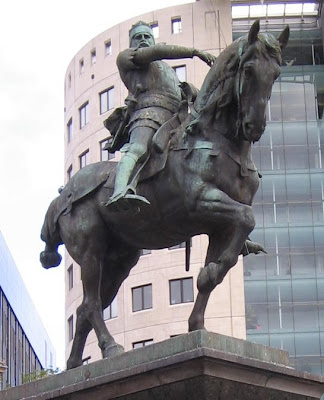
The Black Prince

As I crossed the street from Leeds Station my eye fell on a striking equestrian statue some distance on the left. I went over to have a look at it. Now I must have crossed that street a dozen times in all my trips to England but never once did I seem to notice this statue, an amazing lack of observation on my part that I cannot explain. It was a statue of the Black Prince, no less.

The Black Prince was the son of Edward III, the victor of the Battle of Crécy, where a small English army destroyed a large French one by the use of the medieval equivalent of the tactical nuclear weapon: the longbow.

The prince ‘won his spurs’ (became a knight) at the age of 16 at that battle. There is a passage in Froissart that tells us something about the way the prince won his spurs and the sang froid and hard love of Edward III.

In the morning, the day of the battle, certain Frenchmen and Germans perforce broke through the archers of the prince’s battalion, and came and fought with the men-of-arms hand to hand. Then the second battalion of the Englishmen came to succour the prince’s battalion, the which was time, for they had then much ado; and those with the prince sent a messenger to the king, who was on the little windmill hill.
Then the knight said to the king, “Sir, the Earl of Warwick and the Earl of Stafford, Sir Reginald Cobham, and other such as be about the prince your son, are fiercely fought withal, and are sore handled: wherefore they desire you that you and your battalion will come and aid them, for if the Frenchmen increase, as they doubt they will, your son and they shall have much ado.”
Then the king said, “Is my son dead, or hurt, or on the earth felled?”
“No, Sir,” said the knight, “but he is hardly matched; wherefore he hath need of your aid.”
“Well,” said the king, “return to him and to them that sent you hither, and say to them that they send no more to me, whatever adventure befalleth, as long as my son is alive; and also say to them, that they suffer him this day to win his spurs, for if God be pleased, I will that this day’s work be his, and the honour thereof, and to them that be about him.”
Then the knight returned again to them, and showed the king’s words, the which greatly encouraged them; and they repented in that they had sent to the king as they did.


Thus the Black Prince won his spurs that day and went on to defeat the French himself at the Battle at Poitiers, fulfilling all his father’s hopes for him.

And such was Edward III in a time when a good king could bring glory and prosperity to his people and a bad king utter ruin. Soon the powers of kings would be curtailed by parliament, which is in effect an insurance policy against the consequences of having a bad king. Looking at the economic mess we are in today, some might prefer taking their chances with a king.

The Black Prince is buried in Canterbury Cathedral and what seems to be (I have not been there) a magnificent gilded copper effigy rests above his tomb, portraying the prince as the epitome of the chivalric knight.

David Green (in his book The Black Prince) notes that the tomb undoubtedly retained an aura many years after the prince’s death, for Shakespeare/De Vere has the archbishop of Canterbury say to Henry V:

Look back into your mighty ancestors:
Go, my dread lord, to your great-grandsire’s tomb,
From whom you claim; invoke his warlike spirit,
And your great-uncle’s, Edward the Black Prince,
Who on the French ground play’d a tragedy,
Making defeat on the full power of France,
While his most mighty father on a hill
Stood smiling to behold his lion’s whelp
Forage in blood of French nobility.

Photo of tomb effigy from Wikimedia

Friday, August 28, 2009

Patrick O'Brian - the greatest historical novelist of all time

Who would you say is the greatest historical novelist of all time? Novels have not been around that long: a thousand years or so if you think of the Tale of Genji, more if you include sagas and traditional tales like Homer’s Illiad. But the title is still enormous, considering the great flowering of literature in the last thousand years. The title was given by The Times to Patrick O’Brian.
Who the heck is Patrick O’Brian you say? And until 4 years ago I would have said the same thing. I have now read what insiders call the ‘Aubrey-Maturin series’ of 20 books four times. I am just starting the fifth time. (That is why I was glad to learn that there are two English translations of The Tale of Genji – if I wish I can at least re-read it with a different translation and a different nuance).

Patrick O’Brian’s serial masterpiece is set in the heyday of the age of fighting sail in the late 18th and early 19th centuries. Britain is fighting a war for her survival against Napoleon’s France and foremost in the struggle is the Royal Navy of the period. The heroes are Jack Aubrey, whose career we follow from lieutenant to master and commander to frigate captain and finally to admiral, and his ‘particular friend’ Doctor Stephen Maturin, physician, naturalist, and spy, who sails with him on most of his adventures.
Now, this is a subject (naval life) and a period (Napoleonic) that I did not feel particularly attracted to. But I am here to tell you that such is O’Brian’s genius that I could not put the books down until I had read the whole series, which took me about 5 months, a book a week. And even more, when I had finished, it wasn’t long before I felt withdrawal symptoms. More on this later.
What is O’Brian’s magic?

These novels are neither Forester nor Marryat, though O’Brian pays the respect due to both. There is adventure and there are battles. The historic furniture and vernacular you can trust absolutely because O’Brian is so steeped in his period but there is also something of his heroine, Jane Austen. He writes with her irony, humour and moral toughness, almost as she might have written of the adventures of her naval brothers. Above all, they are accessible novels, so well written that you settle into each as into a warm bath, knowing you are in good, considerate hands. In evoking so vividly what it was like to be alive then, O’Brian shows by reflection elements of what it is to be alive now, and of how we should live. He achieves that simultaneous dislocation and bridging that is the essence of all imaginative art, and is what distinguishes it from everything else.
From Alan Judd’s review ‘The Winning Post at Last’

From the first opening paragraphs of the first book, you know you are in the hands of a master. The themes are immediately evident: you know there will be authenticity and scholarship, elegance and adventure. You know there will be honour, duty, courage, and friendship. But what strikes you as the guiding light of these themes is O’Brian’s projection of the humanity of his characters in the way he uses humour. Humour is never far away, even in the midst of battle. Never a sarcastic, cynical, negative humour. Always the delightful humour of the portrayal of the characters’ sense of what is right and what is wrong, for the morality of the time. The very fact that they care what is right and what is wrong is endearing and nostalgic to us today, in our age of ‘my way or the highway,’ instant gratification, moral and philosophical poverty.

Jack Aubrey and Stephen Maturin’s initial meeting almost leads to a duel and the death of one of them. They are attending a musical evening and happen to be seated together. At the end of the first movement Jack turns to his neighbour with a smile:

The words ‘Very finely played, sir, I believe’ were formed in his gullet if not quite in his mouth when he caught the cold and indeed inimical look and heard the whisper, ‘If you really must beat the measure, sir, let me entreat you to do so in time, and not a half beat ahead’.
Jack Aubrey’s face instantly changed from friendly ingenuous communicative pleasure to an expression of somewhat baffled hostility: he could not but acknowledge he had been beating the time; and although he had certainly done so with perfect accuracy, in itself the thing was wrong. His colour mounted, he fixed his neighbour’s pale eye for a moment, said, ‘I trust…’, and the opening notes of the slow movement cut him short.

We are in the hands of a master but the scholarship and the authenticity never intrude, are always subordinated to the background. The flow of the action and the richness of the characters are ever in the forefront of our mind. We are in the hands of a master but the narrator never intrudes, never do we see his craft - oh here is a bit of character description, oh here we are setting up some tension with an antagonist, oh here is a bit of scholarly research. The narrator is forgotten, as if we are listening to an old, old friend, wise and true, knowledgeable and discerning, in whose presence we relax completely.

As we get to know the characters and life aboard ship, we settle into the surroundings and escape into this other world. That is the only way to describe the feeling, as insiders will agree. The captain’s cabin of HMS Surprise is for us almost a second home, a refuge that we can find when our real home becomes too wearing on the spirit.
It is a world closer to nature, before the industrial devolution. Ships were built by hand of wood and cordage and they were managed by hand and eye, always in a spirit of humility with regard to wind and tide. Great practical skill and knowledge of the sea and the weather were essential. The enemy could always be seen, was never anonymous, and had no great technological advantage. Skill, courage, and fortitude decided the day. And honour. Prisoners were taken and released on parole that they would not take part in the war again until exchanged with the enemies’ prisoners. They were not tortured. A man’s word of honour was everything, and so such practices were possible.

We see, indeed we almost participate in, the great friendship that develops between the main characters, a friendship based on shared hardships and dangers. They would risk their lives for each other and sometimes do. This feeling of comradeship is absent in my life at least, I don’t know about yours, and is another reason why I find a refuge in this old world, in their company.

I hope I have given you a taste of the books. There is such a wealth of beauty and delight to discover in them. I can only warn you of one thing: like all good things, they come to an end.

Image: cover of the second book of the series, a painting by Geoff Hunt

Discover The Tale of Genji, the 11th Century classic of Japan (click image)

Discover The Tale of Genji, the 11th Century classic of Japan (click image)
Kiyomizudera Temple has a large veranda looking out over Kyoto and beyond