
So another year has passed, another decade in fact. 10 years have passed since the world was worrying about the coming Y2K bug, which turned out to be unnecessary like so many worries. In 2010 the world has bigger things to worry about. But let us worry about them tomorrow. Today I wish you a Happy New Year’s Day, spent with family and friends, and time to reflect on what you wish for yourself and for others in 2010. And I wish you above all courage and fortitude, which will see you through whatever the year has in store.
But sudden apparitions of imminent danger many times break our resolutions; and the fancy troubled with the imagination of approaching peril chases away true judgment from her seat. For fear not only astonishes the memory, according to the saying of Thucydides, but it dissipates all manner of consideration, sense of honour, and resolution; while philosophy binds and keeps them together. Plutarch
Noble therefore was the saying of Antisthenes, that we ought to wish an enemy all things beneficial to mankind except fortitude; for so these blessings will belong not to their possessors but to the conqueror. Therefore it was, they say, that Nature provided for the hart, one of the most timorous of creatures, such large and branchy horns, to teach us that strength and weapons nothing avail where conduct and courage are wanting. Plutarch
Showing posts with label Greece. Show all posts
Showing posts with label Greece. Show all posts
Friday, January 1, 2010


Wednesday, November 25, 2009
Courage - according to the Ancients
 Courage is knowing what not to fear. Plato
Courage is to take hard knocks like a man when occasion calls. Plautus
Courage is a kind of salvation. Plato
Courage is its own reward. Plautus
Courage leads starward, fear toward death. Seneca
Courage easily finds its own eloquence. Plautus
Courage is the virtue which champions the cause of right. Cicero
Nothing is as valuable to a man as courage. Terence
A man full of courage is also full of faith. Cicero
Fear is only as deep as the mind allows. Japanese proverb
Let us be brave in the face of adversity. Seneca
A smooth sea never made a skilled mariner. English proverb
A decent boldness ever meets with friends. Homer
The first rule is to keep an untroubled spirit. The second is to look things in the face and know them for what they are. Marcus Aurelius
It is courage, courage, courage, that raises the blood of life to crimson splendour. Live bravely and present a brave front to adversity! Horace
Dare to begin! He who postpones living rightly is like the rustic who waits for the river to run out before he crosses. Horace
It is not death that a man should fear, but he should fear never beginning to live. Marcus Aurelius
There is nothing in the world so much admired as a man who knows how to bear unhappiness with courage. Seneca
Where fear is, happiness is not. Seneca
It is better by noble boldness to run the risk of being subject to half of the evils we anticipate than to remain in cowardly listlessness for fear of what might happen. Herodotus
Sometimes even to live is an act of courage. Seneca
Fortune helps the brave. Virgil
Fortune reveres the brave, and overwhelms the cowardly. Seneca
Fortune and love favour the brave. Ovid
Fortune favours the audacious. Erasmus
Audacity augments courage; hesitation, fear. Publilius Syrus
Fall seven times; stand up eight. Japanese Proverb
A coward turns away, but a brave man's choice is danger. Euripedes
It is easy to be brave from a safe distance. Aesop
To know what is right and not do it is the worst cowardice. Confucius
The superior man makes the difficulty to be overcome his first interest; success comes only later. Confucius
This is courage ... to bear unflinchingly what heaven sends. Euripedes
Nothing befalls a man except what is in his nature to endure. Marcus Aurelius
God gave burdens, also shoulders. Jewish proverb
The burden is equal to the horse's strength. Talmud
Have patience with all things, but chiefly have patience with yourself. Do not lose courage in considering your own imperfections, but instantly set about remedying them - every day begin the task anew. Saint Francis De Sales
The beauty of the soul shines out when a man bears with composure one heavy mischance after another, not because he does not feel them, but because he is a man of high and heroic temper. Aristotle
Photo from Wikimedia
Sunday, November 22, 2009
Courage - Pericles' funeral speech
 I am reading Donald Kagan’s book The Peloponnesian War which tells the story of the long death struggle between Sparta and Athens and their respective allies in the fifth century BC. It is a gripping read as is Livy’s tale of the similar struggle to come between Rome and Carthage (see Roman fortitude). The participants are evenly matched: Sparta is the greatest military power on land, but Athens is the greatest military power on the sea. (In this the war resembles the struggle between Napoleonic France and maritime Britain).
Athens is fortunate in having a great leader in the form of Pericles, ‘son of Xanthippus (a victorious general in the Persian war), the leading man in Athens at that time, and the ablest in speech and in action.’ From Thucydides, a historian and participant in the war, we learn that Pericles’ teacher, Anaxagoras, had instilled in him
…a lofty spirit and an elevated mode of speech, free from the vulgar and knavish tricks of mob-orators, but also a composed countenance that never gave way to laughter, a dignity of carriage and restraint in the arrangement of his clothing which no emotion was allowed to disturb while he was speaking, a voice that was evenly controlled, and all the other characteristics of this sort which so impressed his hearers.
Pericles persuades the Athenians that if they avoid a decisive land battle but wait patiently behind their city walls, relying on supply from the sea which they control, Sparta will realise that they are powerless and will sue for peace. It is a wise strategy but it goes against the grain of the time, especially with the impetuous young. When a Spartan army lays waste the bountiful Athenian countryside while the Athenians watch from the walls, Pericles has to (bravely) bear their accusations of timidity and cowardice. Only he can hold the Athenians in check from certain disaster.
And yet there were times when they were sorely vexed with him, and then he tightened the reins and forced them into the way of their advantage with a master's hand, for all the world like a wise physician, who treats a complicated disease of long standing occasionally with harmless indulgences to please his patient, and occasionally, too, with caustics and bitter drugs which work salvation. For whereas all sorts of distempers, as was to be expected, were rife in a rabble which possessed such a vast empire, he alone was so endowed by nature that he could manage each one of these cases suitably, and more than anything else he used the people's hopes and fears, like rudders, so to speak, giving timely check to their arrogance, and allaying and comforting their despair. Plutarch
Pericles holds back the Athenians from doing what the Spartans want them to do: come out and fight a decisive battle on their terms - on land - where they are the stronger. In this wise but ungrateful and unpopular task he reminds us of Fabius Maximus who, after Rome’s crushing defeat at Cannae, refuses all battle with the seemingly invincible Hannibal. He only shadows him with his army, a constant threat to be guarded against, letting the advantage of time in favour of the Romans do its work. (This resemblance was clear to Plutarch also: I found that he pairs Pericles and Fabius Maximus together in his Parallel Lives, see here).
Pericles bides his time and events prove him right. When funeral rights are held for those who have perished in the first year of war, the Athenians call upon him to give the eulogy as their foremost leader. His speech is not only a eulogy to the fallen Athenian brave but to all brave men. It is a tribute to courage, which puts something higher, something more important, above personal interest and personal safety: freedom and the common good.
You must every day look upon the power of your city and become her lovers, and when you have understood her greatness consider that the men who achieved it were brave and honourable and knew what was necessary when the time came for action. If they ever failed in some attempt, they were determined that, at least, their city should not be deprived of their courage and gave her the most beautiful of all offerings. For they gave their lives for the common good and thereby won for themselves the praise that never grows old and the most distinguished of all graves, not those in which they lie, but where their glory remains in eternal memory, always there at the right time to inspire speech and action. For the whole world is the burial place for brave men; not only does the epitaph inscribed on monuments in their native country commemorate them, but in lands not their own the unwritten memory; more of their spirit even than of what they have done, lives on within each person. Now it is for you to emulate them; knowing that happiness requires freedom and freedom requires courage, do not shrink from the dangers of war.
*****
Courage is what preserves our liberty, safety, life, and our homes and parents, our country and children. Courage comprises all things. Plautus
So, as you go into battle, remember your ancestors and remember your descendants. Tacitus
Happy the man who ventures boldly to defend what he holds dear. Ovid
So when the crisis is upon you, remember that God, like a trainer of wrestlers, has matched you with a tough and stalwart antagonist... that you may prove a victor at the Great Games. Epictetus
Things never go so well that one should have no fear, and never so ill that one should have no hope. Turkish proverb
To persevere, trusting in what hopes he has, is courage. The coward despairs. Euripedes
It is the bold man who every time does best, at home or abroad. Homer
In times of stress, be bold and valiant. Horace
In difficult situations, when hope seems feeble, the boldest plans are safest. Livy
He shall fare well who confronts circumstances aright. Plutarch
Image: Discurso funebre Pericles by Von Folz, from Wikipedia
Thursday, November 19, 2009
Courage - what Leonidas said
 Leonidas, the son of Anaxandridas and brother to Cleomenes, when one said to him, Abating that you are king, you are no better than we, replied, But unless I had been better than you, I had not been king.
His wife Gorgo, when he went forth to Thermopylae to fight the Persian, asked him what command he left with her; and he replied, Marry brave men, and bear them brave children.
The Ephors saying, You lead but few to Thermopylae; They are many, said he, considering on what design we go.
And when they again asked him whether he had any other enterprise in his thought, he replied, I pretend to go to hinder the barbarians’ passage, but really to die fighting for the Greeks.
When he was at Thermopylae, he said to his soldiers: They report the enemy is at hand, and we lose time; for we must either beat the barbarian or die ourselves.
And to another saying, What, the flights of the Persian arrows will darken the very sun, he said, Therefore it will be pleasant for us to fight in the shade.
And another saying, What, Leonidas, do you come to fight so great a number with so few? — he returned: If you esteem number, all Greece is not able to match a small part of that army; if courage, this number is sufficient.
And to another discoursing after the same manner he said, I have enough, since they are to be killed.
When Xerxes wrote to him thus, Sir, you may forbear to fight against the Gods, but may follow my interest and be lord of all Greece, he answered: If you understood wherein consisted the happiness of life, you would not covet other men’s; but know that I would rather die for the liberty of Greece than be a monarch over my countrymen.
And Xerxes writing to him again thus, Send me thy arms, he returned, Come and take them.
When he resolved to fall upon the enemy, and his captains of the war told him he must stay till the forces of the allies had joined him, he said: Do you think all those that intend to fight are not here already? Or do you not understand that those only fight who fear and reverence their kings?
And he ordered his soldiers so to dine, as if they were to sup in another world.
And being asked why the bravest men prefer an honourable death before an inglorious life, he replied, Because they believe one is the gift of Nature, while the other is peculiarly their own.
Being desirous to save the striplings that were with him, and knowing very well that if he dealt openly with them none would accept his kindness, he gave each of them privately letters to carry to the Ephors. He desired likewise to save three of those that were grown men; but they having some notice of his design refused the letters. And one of them said, I came, sir, to be a soldier, and not a courier; and the second, I shall be a better man if here than if away; and the third, I will not be behind these, but the first in the fight.
From Plutarch’s Laconic Apophthegms; or remarkable sayings of the Spartans
Image derived from a photo from Wikimedia
Tuesday, November 17, 2009
Courage - Leonidas and the 300 Spartans
 The story of the Battle of Thermopylae (literally ‘the hot gates’) is a classic tale of courage. It has recently been dramatized and brought to the wider attention of a modern audience in Zack Snyder’s film ‘300’ based on the graphic novel by Frank Miller. While it is obvious that the film (and the novel) is highly stylized, any film that strives to bring to life the great and virtuous deeds of the past will always get my thumbs up. The film lacks a ‘Saving Private Ryan’ type of realism – largely in its portrayal of the Persians as inhuman monsters - but the essential message rings true. (Compare this to Oliver Stone’s film Alexander where the subject and essential message are hopelessly misunderstood and misrepresented.)
Wikipedia has a good overview of the Battle of Thermopylae here.
It is 480 BC and the Persians under Xerxes I are marching with a huge army to invade Greece. Xerxes is eager to avenge the failure of his father Darius I’s invasion which was thwarted by the Greeks at the Battle of Marathon in 490 BC.
 Unfortunately for the Spartans, the invasion comes during the sacred festival of Carneia as well as during the Olympic Games and so it would be doubly sacrilegious for them to go to war at this time. Therefore it is decided to send an advance force to hold the ‘hot gates’ until the main Spartan army can march and join them later. King Leonidas takes his personal royal bodyguard of 300 men and about 1,000 support troops and helots. They will later be joined by other small contingents of Greeks.
 Leonidas and his men are under no illusions; they know they are going to their deaths. Even though the hot gates will afford them a narrow and advantageous defensive position, even though the Spartans are the Delta Force, the Royal Marines of the ancient world, the Persian army numbers in the hundreds of thousands. And the Oracle of Delphi has prophesied:
O ye men who dwell in the streets of broad Lacedaemon!
Either your glorious town shall be sacked by the children of Perseus,
Or, in exchange, must all through the whole Laconian country
Mourn for the loss of a king, descendant of great Heracles.
Thus we know that Leonidas is under no illusions and also by the fact that he gives orders that only those Spartans may come who have living sons. He asks for volunteers to replace those who do not. We also have the following from Plutarch:
And another saying, What, Leonidas, do you come to fight so great a number with so few? — he returned: If you esteem number, all Greece is not able to match a small part of that army; if courage, this number is sufficient.
And to another discoursing after the same manner he said, I have enough, since they are to be killed.
And when they again asked him whether he had any other enterprise in his thought, he replied, I pretend to go to hinder the barbarians’ passage, but really to die fighting for the Greeks.
The Spartans always esteemed courage and not numbers as this famous quote by King Agis II tells:
The Spartans do not ask how many but where they are.
The Spartans take up the defence of the hot gates by forming a shield wall or phalanx. At this time the Greek hoplites fought with a long spear so that only the first two ranks could fight the enemy. Later Philip of Macedon would introduce the 16 foot sarissa, a long pike, allowing the first five rows of the phalanx to fight. (When occasion demanded, they also fought with a short sword).
 Over three days the Spartans ‘cut to ribbons’ all the Persian troops sent against them, including Xerxes elite troops, the notorious ‘Immortals’. Their name stemmed from the fact that they wore masks to conceal their individual identity and their numbers were always maintained at exactly 10,000 so that it seemed that none ever died.
 The Spartans are undone finally when the Persians learn from a Greek traitor that there exists a mountain path which will allow them to outflank and attack the Spartans from the rear. On learning that the path has not been held by the Phocian allies he had stationed there, Leonidas orders his Greek allies to retreat and prepares to form a rearguard with only his 300 Spartans, 700 Thespians and 400 Thebans. This will allow his other 3,000 Greek allies to escape.
Leonidas’ rearguard leave their defensive position and attack Xerxes’ advancing army so as to sell their lives dearly and kill as many Persians as they can.
 Two of Xerxes’ brothers are killed at this time as is Leonidas himself, thus fulfilling the Delphic prophecy. As the Immortals arrive in their rear the Spartans retreat to a hill where they are showered with arrows until all are killed.
The Battle of Thermopylae was a defeat for the Spartans. It did not significantly slow down the advance of Xerxes’ army, nor did it inflict significant losses on the Persians (although they lost some 20,000 men). But had the Persians not discovered the mountain pass, had the Spartans held the hot gates some days longer, Xerxes huge army would have run out of provisions and been forced to retreat. The defence of Thermopylae could have become a successful military operation instead of a courageous act of self-sacrifice.
The Battle of Thermopylae may have been a defeat, but as Michel de Montaigne said, ‘There are some defeats more triumphant than victories’. Thermopylae was a victory of the spirit, which takes no account of fear, no account of danger, no account of possible outcomes but which takes account only of the most important things: of honour, of duty and of freedom. As an example of courage, it may be equalled but it can never be surpassed.
 Go tell the Spartans, stranger passing by, that here obedient to their laws we lie. Simonides of Ceos
Images from the movie '300' and Wikimedia
Sunday, November 15, 2009
Courage - Alexander the Great
 I recently came across the site of The Online Library of Liberty which has among others the text of Plutarch’s The Morals. Here I found Plutarch’s commentary about the life of Alexander the Great. In it he shows how Alexander exemplified virtue in his life and won his successes by sweat and blood and without the help of Fortune, or rather in spite of ill Fortune.
I studied Alexander’s life story some years ago. I could happily write a blog about Alexander alone. There are many striking examples of personal courage in Alexander’s life but one in particular made a deep impression on me. Hollywood could find no more dramatic moment of courage in history than this one but has so far chosen to ignore it.
So I was very gratified to read Plutarch’s eloquent account of the incident. I think you will find it gratifying also, for it is something god-like, hardly to be believed and reveals the essence of Alexander’s life and how he inspired awe and admiration in all, friend and foe alike.
First we must set the stage. Alexander is the most charismatic general in history and his men love him. It is said he can greet 3,000 of them by their name. Alexander and his small army have conquered all of Persia. They are now advancing laboriously through India, conquering small tribes and cities as they go, as Alexander’s ambition drives him to seek a way to the Ocean. They are not a happy band of brothers at this time. In fact the army is close to mutiny. As Peter Green puts it, ‘They were sick of glory and honour. They had endured more in 8 years than most men are called upon to face in a lifetime. Now all they wanted was a quick, safe journey home.’ When Alexander calls upon them to storm the walls of yet another Oxydracian tribal stronghold, they refuse. Alexander is furious and climbs up a ladder himself to shame them, cutting down the defenders on the wall. There he stands, the enemies’ arrows whistling about his ears. His men shout up at him to come back down. He looks at them for a moment and then jumps down… into the stronghold.
Brasidas advanced his fame all over Greece, by breaking through the enemy’s army lying encamped by the seaside near Methone; but when you read of that daring jump of Alexander’s (so astonishing to the hearers, much more to them that beheld it) when he threw himself from the walls of the Oxydracian metropolis among the thickest of the enemy, assailing him on every side with spears, darts, and swords, tell me where you meet with such an example of matchless prowess, or to what you can compare it but to a gleam of lightning violently flashing from a cloud, and impetuously driven by the wind? Such was the appearance of Alexander, as he leaped like an apparition to the earth, glittering in his flaming armour. The enemy, at first amazed and struck with horror, retreated and fell back; till seeing him single they came on again with redoubled force.
Now was not this a great and splendid testimony of Fortune’s kindness, to throw him into an inconsiderable and barbarous town, and there to enclose and immure him a prey to worthless enemies? And when his friends made haste to his assistance, to break the scaling-ladders, and to overthrow and cast them down? Of three that got upon the walls and flung themselves down in his defence, endearing Fortune presently despatched one; the other, pierced and struck with a shower of darts, could only be said to live. Without, the Macedonians foamed and filled the air with helpless cries, having no engines at hand. All they could do was to dig down the walls with their swords, tear out the stones with their nails, and almost to rend them out with their teeth. All this while, Alexander, Fortune’s favourite, whom she always covered with her protection, like a wild beast entangled in a snare, stood deserted and destitute of all assistance, not labouring for Susa, Babylon, Bactria, or to vanquish the mighty Porus. For to miscarry in great and glorious attempts is no reproach; but so malicious was Fortune, so kind to the barbarians, such a hater of Alexander, that she aimed not only at his life and body, but at bereaving him of his honour and sullying his renown. For Alexander’s fall had never been so much lamented had he perished near Euphrates or Hydaspes by the hand of Darius, or by the horses, swords, and axes of the Persians fighting with all their might and main in defence of their king, or had he tumbled from the walls of Babylon, and all his hopes together. Thus Pelopidas and Epaminondas fell; whose death was to be ascribed to their virtue, not to such a poor misfortune as this.
But what was the singular act of Fortune’s favour which we are now enquiring into? What indeed, but in the farthest nook of a barbarous country, on the farther side of a river, within the walls of a miserable village, to pen up and hide the lord and king of the world, that he might there perish shamefully at the hands of barbarians, who should knock him down and pelt him with whatever came next to hand? There the first blow he received with a battle-axe cleft his helmet and entered his skull; at the same time another shot him with an Indian arrow in the breast near one of his paps, the head being four fingers broad and five in length, which, together with the weight of the shaft which projected from the wound, did not a little torment him. But, what was worst of all, while he was thus defending himself from his enemies before him, when he had laid a bold attempter that approached his person sprawling upon the earth with his sword, a fellow from a mill close by came behind him, and with a great iron pestle gave him such a bang upon the neck as deprived him for the present both of his senses and his sight. However, his virtue did not yet forsake him, but supplied him still with courage, infusing strength withal and speed into those about him. For Ptolemy, Limnaeus, and Leonnatus, and some others who had mounted or broken through the wall, made to his succour, and stood about him like so many bulwarks of his virtue; out of mere affection and kindness to their sovereign exposing their bodies, their faces, and their lives in his defence. For it is not Fortune that overrules men to run the hazard of death for brave princes; but the love of virtue allures them - as natural affection charms and entice bees – to surround and guard their chief commander.
From The Second Oration of Plutarch concerning the Fortune or Virtue of Alexander the Great, Plutarch, The Morals, Vol. 1
We have seen that courage is not recklessness; courage is not courage unless guided by prudence. Alexander’s jump was not recklessness but a calculated risk of his life in the cause of a greater goal. He knew his men would follow him. What he miscalculated was the lack of means. His men, on seeing him disappear beyond the wall, surged up the few ladders available like men possessed and overburdened them so that they broke. Others threw themselves like demons against the gates with axes and it was finally the breaking open of the gates which saved Alexander. In a blind rage of revenge and grief his men killed everyone in the stronghold. Alexander survived his wounds, but only just.
If you want to know more about the incredible life of Alexander, I highly recommend Peter Green’s book Alexander of Macedon.
With audacity one can undertake anything. Napoleon
He who fears being conquered is sure of defeat. Napoleon
The battle is not to the strong alone; it is to the vigilant, the active, the brave. Patrick Henry
No great thing comes to any man unless he has courage. Cardinal James Gibbons
Courage is almost a contradiction in terms. It means a strong desire to live taking the form of readiness to die. G.K. Chesterton
One man with courage makes a majority. Andrew Jackson
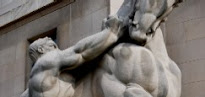
Image: Statue of Alexander and Bucephalus at Thessaloniki, Greece by Rippedangelwings
Friday, August 1, 2008
Anger (1) - The Rod of Hermes
 When I make a big mistake or suffer an important setback, I often try to soften the blow by making a pact with myself. I decide that because this setback has happened I will do some other positive action that I would not otherwise have done. In this way I try to turn a negative into a positive.
The Buddhists believe that we should never be angry at others who do us harm because firstly, they will reap the negative karma of their actions in due course, and secondly they give us the opportunity to practice compassion and patience. If there are no obstacles in the world how can we practice? So from a negative, a positive is produced.
I found this concept echoed in a passage from ‘The Golden Sayings of Epictetus’ translated by George Long. I should not be surprised that this concept had a name thousands of years ago: Epictetus calls it the rod of Hermes.
Can any profit be derived from these men?
Aye, from all.
What, even from a reviler?
Why, tell me what profit a wrestler gains from him who exercises him beforehand? The very greatest: he trains me in the practice of endurance, of controlling my temper, of gentle ways. You deny it. What, the man who lays hold of my neck, and disciplines loins and shoulders, does me good, … while he that trains me to keep my temper does me none? This is what it means, not knowing how to gain advantage from men! Is my neighbour bad? Bad to himself, but good to me: he brings my good temper, my gentleness into play. Is my father bad? Bad to himself, but good to me. This is the rod of Hermes; touch what you will with it, they say, and it becomes gold. Nay, but bring what you will and I will transmute it into Good. Bring sickness, bring death, bring poverty and reproach, bring trial for life – all these things through the rod of Hermes shall be turned to profit.
Subscribe to:
Posts (Atom)
Discover The Tale of Genji, the 11th Century classic of Japan (click image)

Kiyomizudera Temple has a large veranda looking out over Kyoto and beyond