Showing posts with label Books. Show all posts

Tuesday, January 11, 2011

Things which will make me go back to Japan

The introduction to Werner Bischof’s ‘Japan’, which was the subject of my last post, is written by Robert Guillain who is described as the Far East correspondent of Le Monde. It is a fitting, poetic introduction to Bischof’s extraordinary photos. I particularly liked a section where he describes ‘Things which will make me go back to Japan’. Reading them, I realised that I do not have a list of ‘Things which will make me go back to England’. Having a Lithuanian father and English mother has smudged that feeling of belonging to one place. I feel more empathy reading Guillain’s list as any I might make for another place…  Here are a few things from his list that resonate with me:

I will go back – to put it at its lowest – to see Japan without the Japanese, that is for the sake of the country’s very individual local colour; for the astonishment of seeing the originals of those images of nature that the deft brushes of the Nipponese artists have painted on silk; for the pine-tree with its twisted branches, the flight of the wild geese over Tokyo bay, and the thatched villages in the misty valley at the foot of Fujiyama; for the blending of mountain and sea, and to watch the smoking volcanoes; for an island off Tokyo, which is a basket of red camellias floating on the edge of the Pacific…
I will go back to enjoy the strange Japanese way of life. The nudity of its comfort, its simplification of existence and its search for contentment in frugality and closeness to nature…
I will go back for the sake of the children, who are like live dolls; for the girls with their laughter, their Mongol eyelids, their brilliant black hair, their bare feet in wooden sandals and the pure metal of their hearts ensheathed in softness; for Japanese women, who seem to belong to a race different from that of the men, and are the country’s finest achievement…
I will go back to assure myself that the West can learn certain lessons from the East; I will go back, so that Japan may teach me the refinements of the artistic sense and the gift of communing intensely with the mystery of nature; to reacquire from the Japanese that respect for the past, and the people of the past, that we Westerners have lost; to confirm that no-one knows what politeness is until he has experienced Japanese politeness.

Image by Mattias

Tuesday, January 4, 2011

Werner Bischof’s 'Japan'

I came across this photograph (click, gets big) quite haphazardly looking through the posters in a now defunct frame shop around 1998. I bought the poster and framed it and it has decorated my home ever since and will always have a place there as long as I live.
It was taken by Werner Bischof in 1952. To me it is a very powerful statement of the beauty of the visible in Japanese architecture and of the invisible in the Japanese soul. Is there a better example of architecture in perfect harmony with nature? And the photographer has perhaps instinctively so framed the photograph to enhance this harmony. See how the lines of the upper roof are a mirror image of the lines of the branch that reaches out to it. I never tire of contemplating this image and the period that it evokes so eloquently and wondering why I feel such affinity.
I had never heard of Werner Bischof so I searched on the web and found the book the photo came from (‘Japan’ Werner Bischof, Simon and Schuster, 1954) and I ordered it from a rare book dealer. When it arrived I was taken aback to read this beginning to the author’s profile:

This is a book the author will never see.
Werner Bischof finished his work on it in New York in February, 1954, sent the layout and captions off to Zurich, and departed by jeep for what was to have been a year’s photographic trip to Latin America. His trip ended abruptly on May 16th, high in the Peruvian Andes, when a car carrying him and two companions went over a 1500 foot cliff.

I was filled with sadness when I read this. How grateful we should be for each day we live, for how abruptly it may end. To the nostalgia evident in this photo was added the knowledge of the observer’s sudden end. What a loss we feel, when we open the book, for this photo is but the portal to an inestimable treasure of images of Japan by this great photographer.

Werner Bischof, one of the half-dozen most brilliant photographers of his generation, spent almost two years photographing every corner of Japan, every aspect of Japanese life. Out of the many thousands of pictures he took, the 109 most beautiful examples of his work have been assembled in this book.

You will search in vain on the web for these images, which is quite astonishing given their quality. The image above is to my knowledge the only one on the web and I hope I don’t get into trouble for it. But it is the shame of the world that his work is not better known and if this post and this photo introduce you to him then it will be a very great good and I hope I will be forgiven.

Tuesday, May 18, 2010

The Universal Dinner Lady revisited


In my Ship’s log for May 2010 I said that with the coming of Spring there were suddenly far too many demands on my time and energy. I made the analogy that the The Universal Dinner Lady insisted on dancing even if I didn’t feel like it. I explained about the forces of yin and yang rising and falling in their natural rhythm. My girlfriend, who is very intelligent (she will read this), seemed to misunderstand the analogy and asked me if she was being too demanding. And she is Chinese, so if she didn’t understand, maybe others didn’t.
The Universal Dinner Lady is another way of saying the Tao. In Stephen Russel’s analogy, instead of being dowdy grumpy and mean as in our school days, she is portrayed as being sexy, generous, and playful. The Tao is the source of everything in this world. We can ask for anything and she will give. But instead of demanding our dinner ticket, she demands to dance. To get what we want we have to ‘follow the Tao’. We have to put ourselves into the position to receive what it is we want. And the forces of yin and yang are a good way to understand how that can happen. I tried to explain it but I will let Stephen Russel do it better. I was actually thinking of his explanation anyway. Here it is, from his best (in my opinion) book, Barefoot Doctor’s Guide to the Tao:

The Tao gives and the Tao takes away. When it gives, you’re full; when it takes away, you’re empty again, ready to be filled with something new. Knowing this won’t change your life. The cycle of alternation between yin and yang is inexhaustible. But it may soften the blow of the ebb and flow.

Yin is empty, yang is full. Yin is soft, yang is hard, Yin comes down, yang goes up. Yin comes in, yang goes out. Yin gets cold, yang heats up. Yin gets damp, yang dries up. Yin is quiet, yang is loud. Yin retreats, yang advances. (…)

Yin and yang, like night and day, turn into their opposite number on reaching maximum potential. Thus, as the night reaches its darkest moment, the sun is already sending its first tentative rays over the horizon, and those damn birds start their tweeting… As the day reaches its brightest point, the night is already lurking, ready to cover the sky once again. When the passing police siren reaches its loudest moment, the silence is already following in its wake.
It’s the same with the energy in your body. If you go to the extremes of physical activity (yang), you exhaust yourself, and you have to rest (yin). If you stop for long enough, you grow restless and go back out again for more (yang). Obviously, if either yin or yang goes beyond that point, thereby losing its connection with the other, you die. Unchecked yin makes you congeal. Unchecked yang makes you evaporate.
Possibly the most pertinent use of this classification is in distinguishing full (yang) from empty (yin) in your relationship with the world. When your energy to go out into the world is strong, i.e. yang, and the world appears to receive you, you are considered to be full and the world empty; that is, you go and fill the world. When the world is knocking on your door and screaming at you from all directions, the world is then full and you’d better be empty!

That’s what I meant. Stephen Russel’s book is full of eye-opening insights like that which have stuck with me these last 10 years or so. I am sure I have integrated many and they have helped me probably in more ways than I realize. If this insight speaks to you, you should check him out, he is a delight to read.

Images: Aki Hoshino doing a good impersonation of the Universal Dinner Lady in full and empty mode.


Wednesday, March 31, 2010

Henryk Sienkiewicz - the original master of the medieval epic

When I decided to look into Henryk Sienkiewicz’s novels, I first tried to find him at Chapters Bookstore. He was not to be found, not even his Quo Vadis. You will find any number of new authors’ books about the same period and even the same subject but none by the original master of the genre. I suppose I cannot try to wax too indignant because I only just discovered him myself.
I remember buying one or two of those new authors in the past and how disappointing they were, even before I had Sienkiewicz to compare them with. I remember one awful novel where the author expected us to admire and identify with the knightly hero by telling us he had won a fine horse by staying up all night playing dice. I stopped reading at that point.
In Sienkiewicz, as in O’Brian, or Tolkien, there is no striving, no striving at all. The author’s style is unobtrusive. His techniques are seamless. We forget about the narrator completely. We live in the emotions of the protagonists. We escape to another world. That’s ‘all’ there is to it. How easily it seems to be done! But how hard is to do well!
In my last post we had a look at an example of Sienkiewicz’s poetic style in Knights of the Cross. Now I will share with you an example of his action. I have condensed it down a little. God forgive me, because you should not edit such a masterpiece.
The scene:  Zbyszko, our hero, has taken up the Teutonic knight Rotgier’s general challenge to a duel to prove before God the Teutonic Order’s innocence in the affair of the abduction of Zbyszko’s young wife. Zbyszko believes the knight is lying and that the Order is in fact responsible for the abduction.


The fight was to take place in the castle yard, which was surrounded by a porch. When it was broad daylight, the prince and princess arrived together with their children and took their seats in the centre between the pillars, from where the whole yard could best be overlooked. Next to them were the principal courtiers, noble ladies, and the knighthood. All the corners of the vestibule were filled: the domestics gathered behind the wall which was made from the swept snow, some clung to the posts, and even to the roof. There the vulgar muttered among themselves: "God grant that our champion may not be subdued!"
(…)
They entered from opposite sides of the arena and halted at the barriers. Every one of the onlookers then held his breath, every one thought, that very soon two souls would escape to the threshold of the Divine Court and two dead bodies remain on the snow, and the lips, as well as the cheeks of the women turned pale and livid at that thought; the eyes of the men again gazed steadfastly at the opponents as at a rainbow, because every one was trying to forecast, from their postures and armament alone, which side would be victorious.
(…)
It was in some measure favorable for Zbyszko that he had chosen a combat with axes, because fencing with that kind of weapon was impossible. With long and short swords, with which it was necessary to know the strokes, thrusts, and how to ward off blows, the German would have had a considerable superiority. But even so, Zbyszko, as well as the spectators, recognized from his motions and management of the shield, that they had before them an experienced and formidable man, who apparently was not entering a combat of this kind for the first time. To each of Zbyszko's blows Rotgier offered his shield, slightly withdrawing it at the concussion, by which means even the most powerful swing lost its force, and could neither cleave nor crush the smooth surface. He at times retreated and at times became aggressive, doing it quietly, though so quickly that the eyes could hardly follow his motions.
(…)
Rotgier, who had fought in many wars and battles, either in troop or singly, knew by experience that there are some people, like birds of prey, who are born to fight, being specially gifted by Nature, who bestows all things, with what others only attain after years of training, and he at the same time observed that he was now dealing with one of those. He understood from the very first strokes that there was in this youth something as in a hawk, who sees in his opponent only his prey, and thinks of nothing but getting him in his claws. Notwithstanding his own strength, he also noticed that it was not equal to Zbyszko's, and should he get exhausted before succeeding in giving a final stroke, the combat with this formidable, although less experienced, stripling, might result in his ruin. Thus reflecting, he determined to fight with the least possible effort, drew the shield closer to him, did not move much either forward or backward, restricted his motions, and gathered all the power of his soul and arm for one decisive stroke, and awaited his opportunity.
(…)
The terrible fight lasted longer than usual. A deathlike silence reigned in the porches. The only sounds heard were the sometimes ringing and sometimes hollow blows of the sharp points and edges of the axes against the shields. Such sights were not strange to the princes, knights and courtiers; and nevertheless a feeling, resembling terror, seemed to clutch all hearts as if with tongs. It was understood that this was not a mere exhibition of strength, skill and courage, but that in this fight there was a greater fury and despair, a greater and more inexorable stubbornness, a deeper vengeance. On one side terrible wrongs, love and fathomless sorrow; on the other, the honor of the entire Order and deep hatred, met on this field of battle for the Judgment of God.


Photo of Krakow Castle courtyard by Galen Frysinger

Saturday, March 27, 2010

Henryk Sienkiewicz - the second greatest historical novelist of all time?


If you are a regular to the blog, you know that I am a Patrick O’Brian ‘orphan’ - see Patrick O’Brian – the greatest historical novelist of all time. I am a recovering chain-reader of his novels. I think of his main protagonists – Jack Aubry and Stephen Maturin – less as fictional characters and more as people I know. Yes, I know, I need to get out more...

Whilst searching the web for other great historical novelists who might take my mind off O’Brian, I came across some promising recommendations regarding Henryk Sienkiewicz. Sienkiewicz is a Polish writer who is probably best known for his novel Quo Vadis and who received the Nobel Prize for Literature in 1905. (You can read a good Wikipedia overview of him here). When I discovered he had written several books set in the period of the Teutonic Knights’ crusades against pagan Lithuania, a subject that interests me, I decided to look into him. I was not disappointed.

I found an online version of his Knights of the Cross here. As with Patrick O’Brian, one only needs to read a few pages to know one is in the hands of a master. The feeling of historical authenticity, the effortless way our interest is aroused and maintained, the living, breathing characters faithful to their individual agendas, all of this reminded me of O’Brian, with a touch of Conan-Doyle. Let us not forget this is not a modern-day author. And all of this comes through in spite of being ‘once removed’ by a translation from the original Polish. In fact, in spite of the translation, there is a poetry in Sienkiewicz that I believe surpasses even O’Brian. (I will probably get some hate mail for saying that).
I will let you judge for yourself with the following passage, which I found particularly beautiful. Let us briefly set the stage: Zbyszko, our young knightly hero, is attending a church service at the court of the King Jagiello of Lithuania-Poland where he claps eyes on Queen Jadwiga for the first time.

Jadwiga entered through the vestry door also. Seeing her enter, the knights standing near the stalls, immediately kneeled, although mass had not begun, voluntarily paying her homage as to a saint. Zbyszko did the same; nobody in this assembly doubted that he really saw a saint, whose image would some time adorn the church altars. Besides the respect due to a queen, they almost worshipped her on account of her religious and holy life. It was reported that the queen could perform miracles. They said that she could cure the sick by touching them with her hand; that people who could not move their legs nor their arms, were able to do it, after they put on a dress which the queen had worn. Trustworthy witnesses affirmed that they had heard with their own ears, Christ speak to her from the altar. Foreign monarchs worshipped her on their knees and even the Order of the Knights of the Cross respected her and feared to offend her. Pope Bonifacius IX called her the pious and chosen daughter of the church. The world looked at her deeds and remembered that this child of the Andegavian house and Polish Piasts, this daughter of the powerful Louis, a pupil of the most fastidious of courts, and also one of the most beautiful women on earth, renounced happiness, renounced her first love and being a queen married a "wild" prince of Lithuania, in order to bring to the cross, by his help, the last pagan nation in Europe. That which could not be accomplished by the forces of all the Germans, by a sea of poured out blood, was done with one word from her. Never did the glory of an apostle shine over a younger and more charming forehead; never was the apostleship united with equal self-denial; never was the beauty of a woman lighted with such angelic kindness and such quiet sadness. (…)
Therefore there came to her people to beseech her, that she ask health for them; there came envoys from the provinces and from other countries, to ask that she pray according to their need, either for rain, or for fair weather for harvesting; for lucky moving time; for abundant fishing in the lakes or for game in the forests. Those knights, living in castles and ‘grodeks’ on the frontier, who according to the custom learned from the Germans, had become robbers or waged war among themselves, at the command of the queen, put their swords in their scabbards, released their prisoners without ransom, restored stolen herds and clasped hands in friendship. All kinds of misery, all kinds of poverty crowded the gates of her castle in Krakow. Her pure spirit penetrated human hearts, softened the hard lot of the serfs, the great pride of the lords, the unjust severity of the judges, and hovered like a dove of happiness, like an angel of justice and peace, over the whole country.

Friday, February 12, 2010

Mending the World

Let’s take a break from the dark clouds and the doom and gloom. ‘Why are you writing about that stuff here anyway?’ you ask. ‘This is supposed to be a blog about philosophy and healing for goodness sake, I come here to get away from all that crazy stuff.’ Yep, you may have a point. But I talk about that crazy stuff because it is a consequence of bad philosophy. Just like for an individual, when a country and an economy are governed by short-term selfish immoral goals, bad consequences arise and suffering ensues. Eventually.
We have talked about this before: the swamp plant may grow fast and do well for a time, but it will not last. Only growth based on the firm soil of integrity is lasting and beneficial to all. What has happened in recent years is unacceptable to reasoning people and I feel winds of change are blowing and I feel a desire to give those winds of change a little help. So bear with me if I rant about bad philosophy in the world. I am reminded of this quote of many centuries ago:

Do you know, my son, with what little understanding the world is ruled? Pope Julius III (1487 – 1555)

Not many people see this blog but if only one person reads this post, who knows what tiny ripples of change may be set in motion?

So let us return to philosophy again for a moment and let me share with you a passage from an important little book I have discovered recently: Life’s Daily Blessings – Inspiring Reflections on Gratitude and Joy for Every Day, based on Jewish Wisdom by Rabbi Kerry M. Orlitzky. From compiling quotes for the blog, I have come across several Jewish proverbs and I always found them very succinct powerful and true. So when I fell on this book I was eager to learn more about the Jewish tradition. I was not disappointed. I share with you here a very appropriate passage for this blog and for this world today.

Mending the World

Blessed are You, Adonai our God, Ruler of the universe, for giving us the opportunity to mend the world. Rabbi Ron Klotz

While this is not a traditional blessing – that is, not one of the lists of blessings penned by the Rabbis to be among the one hundred that are to be said each day – it certainly contains what might be called traditional sentiments. We are each obligated to help repair the brokenness in the world, and in others. Of course, we may be simply motivated to do so because it is the right thing to do. But we also want to recognize that when we do so, we are contributing to God’s work in the world. In repairing what is broken and working to bring perfection back to the world by healing it and those who inhabit it, we are acting as channels through which God’s presence flows into the world.
The blessing that Rabbi Klotz wrote acknowledges the sacredness of such an act. It is a privilege to join with God in order to fix what is broken in the world. But the world is not alone in its need of repair. When we contribute to fixing the world, we often end up healing what may be broken in ourselves.

Monday, November 30, 2009

Courage - committing to a higher purpose

We come to the end of my posts on courage, for now. It was revealing to me to ponder the nature of courage and its importance. I never thought about it much before. Now I see that it makes ALL the difference. I see that courage is the cure for many evils including sadness, despair, laziness, and of course fear. Just think of the word 'discouragement’: the taking away of our courage takes away all our power and brings us low in spirit. To raise our spirit up we must find a goal, a principle, a reason to put BEFORE our sadness, our jadedness, or our comfort - that is the definition of courage. Then we will harness the power of courage in our lives.

Everything good in my life is a result of chances I took, goals I worked for, sacrifices I made. And the reverse is true: what is lacking is a result of chances I did not take, bold efforts I did not make, fears I did not break. When I feel down or in a rut or blocked, I know now with absolute certainty that it is my courage which is flagging.

I am reminded of a quote of W.H. Murray speaking of the power of courage from his book The Scottish Himalayan Expedition:

… when I said that nothing had been done I erred in one important matter. We had definitely committed ourselves and were halfway out of our ruts. We had put down our passage money— booked a sailing to Bombay. This may sound too simple, but is great in consequence. Until one is committed, there is hesitancy, the chance to draw back, always ineffectiveness. Concerning all acts of initiative (and creation) there is one elementary truth… that the moment one definitely commits oneself, then providence moves too. All sorts of things occur to help one that would never otherwise have occurred. A whole stream of events issues from the decision, raising in one’s favour all manner of unforeseen incidents and meetings and material assistance which no man could have dreamed would have come his way. I have learned a deep respect for one of Goethe’s couplets:

Whatever you can do or dream you can, begin it. Boldness has genius, power and magic in it.

I know now that to get what I want from life I will have to cultivate more courage than I have been doing. I will have to get more buddy buddy on a daily basis with courage. There is no substitute. Nothing else will do the job. Then and only then may I one day get to change my blog name to Healed Philosophy.

You are only as strong as your purpose, therefore let us choose reasons to act that are big, bold, righteous and eternal. Barry Munro

Who dares nothing, need hope for nothing. Johann Friedrich Von Schiller

Whether you be man or woman you will never do anything in this world without courage. It is the greatest quality of the mind next to honour. James Allen

Life shrinks or expands in proportion to one's courage. Anais Nin

Great things are done more through courage than through wisdom. German proverb

Spiritual cowardice is not only weakness but wickedness. G.B.Gambrell

Knowledge without courage is sterile. Baltasar Gracian

Moral courage is the most valuable and usually the most absent characteristic in men. George Patton

He who loses wealth loses much; he who loses a friend loses more; but he who loses his courage loses all. Cervantes

Wealth lost - something lost; Honour lost - much lost; Courage lost - all lost. German proverb

May you live all the days of your life. Jonathan Swift

For all sad words of tongue and pen, The saddest are these, "It might have been". John Greenleaf Whittier

A great deal of talent is lost to the world for want of a little courage. Every day sends to their graves obscure men whose timidity prevented them from making a first effort. Sydney Smith

Everyone has talent. What is rare is the courage to follow that talent to the dark place it leads. Erica Jong

We could never learn to be brave and patient, if there were only joy in the world. Helen Keller

Quiet minds cannot be perplexed or frightened, but go on in fortune or misfortune at their own private pace, like a clock during a thunderstorm. Robert Louis Stevenson

Have courage for the great sorrows of life and patience for the small ones; and when you have laboriously accomplished your daily task, to sleep in peace. God is awake. Victor Hugo

Sunday, November 15, 2009

Courage - Alexander the Great

I recently came across the site of The Online Library of Liberty which has among others the text of Plutarch’s The Morals. Here I found Plutarch’s commentary about the life of Alexander the Great. In it he shows how Alexander exemplified virtue in his life and won his successes by sweat and blood and without the help of Fortune, or rather in spite of ill Fortune.

I studied Alexander’s life story some years ago. I could happily write a blog about Alexander alone. There are many striking examples of personal courage in Alexander’s life but one in particular made a deep impression on me. Hollywood could find no more dramatic moment of courage in history than this one but has so far chosen to ignore it.

So I was very gratified to read Plutarch’s eloquent account of the incident. I think you will find it gratifying also, for it is something god-like, hardly to be believed and reveals the essence of Alexander’s life and how he inspired awe and admiration in all, friend and foe alike.

First we must set the stage. Alexander is the most charismatic general in history and his men love him. It is said he can greet 3,000 of them by their name. Alexander and his small army have conquered all of Persia. They are now advancing laboriously through India, conquering small tribes and cities as they go, as Alexander’s ambition drives him to seek a way to the Ocean. They are not a happy band of brothers at this time. In fact the army is close to mutiny. As Peter Green puts it, ‘They were sick of glory and honour. They had endured more in 8 years than most men are called upon to face in a lifetime. Now all they wanted was a quick, safe journey home.’ When Alexander calls upon them to storm the walls of yet another Oxydracian tribal stronghold, they refuse. Alexander is furious and climbs up a ladder himself to shame them, cutting down the defenders on the wall. There he stands, the enemies’ arrows whistling about his ears. His men shout up at him to come back down. He looks at them for a moment and then jumps down… into the stronghold.

Brasidas advanced his fame all over Greece, by breaking through the enemy’s army lying encamped by the seaside near Methone; but when you read of that daring jump of Alexander’s (so astonishing to the hearers, much more to them that beheld it) when he threw himself from the walls of the Oxydracian metropolis among the thickest of the enemy, assailing him on every side with spears, darts, and swords, tell me where you meet with such an example of matchless prowess, or to what you can compare it but to a gleam of lightning violently flashing from a cloud, and impetuously driven by the wind? Such was the appearance of Alexander, as he leaped like an apparition to the earth, glittering in his flaming armour. The enemy, at first amazed and struck with horror, retreated and fell back; till seeing him single they came on again with redoubled force.

Now was not this a great and splendid testimony of Fortune’s kindness, to throw him into an inconsiderable and barbarous town, and there to enclose and immure him a prey to worthless enemies? And when his friends made haste to his assistance, to break the scaling-ladders, and to overthrow and cast them down? Of three that got upon the walls and flung themselves down in his defence, endearing Fortune presently despatched one; the other, pierced and struck with a shower of darts, could only be said to live. Without, the Macedonians foamed and filled the air with helpless cries, having no engines at hand. All they could do was to dig down the walls with their swords, tear out the stones with their nails, and almost to rend them out with their teeth. All this while, Alexander, Fortune’s favourite, whom she always covered with her protection, like a wild beast entangled in a snare, stood deserted and destitute of all assistance, not labouring for Susa, Babylon, Bactria, or to vanquish the mighty Porus. For to miscarry in great and glorious attempts is no reproach; but so malicious was Fortune, so kind to the barbarians, such a hater of Alexander, that she aimed not only at his life and body, but at bereaving him of his honour and sullying his renown. For Alexander’s fall had never been so much lamented had he perished near Euphrates or Hydaspes by the hand of Darius, or by the horses, swords, and axes of the Persians fighting with all their might and main in defence of their king, or had he tumbled from the walls of Babylon, and all his hopes together. Thus Pelopidas and Epaminondas fell; whose death was to be ascribed to their virtue, not to such a poor misfortune as this.

But what was the singular act of Fortune’s favour which we are now enquiring into? What indeed, but in the farthest nook of a barbarous country, on the farther side of a river, within the walls of a miserable village, to pen up and hide the lord and king of the world, that he might there perish shamefully at the hands of barbarians, who should knock him down and pelt him with whatever came next to hand? There the first blow he received with a battle-axe cleft his helmet and entered his skull; at the same time another shot him with an Indian arrow in the breast near one of his paps, the head being four fingers broad and five in length, which, together with the weight of the shaft which projected from the wound, did not a little torment him. But, what was worst of all, while he was thus defending himself from his enemies before him, when he had laid a bold attempter that approached his person sprawling upon the earth with his sword, a fellow from a mill close by came behind him, and with a great iron pestle gave him such a bang upon the neck as deprived him for the present both of his senses and his sight. However, his virtue did not yet forsake him, but supplied him still with courage, infusing strength withal and speed into those about him. For Ptolemy, Limnaeus, and Leonnatus, and some others who had mounted or broken through the wall, made to his succour, and stood about him like so many bulwarks of his virtue; out of mere affection and kindness to their sovereign exposing their bodies, their faces, and their lives in his defence. For it is not Fortune that overrules men to run the hazard of death for brave princes; but the love of virtue allures them - as natural affection charms and entice bees – to surround and guard their chief commander.


From The Second Oration of Plutarch concerning the Fortune or Virtue of Alexander the Great, Plutarch, The Morals, Vol. 1

We have seen that courage is not recklessness; courage is not courage unless guided by prudence. Alexander’s jump was not recklessness but a calculated risk of his life in the cause of a greater goal. He knew his men would follow him. What he miscalculated was the lack of means. His men, on seeing him disappear beyond the wall, surged up the few ladders available like men possessed and overburdened them so that they broke. Others threw themselves like demons against the gates with axes and it was finally the breaking open of the gates which saved Alexander. In a blind rage of revenge and grief his men killed everyone in the stronghold. Alexander survived his wounds, but only just.

If you want to know more about the incredible life of Alexander, I highly recommend Peter Green’s book Alexander of Macedon.

With audacity one can undertake anything. Napoleon

He who fears being conquered is sure of defeat. Napoleon

The battle is not to the strong alone; it is to the vigilant, the active, the brave. Patrick Henry

No great thing comes to any man unless he has courage. Cardinal James Gibbons

Courage is almost a contradiction in terms. It means a strong desire to live taking the form of readiness to die. G.K. Chesterton

One man with courage makes a majority. Andrew Jackson


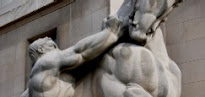
Image: Statue of Alexander and Bucephalus at Thessaloniki, Greece by Rippedangelwings

Friday, August 28, 2009

Patrick O'Brian - the greatest historical novelist of all time

Who would you say is the greatest historical novelist of all time? Novels have not been around that long: a thousand years or so if you think of the Tale of Genji, more if you include sagas and traditional tales like Homer’s Illiad. But the title is still enormous, considering the great flowering of literature in the last thousand years. The title was given by The Times to Patrick O’Brian.
Who the heck is Patrick O’Brian you say? And until 4 years ago I would have said the same thing. I have now read what insiders call the ‘Aubrey-Maturin series’ of 20 books four times. I am just starting the fifth time. (That is why I was glad to learn that there are two English translations of The Tale of Genji – if I wish I can at least re-read it with a different translation and a different nuance).

Patrick O’Brian’s serial masterpiece is set in the heyday of the age of fighting sail in the late 18th and early 19th centuries. Britain is fighting a war for her survival against Napoleon’s France and foremost in the struggle is the Royal Navy of the period. The heroes are Jack Aubrey, whose career we follow from lieutenant to master and commander to frigate captain and finally to admiral, and his ‘particular friend’ Doctor Stephen Maturin, physician, naturalist, and spy, who sails with him on most of his adventures.
Now, this is a subject (naval life) and a period (Napoleonic) that I did not feel particularly attracted to. But I am here to tell you that such is O’Brian’s genius that I could not put the books down until I had read the whole series, which took me about 5 months, a book a week. And even more, when I had finished, it wasn’t long before I felt withdrawal symptoms. More on this later.
What is O’Brian’s magic?

These novels are neither Forester nor Marryat, though O’Brian pays the respect due to both. There is adventure and there are battles. The historic furniture and vernacular you can trust absolutely because O’Brian is so steeped in his period but there is also something of his heroine, Jane Austen. He writes with her irony, humour and moral toughness, almost as she might have written of the adventures of her naval brothers. Above all, they are accessible novels, so well written that you settle into each as into a warm bath, knowing you are in good, considerate hands. In evoking so vividly what it was like to be alive then, O’Brian shows by reflection elements of what it is to be alive now, and of how we should live. He achieves that simultaneous dislocation and bridging that is the essence of all imaginative art, and is what distinguishes it from everything else.
From Alan Judd’s review ‘The Winning Post at Last’

From the first opening paragraphs of the first book, you know you are in the hands of a master. The themes are immediately evident: you know there will be authenticity and scholarship, elegance and adventure. You know there will be honour, duty, courage, and friendship. But what strikes you as the guiding light of these themes is O’Brian’s projection of the humanity of his characters in the way he uses humour. Humour is never far away, even in the midst of battle. Never a sarcastic, cynical, negative humour. Always the delightful humour of the portrayal of the characters’ sense of what is right and what is wrong, for the morality of the time. The very fact that they care what is right and what is wrong is endearing and nostalgic to us today, in our age of ‘my way or the highway,’ instant gratification, moral and philosophical poverty.

Jack Aubrey and Stephen Maturin’s initial meeting almost leads to a duel and the death of one of them. They are attending a musical evening and happen to be seated together. At the end of the first movement Jack turns to his neighbour with a smile:

The words ‘Very finely played, sir, I believe’ were formed in his gullet if not quite in his mouth when he caught the cold and indeed inimical look and heard the whisper, ‘If you really must beat the measure, sir, let me entreat you to do so in time, and not a half beat ahead’.
Jack Aubrey’s face instantly changed from friendly ingenuous communicative pleasure to an expression of somewhat baffled hostility: he could not but acknowledge he had been beating the time; and although he had certainly done so with perfect accuracy, in itself the thing was wrong. His colour mounted, he fixed his neighbour’s pale eye for a moment, said, ‘I trust…’, and the opening notes of the slow movement cut him short.

We are in the hands of a master but the scholarship and the authenticity never intrude, are always subordinated to the background. The flow of the action and the richness of the characters are ever in the forefront of our mind. We are in the hands of a master but the narrator never intrudes, never do we see his craft - oh here is a bit of character description, oh here we are setting up some tension with an antagonist, oh here is a bit of scholarly research. The narrator is forgotten, as if we are listening to an old, old friend, wise and true, knowledgeable and discerning, in whose presence we relax completely.

As we get to know the characters and life aboard ship, we settle into the surroundings and escape into this other world. That is the only way to describe the feeling, as insiders will agree. The captain’s cabin of HMS Surprise is for us almost a second home, a refuge that we can find when our real home becomes too wearing on the spirit.
It is a world closer to nature, before the industrial devolution. Ships were built by hand of wood and cordage and they were managed by hand and eye, always in a spirit of humility with regard to wind and tide. Great practical skill and knowledge of the sea and the weather were essential. The enemy could always be seen, was never anonymous, and had no great technological advantage. Skill, courage, and fortitude decided the day. And honour. Prisoners were taken and released on parole that they would not take part in the war again until exchanged with the enemies’ prisoners. They were not tortured. A man’s word of honour was everything, and so such practices were possible.

We see, indeed we almost participate in, the great friendship that develops between the main characters, a friendship based on shared hardships and dangers. They would risk their lives for each other and sometimes do. This feeling of comradeship is absent in my life at least, I don’t know about yours, and is another reason why I find a refuge in this old world, in their company.

I hope I have given you a taste of the books. There is such a wealth of beauty and delight to discover in them. I can only warn you of one thing: like all good things, they come to an end.

Image: cover of the second book of the series, a painting by Geoff Hunt

Monday, May 4, 2009

The Way to Love (3) – The Last Meditations of Anthony de Mello (part three)

You see persons and things not as they are but as you are. If you wish to see them as they are you must attend to your attachments and the fears that your attachments generate. Because when you look at life it is these attachments and fears that will decide what you will notice and what you block out.

When we are in love we are seeing the beloved not as they are but as we are. We are projecting our own qualities into this person. Rabindranath Tagore said it so well:

Beauty is truth’s smile when she beholds her own face in a perfect mirror.

We are seeing an idealized projection of our own self, magnified to a perceived perfection in this person. They are a beautiful creation, a work of art, in our head. This reminds me of a technique for helping one get over a lost love (I forget the source) that consists in meditating and imagining oneself to be the person one loves. The power of the technique resides in showing us through the meditation that we have the same qualities as the person we love, because we see them, we feel them, we know them. Thus we need not miss the person, for we ‘contain’ all the qualities that we loved.
Getting back to de Mello, we see through attachment-coloured glasses. Love is not blind, it is attachment that is blind. Love sees clearly because love encompasses everyone and everything, whereas attachment encompasses very little: it excludes everyone and everything except the object of its attachment.

You were in love and you felt rejected or jealous; suddenly all your mind and heart became focused on this one thing, and the banquet of life turned to ashes in your mouth.

I remember when I was going through my ‘attachment’ how it killed my enjoyment of everything else. I could hardly concentrate on the karate instructor, I could hardly read three paragraphs of a book, I could hardly enjoy the presence of my children. This is not love: it is slavery.

How can you love someone whom you are a slave to? How can you love someone whom you cannot live without? …Love is to be found only in fearlessness and freedom.

De Mello shows us the path out of slavery: awareness of the folly of our dependence, our addiction to this person or to anyone. The path to freedom comes from cultivating activities that we love, activities that we engage in without regard to society or the opinions of other people, activities that are our true passion.

The royal road to mysticism and to Reality does not pass through the world of people. It passes through the world of actions that are engaged in for themselves without an eye to success or to gain – or profit actions. Contrary to popular beliefs, the cure for lovelessness and loneliness is not company but contact with Reality. The moment you touch this Reality you will know what freedom and love are. Freedom from people – and so the ability to love them.

Sunday, May 3, 2009

The Way to Love (2) - The Last Meditations of Anthony de Mello (part two)

In my post Love (lost) I told you that the love I knew was all in my head. It must be so otherwise everyone my love meets would fall in love with her. In fact, my friends would have varying reactions to her from ‘She’s bad news’ to ‘I don’t know what you see in her’ to ‘She’s kinda cute’. When things were going ‘well’ and I was sitting on top of the world, it was all in my head. And when things broke down and I was filled with negative emotions, they were all in my head too. Feelings of anger, betrayal, jealousy, revenge rose and fell in me like a stormy sea. But reading de Mello I found, if not immediate peace and calm, then at least the direction to and the sight of peace and calm. And that is a lot when you are emotionally cast adrift on that cruel sea.

Now keep looking at this unpleasant situation or person until you realize that it isn’t they who are causing the negative emotions. They are just going their way, being themselves, doing their thing whether right or wrong, good or bad. It is your computer that, thanks to your programming, insists on your reacting with negative emotions.

And the clinching argument:

You will see this better if you realize that someone with a different programming when faced with this same situation or person or event would react quite calmly, even happily… The way to be in charge of this situation is to be in charge of yourself, which you are not. How does one achieve this mastery? All you have to do is to understand there are people in the world who, if they were in your place, would not be negatively affected by this person. They would be in charge of the situation, above it, not subject to it as you are. Therefore your negative feelings are caused, not by this person, as you mistakenly think, but by your programming.

Yes, someone with better relationship skills, someone with more clarity, someone with better self-control, someone with better understanding, someone who loves from a position of independence and non-attachment, someone who loves truly – such a person would react very differently than I did.
Thus there are no excuses – the answer lies within. We must change the programming. Our pain is the light showing us the way we need to change. We must become that person who is master of himself and the situation. Then, one day, we will know the way to love.

More to come in part three

Thursday, April 30, 2009

The Way to Love (1) - The Last Meditations of Anthony de Mello

The title of this little book has at least two meanings: the way to love in the sense of how we should love, and the Way to love in the sense of the spiritual path to love. They are the same.
The lessons of this little book are not easy to swallow when we are reeling from the loss of a love. But they are the necessary lessons that we need to learn in order to heal and to pass to the next level of love. My copy is dog-eared and many passages are underlined. I think I had a lot of lessons to learn.
De Mello’s message is that love is basically a nightmare. Or rather attachment is a nightmare, which in many of our cases is the same thing because we don’t know what love really is.

If you wish to attain lasting happiness, you must be ready to hate father, mother, even your own life and to take leave of all your possessions. Not by renouncing them or giving them up because what you give up violently you are forever bound to. But rather by seeing them for the nightmare they are; and then, whether you keep them or not, they will have lost their grip over you, their power to hurt you, and you will be out of your dream at last, out of your darkness, your fear, your unhappiness.

De Mello shows us that we are programmed by our upbringing and by society to believe we cannot be happy without certain things – money, power, love etc. We exhaust our energies trying to rearrange reality around us to conform to our programming. Sometimes we succeed briefly, but not for long. It is an impossible task. We must change the programming instead. This reminds me of the Buddhist saying: we cannot cover the world with leather, but if we cover our feet with leather it will be the same as covering the world with leather.

On the contrary, getting rid of attachments is a perfectly delightful task if the instrument you use to rid yourself of them is not willpower or renunciation but sight. All you need to do is open your eyes and see that you do not really need the object of your attachment at all…

Attachment is a false belief, a fantasy in your head. Think of your previous loves that you thought you could never live without, says De Mello, and how you got over them. De Mello suggests this affirmation to ‘give the order’ to your subconscious to change the programming:

I am not really attached to you at all. I am merely deluding myself into the belief that without you I will not be happy.

De Mello is pitiless in hammering the message home that the ‘battle of attachments’ can never be won. If we don’t get what we want we are unhappy, but if we get what we want, the minds dwells on the one thing we didn’t get. This reminds me of what we saw in my posts on gratitude: if we are not grateful for what we already have, we are unlikely to be grateful for what we will have. When we get what we want, without gratitude we soon become bored and start wanting something else and the battle of attachments wages on. De Mello enjoins us to enjoy things without becoming attached to them, without clinging to them, without believing that we can’t live without them (because we can and do live without them).

If you learn to enjoy the scent of a thousand flowers you will not cling to one or suffer when you cannot get it.

This brings us in fact to the right way to love: loving in a non-attached way, with no strings ‘attached’, loving from a position of independence. This goes against the way we normally love: we in effect say to the person ‘if you want to be especial to me you must meet my conditions’. Likewise, if we want to be ‘especial’ to someone we must ‘pay a price in lost freedom’.
Again these are hard lessons, when you are hurting, when you would willingly pay any price to get your lost love back. But our lost love is not coming back and usually it is better that way. And our path to healing passes through the realisation that it is better that way and why. De Mello gives us a striking way to see clearly through our pain by saying to the object of our attachment:

I leave you free to be yourself, to think your thoughts, to indulge your tastes, follow your inclinations, behave in any way that you decide is to your liking.

Once we say those words, we will either disagree with them and reveal our clinging, exploiting, deluded self or agree with them, sincerely, in which case we will feel all our attachment and dependence drop. It is likely we will not agree, in which case those words will serve as an affirmation to lead us to that place where they will become true.

I used these affirmations and I can say they help. It is a cruel medicine and it doesn’t work overnight, but it is what the doctor ordered.

More to come in part two

Sunday, March 2, 2008

Recommended books

Taoism

Tao Te King, le livre du Tao et de sa vertu, Lao Tseu, Éditions Dervy
If you are French-speaking or bilingual, this is a valuable edition. Half the book is dedicated to explanatory notes that are a classic in themselves. Alex
The Tao Te Ching, Lao Tzu (English version)
Be content with what you have, rejoice in the way things are. When you realise there is nothing lacking, the whole world belongs to you
I Ching or Book of Changes, Wilhelm/Baynes
Penetrating reflection must not be pushed too far, lest it cripple the power of decision. After a matter has been thoroughly pondered, it is essential to form a decision and to act
Back to beginnings, Huanchu Daoren
When fate slights me in terms of prosperity, I respond by enriching my virtue. When fate belabours me physically, I make up for it by making my mind free
Wandering on the Way, Chuang Tzu
The Importance of Living, Lin Yutang
The secret of contentment is knowing how to enjoy what you have, and to be able to lose all desire for things beyond your reach
Barefoot Doctor's Guide to the Tao, A Spiritual Handbook for the Urban Warrior, Stephen Russell
Doubting is an indulgence that, however tempting, is best avoided at all times, especially in cases of extreme emergency
How would Confucius ask for a raise?, Carol Osborne

Buddhism

Training the Mind, Chogyam Trungpa
The person who collects merit has to be humble and willing to give rather than being willing to collect
Healing anger - The power of patience from a Buddhist perspective, H.H. the Dalai Lama
A Study in Karma, Annie Besant
Yoga and Destiny, Elisabeth Haich and Selvarajan Yesudian

Zen

Hara, The Vital Centre of Man, Karlfried Graf Durkheim
Man, as a living being, is not rooted in himself. Rather he is nourished, sustained, and held in order by Nature whose laws operate without his knowledge and assistance
Zen in the Art of Archery, Eugen Herrigel
Zen in the Art of the Tea Ceremony, Horst Hammitzsch
The Book of Five Rings, Myamoto Musashi
Wabi Sabi - The Japanese art of impermanence, Andrew Juniper

Eastern philosophy

The Story of Oriental Philosophy, L. Adams Beck

Western philosophy

The Power of your Subconscious Mind, Dr. Joseph Murphy
The trouble with most people is they don't have any invisible means of support
Meditations - the spiritual teachings of Marcus Aurelius, Mark Forstater

Discover The Tale of Genji, the 11th Century classic of Japan (click image)

Discover The Tale of Genji, the 11th Century classic of Japan (click image)
Kiyomizudera Temple has a large veranda looking out over Kyoto and beyond