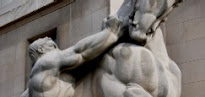
Showing posts with label Courage. Show all posts

Wednesday, March 16, 2011

The 50 at Fukushima Daiichi

Some days ago I read that TEPCO was withdrawing all its personnel from its stricken Fukushima Daiichi nuclear power plant, all except for 50 who were to remain to fight the overheating reactors. The word ‘heroes’ immediately came into my mind along with memories of those heroic doomed Russian helicopter pilots who dumped load after load of concrete on radioactive Chernobyl. 
A few days ago the word ‘heroes’ was not being used in the media because it looked like the danger was small and that the problem would be contained. Not anymore.

[7:06 a.m. ET Wednesday, 8:06 p.m.  in Tokyo] The number of nuclear workers at the damaged Fukushima Daiichi nuclear plant was slashed Tuesday from 800 to 50, but had grown to 180 by Wednesday afternoon, the Tokyo Electric Power Company said.
"Their situation is not great," said David Brenner, director of the Center for Radiological Research at Columbia University. "It's pretty clear that they will be getting very high doses of radiation. There's certainly the potential for lethal doses of radiation. They know it, and I think you have to call these people heroes." (from ‘This just in’ WSJ Blog)

Strangely, as I was writing this, an article at the WSJ site about the 180 heroes suddenly disappeared. I suppose it was pulled because it painted too heroic and desperate a picture of events out of control, or at least not going to plan. In it there were quotes from nuclear experts about the specialized knowledge of these 50 who, precisely because of their knowledge, knew exactly what risks they were taking and therefore were true heroes. They were doing what they considered to be their job and more importantly their duty to protect their endangered nation. I remember one commentator saying they were in ‘uncharted territory’ and likened events to an adventure movie where the workers were ‘ad libing’ as they went along. For example, using fire trucks to pump seawater into the reactors to cool them ‘was not in the manual’.

There is no lack of examples of courage and duty in Japanese history. Indeed such heroic courage and devotion to duty are a large part of the samurai code that is deeply ingrained even today in the Japanese psyche. Akira Kurosawa gave us the quintessential legend of the 7 samurai; history gives us the 47 Ronin. Today’s events give us those who will become known forever as the 50 at Fukushima Daiichi.

The reputation of a thousand years may be determined by the conduct of one hour.  Japanese Proverb

Tuesday, December 14, 2010

The Rainbow and the Covenant

Whilst stirring my oatmeal in the morning I usually read my current Patrick O’Brian novel. Having just completed the series again, I was reading instead 1001 Pearls of Bible Wisdom by Malcolm Day. Regular readers know I have no qualms about posting religious insight along with the philosophical, be it from the Bible or the Talmud or the Koran. I was reading the section about forgiveness and reconciliation. 
All my life, I have always had a hard time understanding how Jesus could ‘die for our sins’. Why should God forgive us because Jesus died on the cross? I understood that Jesus asked God to ‘forgive them for they know not what they do’ but why should He? And it was always strange to me that, for such a central concept, I had not come across any explanations, no elaboration about why this should be.

Well, at 53, stirring my porridge one morning, I finally understood why.

The Rainbow and the Covenant

After the flood that destroyed all living things, except those taken into Noah’ ark, God made a covenant, or pledge, with humanity never to devastate the Earth again. As a reminder of his promise he placed a rainbow in the sky: ‘I have set my bow in the clouds, and it shall be a sign of the covenant…” (Genesis 9:13).  The covenant was fulfilled in the Passion of Christ. Jesus straddles the divide between human wrongdoing and God’s judgment and, through the Crucifixion, enables God to be reconciled with sinful humanity. People no longer need to endure God’s wrath – their sins are forgiven.

And following this introduction we read …

… in Christ God was reconciling the world to himself, not counting their trespasses against them … 2 Corinthians 5:19

In Jesus God took on the form and condition of a man, open to fear, weakness and pain. Yet Jesus could ask God to forgive his persecutors while on the cross. Thus God could see that there was some good in man, despite his sins. Thus he was reconciled and the covenant fulfilled.

I am reminded of that quote we saw in Into Great Silence:

Behold I am become human. If you should not want to join me in becoming God, you would do me wrong.

Image by Brian Parton

Tuesday, September 14, 2010

Base jumping with The Snowman

I have just discovered the following video that combines a little masterpiece of a song with a little masterpiece of an animation from Howard Blake’s little 1982 masterpiece ‘The Snowman’. I thought about saving it to post later this Christmas but it is just too good to deprive you of for any length of time.
So here it is. It captures so well those times of our childhood when Christmas was filled with magic and wonder; times when there was so much about this world we didn’t know or understand that the line between what was real and what was imagined, the possible and the impossible, was yet to be drawn.
For today’s children that line must be ever and ever more tenuous. A child today can watch this video and decide that he wants to experience walking in the air. He can base jump with the Snowman. Perhaps a video like this one inspired our own Halvor Angvik to become a base jumper. If you read this Halvor, how about putting this music to one of your next videos? Maybe it will inspire some young minds.


For a funky club mix twist to this music I doubt you’ll find better than this:

Monday, August 9, 2010

Wingsuit proximity flying - that crazy guy again

You may remember last October I posted a spectacular video of some crazy guy base jumping with a wingsuit down the north face of the Eiger. I commented at the time that such a practice might be laudable in pursuit of some military objective that would save lives but was foolhardy gambling with one’s life in the pursuit of thrills. The next day, that crazy guy (Halvor Angvik) wrote me a very scientific and reasoned four page reply showing that preparation, knowledge and practice removed much of the risk and that risk-taking was anyway a necessary part of life, at least a necessary part of a life worth living. And I had to admit he was in the right of it.
So now, ladies and gentlemen, let me present for your viewing horror Halvor’s latest video entitled ‘Wingsuit proximity flying – working a line’ in which Halvor makes 5 jumps, each successive jump more hair-raisingly spectacular than the last. I need a coffee.

Monday, July 5, 2010

Sacrifice - from the phlegmatic Michael Caine

I have often been called phlegmatic, calm, not easily angered. (I have been called a lot of other things too…)

Phlegmatic (definition from Dictionary.com)

Adj.
1. not easily excited to action or display of emotion; apathetic; sluggish.
2. self-possessed, calm, or composed.
3. of the nature of or abounding in the humour phlegm.

Synonyms
1. stoical, cool, cold, uninterested, dull, torpid. 2.  cool, collected, unruffled, placid, quiet.

When they call me phlegmatic they usually also refer to my British background, a disposition for phlegm being seen as a typically British trait. I may have some claim to that quality (some would say particularly the cold, dull and torpid part) but I have nothing in comparison to the phlegm of one of my favourite actors: Sir Michael Caine.

I recently saw him in ‘The Weather Man’ (2005) starring Nicolas Cage. It’s a very honest movie, worth your while, even important, particularly for a few lines that Caine delivers with an armour-piercing phlegm.

To get anything of value you have to sacrifice. Do you know the harder thing to do and the right thing to do are usually the same thing? Nothing that has meaning is easy. Easy doesn’t enter into grown up life.

Easy doesn’t enter into grown up life. It’s as simple as that. Most of our problems arise from that one simple fact and our inability to face up to doing the hard thing, the right thing, the thing that takes courage. The minute we stop resisting and accept that, we will start to make progress. And that’s also when we will start to become men. And women.

Here’s the clip, I found it on Youtube. Your whole life has brought you to this moment with Michael Caine.

Monday, May 31, 2010

Overheard in the Sacristy

I think, at a child's birth, if a mother could ask a fairy godmother to endow it with the most useful gift, that gift would be curiosity. Eleanor Roosevelt

On Marketwatch I saw a few lines about the ‘Vatican’s soccer playoffs’, the Clericus Cup, the ‘Vatican’s football championship, played in the shadow of St Peter’s’. This immediately brought a smile to my lips. I remembered that beautiful little film ‘The Cup’ about Buddhist soccer monks. I wondered what a game of soccer played by ordained priests looks like. Do the wingers feint left then go right or do they consider that sinful? When the centre forward is flattened in the penalty zone does he immediately jump up and assure the referee that he is alright, actually he tripped over his own foot?
My curiosity led me to Google the Clericus Cup and my eye caught a blog called Overheard in the Sacristy.  The header photo immediately puts you in the frame of mind you feel when you enter a cathedral. The blog author is Father Loren Gonzales, ‘a priest of the Diocese of Phoenix AZ currently shepherding a parish in Peoria’. Here I found posts, among others, on the Clericus Cup (of course), the scientifically proven anti-depressant qualities of Frankincense, and the official church burial of the recently discovered remains of 16th century astronomer Nicolaus Copernicus, nearly 500 years after he was laid to rest in an unmarked grave, his sensational findings condemned by the Roman Catholic Church of the time. I thank my mother and fairy godmother for the curiosity and we will surely be keeping our ears open in future for what is Overheard in the Sacristy.

Today father Gonzales quite rightly dedicates a post to Memorial Day, We remember. He offers a prayer for the fallen, which I take the liberty to reproduce here.

Dear God our Father,

Your word tells us, “Unless the LORD build the house, they labor in vain who build. Unless the LORD guard the city, in vain does the guard keep watch” (Psalm 127:1).

Thank You for those who have guarded not only our cities, but our country, allies, and many other communities from unjust and unprincipled aggressors. On this Memorial Day, with a solemn and sacred spirit, we pause to remember and honor the brave men and women in our Armed Forces who gave up their lives for their fellow Americans at home and abroad. Many were young and many were married, with their loved ones praying for them back home; but they were each fighting to protect the freedom we enjoy when they were called to make the ultimate sacrifice.

Dear God, please bless our heroes and heroines with Your mercy, grace, and peace. Bless also their families and friends. May Your perpetual light shine upon them; and may their souls and the souls of all our faithful departed rest in peace. In Jesus’ name.

Amen.

Friday, May 21, 2010

Yiddish proverbs - in adversity


The wheel turns round.
Confidence is half of victory.
If you ever need a helping hand you'll find one at the end of your arm.
He that cannot endure the bad, will not live to see the good.
If things are not as you wish, wish them as they are.
If we cannot do what we will, we must will what we can.
When one must, one can.
Everyone is kneaded out of the same dough but not baked in the same oven.
Trouble does not come alone.
Trouble is to man what rust is to iron.
Worries go down better with soup.
Fleas are not lobsters.
Bad habits are easier to abandon today than tomorrow.
The wagon rests in winter, the sleigh in summer, the horse never.
Tomorrow your horse may be lame.
You can't measure the whole world with your own yardstick.
Do not throw away the old bucket until you know whether the new one holds water.
Do not throw a stone into a well from which you have drunk.
Do not spit into the well - you might drink from it later.
If a link is broken, the whole chain breaks.
If a man is destined to drown, he will drown even in a spoonful of water.
If you do not want to do something, one excuse is as good as another.
Time is the best doctor.
The glaciers did not freeze overnight.
With time, even a bear can learn to dance.
You can throw a cat wherever you want, it always falls on its feet.
If each one sweeps before his own door, the whole street is clean.
If you want your dreams to come true, don't sleep.
Sleep faster, we need the pillows.
Uphill one climbs slowly, downhill one rolls fast.
Had you gotten up early, you would not have needed to stay up late.
Provide for the worst; the best can take care of itself.
Bygone troubles are good to tell.

Wednesday, May 12, 2010

Yiddish proverbs - the fool and the wise man

Here is the first of a series of posts featuring lists of Yiddish proverbs by subject. We start with the fool and the wise man. I think all cultures have such proverbs, certainly in English we do – fools rush in where brave men fear to tread etc. So it is a subject and a form that is well recognised and we eagerly soak up these new perspectives on an old subject.

As I was thinking of an intro I realized that there is really no such thing as a pure fool or a pure wise man. We are all fools on some subject or other and we are all relatively wise on some subjects. Not only that, we can be fools for short periods of time, for example when we are stuck (when we ‘do the same thing over and over expecting a different result’), when we are ‘dis-couraged’, or when we are angry. And even foolish people can take on the mantle of wisdom when they are fearless, when they speak the truth that others dare only to think, and when they are sincerely themselves.
So we all have something of a working relationship with stupidity and wisdom and I found that relationship very well put in this quote, which I just happened to fall upon today:

Every creative act is a sudden cessation of stupidity. Edwin Land

With that in mind, here are the collective insights of countless Yiddish generations on the fool and the wise man.

A fool can ask more questions in an hour than a wise man can answer in a year.
A dead man is mourned seven days; a fool, his lifetime.
A fool is his own informer.
A fool shows his annoyance at once, but a prudent man overlooks an insult.
A fool who can keep silent is counted among the wise.
If you seek a reputation for wisdom, agree with everyone.
A fool grows without rain.
The complete fool is half prophet.
Not everyone who sits in the seat of honour is master.
Send a fool to close the shutters and he'll close them all over town.
Send a fool to the market and a fool he will return.
A schlemiel lands on his back, and bruises his nose.
We are all schlemiels.
Hope may give a man strength, but not sense.
If the head doesn't work it's bad news for the legs.
When the stomach is empty, so is the brain.
Some people are like new shoes - the cheaper they are, the louder they squeak!
One fool is an expert on the other.
The crow flies high and alights on a pig.
A snake deserves no pity.
A chip on the shoulder indicates wood higher up.
A dog without teeth will also attack a bone.
Show a dog a finger, and he wants the whole hand.
Many complain of their looks, but none of their brains.

A wise man hears one word and understands two.
A wise man knows what he says; a fool says what he knows.
All signs are misleading.
Better ask ten times than go astray once.
He that cannot ask cannot live.
When a wise man talks to a fool, two fools are talking.
Hell shared with a sage is better than paradise with a fool.
Talking comes by nature, silence by wisdom.
Talk is worth a shilling; silence is worth two.
Talk too much and you talk about yourself.
Protest long enough that you are right, and you will be wrong.
Silence is also speech.
Beware of still water, a still dog, and a still enemy.
The wise man, even when he holds his tongue, says more than the fool when he speaks.
Time and words can't be recalled, even if it was only yesterday.
One good forewit is worth two afterwits.
Words should be weighed, not counted.
Words show the wit of a man, but actions his meaning. 


Friday, January 1, 2010

2010 - with courage and fortitude

So another year has passed, another decade in fact. 10 years have passed since the world was worrying about the coming Y2K bug, which turned out to be unnecessary like so many worries. In 2010 the world has bigger things to worry about. But let us worry about them tomorrow. Today I wish you a Happy New Year’s Day, spent with family and friends, and time to reflect on what you wish for yourself and for others in 2010. And I wish you above all courage and fortitude, which will see you through whatever the year has in store.

But sudden apparitions of imminent danger many times break our resolutions; and the fancy troubled with the imagination of approaching peril chases away true judgment from her seat. For fear not only astonishes the memory, according to the saying of Thucydides, but it dissipates all manner of consideration, sense of honour, and resolution; while philosophy binds and keeps them together. Plutarch

Noble therefore was the saying of Antisthenes, that we ought to wish an enemy all things beneficial to mankind except fortitude; for so these blessings will belong not to their possessors but to the conqueror. Therefore it was, they say, that Nature provided for the hart, one of the most timorous of creatures, such large and branchy horns, to teach us that strength and weapons nothing avail where conduct and courage are wanting. Plutarch

Monday, November 30, 2009

Courage - committing to a higher purpose

We come to the end of my posts on courage, for now. It was revealing to me to ponder the nature of courage and its importance. I never thought about it much before. Now I see that it makes ALL the difference. I see that courage is the cure for many evils including sadness, despair, laziness, and of course fear. Just think of the word 'discouragement’: the taking away of our courage takes away all our power and brings us low in spirit. To raise our spirit up we must find a goal, a principle, a reason to put BEFORE our sadness, our jadedness, or our comfort - that is the definition of courage. Then we will harness the power of courage in our lives.

Everything good in my life is a result of chances I took, goals I worked for, sacrifices I made. And the reverse is true: what is lacking is a result of chances I did not take, bold efforts I did not make, fears I did not break. When I feel down or in a rut or blocked, I know now with absolute certainty that it is my courage which is flagging.

I am reminded of a quote of W.H. Murray speaking of the power of courage from his book The Scottish Himalayan Expedition:

… when I said that nothing had been done I erred in one important matter. We had definitely committed ourselves and were halfway out of our ruts. We had put down our passage money— booked a sailing to Bombay. This may sound too simple, but is great in consequence. Until one is committed, there is hesitancy, the chance to draw back, always ineffectiveness. Concerning all acts of initiative (and creation) there is one elementary truth… that the moment one definitely commits oneself, then providence moves too. All sorts of things occur to help one that would never otherwise have occurred. A whole stream of events issues from the decision, raising in one’s favour all manner of unforeseen incidents and meetings and material assistance which no man could have dreamed would have come his way. I have learned a deep respect for one of Goethe’s couplets:

Whatever you can do or dream you can, begin it. Boldness has genius, power and magic in it.

I know now that to get what I want from life I will have to cultivate more courage than I have been doing. I will have to get more buddy buddy on a daily basis with courage. There is no substitute. Nothing else will do the job. Then and only then may I one day get to change my blog name to Healed Philosophy.

You are only as strong as your purpose, therefore let us choose reasons to act that are big, bold, righteous and eternal. Barry Munro

Who dares nothing, need hope for nothing. Johann Friedrich Von Schiller

Whether you be man or woman you will never do anything in this world without courage. It is the greatest quality of the mind next to honour. James Allen

Life shrinks or expands in proportion to one's courage. Anais Nin

Great things are done more through courage than through wisdom. German proverb

Spiritual cowardice is not only weakness but wickedness. G.B.Gambrell

Knowledge without courage is sterile. Baltasar Gracian

Moral courage is the most valuable and usually the most absent characteristic in men. George Patton

He who loses wealth loses much; he who loses a friend loses more; but he who loses his courage loses all. Cervantes

Wealth lost - something lost; Honour lost - much lost; Courage lost - all lost. German proverb

May you live all the days of your life. Jonathan Swift

For all sad words of tongue and pen, The saddest are these, "It might have been". John Greenleaf Whittier

A great deal of talent is lost to the world for want of a little courage. Every day sends to their graves obscure men whose timidity prevented them from making a first effort. Sydney Smith

Everyone has talent. What is rare is the courage to follow that talent to the dark place it leads. Erica Jong

We could never learn to be brave and patient, if there were only joy in the world. Helen Keller

Quiet minds cannot be perplexed or frightened, but go on in fortune or misfortune at their own private pace, like a clock during a thunderstorm. Robert Louis Stevenson

Have courage for the great sorrows of life and patience for the small ones; and when you have laboriously accomplished your daily task, to sleep in peace. God is awake. Victor Hugo

Wednesday, November 25, 2009

Courage - according to the Ancients

Courage is knowing what not to fear. Plato

Courage is to take hard knocks like a man when occasion calls. Plautus

Courage is a kind of salvation. Plato

Courage is its own reward. Plautus

Courage leads starward, fear toward death. Seneca

Courage easily finds its own eloquence. Plautus

Courage is the virtue which champions the cause of right. Cicero

Nothing is as valuable to a man as courage. Terence

A man full of courage is also full of faith. Cicero

Fear is only as deep as the mind allows. Japanese proverb

Let us be brave in the face of adversity. Seneca

A smooth sea never made a skilled mariner. English proverb

A decent boldness ever meets with friends. Homer


The first rule is to keep an untroubled spirit. The second is to look things in the face and know them for what they are. Marcus Aurelius

It is courage, courage, courage, that raises the blood of life to crimson splendour. Live bravely and present a brave front to adversity! Horace

Dare to begin! He who postpones living rightly is like the rustic who waits for the river to run out before he crosses. Horace

It is not death that a man should fear, but he should fear never beginning to live. Marcus Aurelius

There is nothing in the world so much admired as a man who knows how to bear unhappiness with courage. Seneca

Where fear is, happiness is not. Seneca

It is better by noble boldness to run the risk of being subject to half of the evils we anticipate than to remain in cowardly listlessness for fear of what might happen. Herodotus

Sometimes even to live is an act of courage. Seneca

Fortune helps the brave. Virgil

Fortune reveres the brave, and overwhelms the cowardly. Seneca

Fortune and love favour the brave. Ovid

Fortune favours the audacious. Erasmus

Audacity augments courage; hesitation, fear. Publilius Syrus

Fall seven times; stand up eight. Japanese Proverb

A coward turns away, but a brave man's choice is danger. Euripedes

It is easy to be brave from a safe distance. Aesop

To know what is right and not do it is the worst cowardice. Confucius

The superior man makes the difficulty to be overcome his first interest; success comes only later. Confucius

This is courage ... to bear unflinchingly what heaven sends. Euripedes

Nothing befalls a man except what is in his nature to endure. Marcus Aurelius

God gave burdens, also shoulders. Jewish proverb

The burden is equal to the horse's strength. Talmud

Have patience with all things, but chiefly have patience with yourself. Do not lose courage in considering your own imperfections, but instantly set about remedying them - every day begin the task anew. Saint Francis De Sales

The beauty of the soul shines out when a man bears with composure one heavy mischance after another, not because he does not feel them, but because he is a man of high and heroic temper. Aristotle
Photo from Wikimedia

Sunday, November 22, 2009

Courage - Pericles' funeral speech

I am reading Donald Kagan’s book The Peloponnesian War which tells the story of the long death struggle between Sparta and Athens and their respective allies in the fifth century BC. It is a gripping read as is Livy’s tale of the similar struggle to come between Rome and Carthage (see Roman fortitude). The participants are evenly matched: Sparta is the greatest military power on land, but Athens is the greatest military power on the sea. (In this the war resembles the struggle between Napoleonic France and maritime Britain).

Athens is fortunate in having a great leader in the form of Pericles, ‘son of Xanthippus (a victorious general in the Persian war), the leading man in Athens at that time, and the ablest in speech and in action.’ From Thucydides, a historian and participant in the war, we learn that Pericles’ teacher, Anaxagoras, had instilled in him

…a lofty spirit and an elevated mode of speech, free from the vulgar and knavish tricks of mob-orators, but also a composed countenance that never gave way to laughter, a dignity of carriage and restraint in the arrangement of his clothing which no emotion was allowed to disturb while he was speaking, a voice that was evenly controlled, and all the other characteristics of this sort which so impressed his hearers.

Pericles persuades the Athenians that if they avoid a decisive land battle but wait patiently behind their city walls, relying on supply from the sea which they control, Sparta will realise that they are powerless and will sue for peace. It is a wise strategy but it goes against the grain of the time, especially with the impetuous young. When a Spartan army lays waste the bountiful Athenian countryside while the Athenians watch from the walls, Pericles has to (bravely) bear their accusations of timidity and cowardice. Only he can hold the Athenians in check from certain disaster.

And yet there were times when they were sorely vexed with him, and then he tightened the reins and forced them into the way of their advantage with a master's hand, for all the world like a wise physician, who treats a complicated disease of long standing occasionally with harmless indulgences to please his patient, and occasionally, too, with caustics and bitter drugs which work salvation. For whereas all sorts of distempers, as was to be expected, were rife in a rabble which possessed such a vast empire, he alone was so endowed by nature that he could manage each one of these cases suitably, and more than anything else he used the people's hopes and fears, like rudders, so to speak, giving timely check to their arrogance, and allaying and comforting their despair. Plutarch

Pericles holds back the Athenians from doing what the Spartans want them to do: come out and fight a decisive battle on their terms - on land - where they are the stronger. In this wise but ungrateful and unpopular task he reminds us of Fabius Maximus who, after Rome’s crushing defeat at Cannae, refuses all battle with the seemingly invincible Hannibal. He only shadows him with his army, a constant threat to be guarded against, letting the advantage of time in favour of the Romans do its work. (This resemblance was clear to Plutarch also: I found that he pairs Pericles and Fabius Maximus together in his Parallel Lives, see here).

Pericles bides his time and events prove him right. When funeral rights are held for those who have perished in the first year of war, the Athenians call upon him to give the eulogy as their foremost leader. His speech is not only a eulogy to the fallen Athenian brave but to all brave men. It is a tribute to courage, which puts something higher, something more important, above personal interest and personal safety: freedom and the common good.

You must every day look upon the power of your city and become her lovers, and when you have understood her greatness consider that the men who achieved it were brave and honourable and knew what was necessary when the time came for action. If they ever failed in some attempt, they were determined that, at least, their city should not be deprived of their courage and gave her the most beautiful of all offerings. For they gave their lives for the common good and thereby won for themselves the praise that never grows old and the most distinguished of all graves, not those in which they lie, but where their glory remains in eternal memory, always there at the right time to inspire speech and action. For the whole world is the burial place for brave men; not only does the epitaph inscribed on monuments in their native country commemorate them, but in lands not their own the unwritten memory; more of their spirit even than of what they have done, lives on within each person. Now it is for you to emulate them; knowing that happiness requires freedom and freedom requires courage, do not shrink from the dangers of war.

*****

Courage is what preserves our liberty, safety, life, and our homes and parents, our country and children. Courage comprises all things. Plautus

So, as you go into battle, remember your ancestors and remember your descendants. Tacitus

Happy the man who ventures boldly to defend what he holds dear. Ovid

So when the crisis is upon you, remember that God, like a trainer of wrestlers, has matched you with a tough and stalwart antagonist... that you may prove a victor at the Great Games. Epictetus

Things never go so well that one should have no fear, and never so ill that one should have no hope. Turkish proverb

To persevere, trusting in what hopes he has, is courage. The coward despairs. Euripedes

It is the bold man who every time does best, at home or abroad. Homer

In times of stress, be bold and valiant. Horace

In difficult situations, when hope seems feeble, the boldest plans are safest. Livy

He shall fare well who confronts circumstances aright. Plutarch

Image: Discurso funebre Pericles by Von Folz, from Wikipedia

Friday, November 20, 2009

Courage - never give up

To listen to all my talk of the courage of the ancients one would think there were no examples worthy of note closer to hand. But of course there are. We baby boomers are but one or two generations away from the last world war when another seemingly invincible foe threatened to conquer the free world. Another Battle of Thermopylae took place only 70 years ago. A few men again stood against many. The defending heroes numbered about the same as that Greek advance guard long ago, but instead of spears and short swords they wielded Hurricanes and Spitfires.
Their battle would be called the Battle of Britain, but their story begins before that. Here is an excerpt of Churchill’s address to the House of Commons on 4 June 1940 following the evacuation of 335,000 allied troops from Dunkirk

A miracle of deliverance, achieved by valour, by perseverance, by perfect discipline, by faultless service, by resource, by skill, by unconquerable fidelity, is manifest to us all. The enemy was hurled back by the retreating British troops. He was so roughly handled that he did not hurry their departure seriously. The Royal Air Force engaged the main strength of the German Air Force, and inflicted upon them losses of at least four to one; and the Navy, using nearly 1,000 ships of all kinds, carried over 335,000 men, French and British, out of the jaws of death and shame, to their native land and to the tasks which lie immediately ahead. We must be very careful not to assign to this deliverance the attributes of a victory. Wars are not won by evacuations. But there was a victory inside this deliverance, which should be noted. It was gained by the Air Force….

This was a great trial of strength between the British and German Air Forces. Can you conceive a greater objective for the Germans in the air than to make evacuation from these beaches impossible, and to sink all these ships which were displayed, almost to the extent of thousands? Could there have been an objective of greater military importance and significance for the whole purpose of the war than this? They tried hard, and they were beaten back; they were frustrated in their task. We got the Army away; and they have paid fourfold for any losses which they have inflicted. Very large formations of German aeroplanes - and we know that they are a very brave race - have turned on several occasions from the attack of one quarter of their number of the Royal Air Force, and have dispersed in different directions….


When we consider how much greater would be our advantage in defending the air above this Island against an overseas attack, I must say that I find in these facts a sure basis upon which practical and reassuring thoughts may rest. I will pay my tribute to these young airmen. The great French Army was very largely, for the time being, cast back and disturbed by the onrush of a few thousands of armoured vehicles. May it not also be that the cause of civilization itself will be defended by the skill and devotion of a few thousand airmen?

*******

The greatest test of courage on earth is to bear defeat without losing heart. Robert G. Ingersoll

Courage is going from failure to failure without losing enthusiasm. Winston Churchill

Who hath not known ill fortune, never knew himself, or his own virtue. David Mallett

Everyone will be taxed according to his means. Johann Friedrich Von Schiller

Optimism is essential to achievement and it is also the foundation of courage and true progress. Nicholas Murray Butler

Optimism is the foundation of courage. Nicholas Murray Butler

Stand upright, speak thy thoughts, declare the truth thou hast, that all may share; be bold, proclaim it everywhere. They only live who dare. Voltaire

Courage, in the final analysis, is nothing but an affirmative answer to the shocks of existence. Kurt Goldstein

Where life is more terrible than death, it is the truest valour to dare to live. Sir Thomas Brown

Often the test of courage is not to die, but to live. Conte Vittorio Alfienri

Courage is generosity of the highest order, for the brave are prodigal of the most precious things. Charles Caleb Colton

The bravest are the tenderest. The loving are the daring. Henry Wadsworth Longfellow

Courage is grace under pressure. Ernest Hemingway

Avoiding danger is no safer in the long run than outright exposure. Life is either a daring adventure, or nothing. Helen Keller

Courage is the price that life exacts for granting peace. Amelia Earhart

Freedom is not for the timid. Vijaya Lakshmi Pandit


Image by Molock67


Thursday, November 19, 2009

Courage - what Leonidas said

Leonidas, the son of Anaxandridas and brother to Cleomenes, when one said to him, Abating that you are king, you are no better than we, replied, But unless I had been better than you, I had not been king.

His wife Gorgo, when he went forth to Thermopylae to fight the Persian, asked him what command he left with her; and he replied, Marry brave men, and bear them brave children.

The Ephors saying, You lead but few to Thermopylae; They are many, said he, considering on what design we go.

And when they again asked him whether he had any other enterprise in his thought, he replied, I pretend to go to hinder the barbarians’ passage, but really to die fighting for the Greeks.

When he was at Thermopylae, he said to his soldiers: They report the enemy is at hand, and we lose time; for we must either beat the barbarian or die ourselves.

And to another saying, What, the flights of the Persian arrows will darken the very sun, he said, Therefore it will be pleasant for us to fight in the shade.

And another saying, What, Leonidas, do you come to fight so great a number with so few? — he returned: If you esteem number, all Greece is not able to match a small part of that army; if courage, this number is sufficient.

And to another discoursing after the same manner he said, I have enough, since they are to be killed.

When Xerxes wrote to him thus, Sir, you may forbear to fight against the Gods, but may follow my interest and be lord of all Greece, he answered: If you understood wherein consisted the happiness of life, you would not covet other men’s; but know that I would rather die for the liberty of Greece than be a monarch over my countrymen.

And Xerxes writing to him again thus, Send me thy arms, he returned, Come and take them.

When he resolved to fall upon the enemy, and his captains of the war told him he must stay till the forces of the allies had joined him, he said: Do you think all those that intend to fight are not here already? Or do you not understand that those only fight who fear and reverence their kings?

And he ordered his soldiers so to dine, as if they were to sup in another world.

And being asked why the bravest men prefer an honourable death before an inglorious life, he replied, Because they believe one is the gift of Nature, while the other is peculiarly their own.

Being desirous to save the striplings that were with him, and knowing very well that if he dealt openly with them none would accept his kindness, he gave each of them privately letters to carry to the Ephors. He desired likewise to save three of those that were grown men; but they having some notice of his design refused the letters. And one of them said, I came, sir, to be a soldier, and not a courier; and the second, I shall be a better man if here than if away; and the third, I will not be behind these, but the first in the fight.

From Plutarch’s Laconic Apophthegms; or remarkable sayings of the Spartans
Image derived from a photo from Wikimedia

Tuesday, November 17, 2009

Courage - Leonidas and the 300 Spartans

The story of the Battle of Thermopylae (literally ‘the hot gates’) is a classic tale of courage. It has recently been dramatized and brought to the wider attention of a modern audience in Zack Snyder’s film ‘300’ based on the graphic novel by Frank Miller. While it is obvious that the film (and the novel) is highly stylized, any film that strives to bring to life the great and virtuous deeds of the past will always get my thumbs up. The film lacks a ‘Saving Private Ryan’ type of realism – largely in its portrayal of the Persians as inhuman monsters - but the essential message rings true. (Compare this to Oliver Stone’s film Alexander where the subject and essential message are hopelessly misunderstood and misrepresented.)

Wikipedia has a good overview of the Battle of Thermopylae here.

It is 480 BC and the Persians under Xerxes I are marching with a huge army to invade Greece. Xerxes is eager to avenge the failure of his father Darius I’s invasion which was thwarted by the Greeks at the Battle of Marathon in 490 BC.

Unfortunately for the Spartans, the invasion comes during the sacred festival of Carneia as well as during the Olympic Games and so it would be doubly sacrilegious for them to go to war at this time. Therefore it is decided to send an advance force to hold the ‘hot gates’ until the main Spartan army can march and join them later. King Leonidas takes his personal royal bodyguard of 300 men and about 1,000 support troops and helots. They will later be joined by other small contingents of Greeks.

Leonidas and his men are under no illusions; they know they are going to their deaths. Even though the hot gates will afford them a narrow and advantageous defensive position, even though the Spartans are the Delta Force, the Royal Marines of the ancient world, the Persian army numbers in the hundreds of thousands. And the Oracle of Delphi has prophesied:

O ye men who dwell in the streets of broad Lacedaemon!
Either your glorious town shall be sacked by the children of Perseus,
Or, in exchange, must all through the whole Laconian country
Mourn for the loss of a king, descendant of great Heracles.

Thus we know that Leonidas is under no illusions and also by the fact that he gives orders that only those Spartans may come who have living sons. He asks for volunteers to replace those who do not. We also have the following from Plutarch:

And another saying, What, Leonidas, do you come to fight so great a number with so few? — he returned: If you esteem number, all Greece is not able to match a small part of that army; if courage, this number is sufficient.

And to another discoursing after the same manner he said, I have enough, since they are to be killed.

And when they again asked him whether he had any other enterprise in his thought, he replied, I pretend to go to hinder the barbarians’ passage, but really to die fighting for the Greeks.

The Spartans always esteemed courage and not numbers as this famous quote by King Agis II tells:

The Spartans do not ask how many but where they are.

The Spartans take up the defence of the hot gates by forming a shield wall or phalanx. At this time the Greek hoplites fought with a long spear so that only the first two ranks could fight the enemy. Later Philip of Macedon would introduce the 16 foot sarissa, a long pike, allowing the first five rows of the phalanx to fight. (When occasion demanded, they also fought with a short sword).

Over three days the Spartans ‘cut to ribbons’ all the Persian troops sent against them, including Xerxes elite troops, the notorious ‘Immortals’. Their name stemmed from the fact that they wore masks to conceal their individual identity and their numbers were always maintained at exactly 10,000 so that it seemed that none ever died.

The Spartans are undone finally when the Persians learn from a Greek traitor that there exists a mountain path which will allow them to outflank and attack the Spartans from the rear. On learning that the path has not been held by the Phocian allies he had stationed there, Leonidas orders his Greek allies to retreat and prepares to form a rearguard with only his 300 Spartans, 700 Thespians and 400 Thebans. This will allow his other 3,000 Greek allies to escape.

Leonidas’ rearguard leave their defensive position and attack Xerxes’ advancing army so as to sell their lives dearly and kill as many Persians as they can.

Two of Xerxes’ brothers are killed at this time as is Leonidas himself, thus fulfilling the Delphic prophecy. As the Immortals arrive in their rear the Spartans retreat to a hill where they are showered with arrows until all are killed.

The Battle of Thermopylae was a defeat for the Spartans. It did not significantly slow down the advance of Xerxes’ army, nor did it inflict significant losses on the Persians (although they lost some 20,000 men). But had the Persians not discovered the mountain pass, had the Spartans held the hot gates some days longer, Xerxes huge army would have run out of provisions and been forced to retreat. The defence of Thermopylae could have become a successful military operation instead of a courageous act of self-sacrifice.

The Battle of Thermopylae may have been a defeat, but as Michel de Montaigne said, ‘There are some defeats more triumphant than victories’. Thermopylae was a victory of the spirit, which takes no account of fear, no account of danger, no account of possible outcomes but which takes account only of the most important things: of honour, of duty and of freedom. As an example of courage, it may be equalled but it can never be surpassed.

Go tell the Spartans, stranger passing by, that here obedient to their laws we lie. Simonides of Ceos

Images from the movie '300' and Wikimedia

Sunday, November 15, 2009

Courage - Alexander the Great

I recently came across the site of The Online Library of Liberty which has among others the text of Plutarch’s The Morals. Here I found Plutarch’s commentary about the life of Alexander the Great. In it he shows how Alexander exemplified virtue in his life and won his successes by sweat and blood and without the help of Fortune, or rather in spite of ill Fortune.

I studied Alexander’s life story some years ago. I could happily write a blog about Alexander alone. There are many striking examples of personal courage in Alexander’s life but one in particular made a deep impression on me. Hollywood could find no more dramatic moment of courage in history than this one but has so far chosen to ignore it.

So I was very gratified to read Plutarch’s eloquent account of the incident. I think you will find it gratifying also, for it is something god-like, hardly to be believed and reveals the essence of Alexander’s life and how he inspired awe and admiration in all, friend and foe alike.

First we must set the stage. Alexander is the most charismatic general in history and his men love him. It is said he can greet 3,000 of them by their name. Alexander and his small army have conquered all of Persia. They are now advancing laboriously through India, conquering small tribes and cities as they go, as Alexander’s ambition drives him to seek a way to the Ocean. They are not a happy band of brothers at this time. In fact the army is close to mutiny. As Peter Green puts it, ‘They were sick of glory and honour. They had endured more in 8 years than most men are called upon to face in a lifetime. Now all they wanted was a quick, safe journey home.’ When Alexander calls upon them to storm the walls of yet another Oxydracian tribal stronghold, they refuse. Alexander is furious and climbs up a ladder himself to shame them, cutting down the defenders on the wall. There he stands, the enemies’ arrows whistling about his ears. His men shout up at him to come back down. He looks at them for a moment and then jumps down… into the stronghold.

Brasidas advanced his fame all over Greece, by breaking through the enemy’s army lying encamped by the seaside near Methone; but when you read of that daring jump of Alexander’s (so astonishing to the hearers, much more to them that beheld it) when he threw himself from the walls of the Oxydracian metropolis among the thickest of the enemy, assailing him on every side with spears, darts, and swords, tell me where you meet with such an example of matchless prowess, or to what you can compare it but to a gleam of lightning violently flashing from a cloud, and impetuously driven by the wind? Such was the appearance of Alexander, as he leaped like an apparition to the earth, glittering in his flaming armour. The enemy, at first amazed and struck with horror, retreated and fell back; till seeing him single they came on again with redoubled force.

Now was not this a great and splendid testimony of Fortune’s kindness, to throw him into an inconsiderable and barbarous town, and there to enclose and immure him a prey to worthless enemies? And when his friends made haste to his assistance, to break the scaling-ladders, and to overthrow and cast them down? Of three that got upon the walls and flung themselves down in his defence, endearing Fortune presently despatched one; the other, pierced and struck with a shower of darts, could only be said to live. Without, the Macedonians foamed and filled the air with helpless cries, having no engines at hand. All they could do was to dig down the walls with their swords, tear out the stones with their nails, and almost to rend them out with their teeth. All this while, Alexander, Fortune’s favourite, whom she always covered with her protection, like a wild beast entangled in a snare, stood deserted and destitute of all assistance, not labouring for Susa, Babylon, Bactria, or to vanquish the mighty Porus. For to miscarry in great and glorious attempts is no reproach; but so malicious was Fortune, so kind to the barbarians, such a hater of Alexander, that she aimed not only at his life and body, but at bereaving him of his honour and sullying his renown. For Alexander’s fall had never been so much lamented had he perished near Euphrates or Hydaspes by the hand of Darius, or by the horses, swords, and axes of the Persians fighting with all their might and main in defence of their king, or had he tumbled from the walls of Babylon, and all his hopes together. Thus Pelopidas and Epaminondas fell; whose death was to be ascribed to their virtue, not to such a poor misfortune as this.

But what was the singular act of Fortune’s favour which we are now enquiring into? What indeed, but in the farthest nook of a barbarous country, on the farther side of a river, within the walls of a miserable village, to pen up and hide the lord and king of the world, that he might there perish shamefully at the hands of barbarians, who should knock him down and pelt him with whatever came next to hand? There the first blow he received with a battle-axe cleft his helmet and entered his skull; at the same time another shot him with an Indian arrow in the breast near one of his paps, the head being four fingers broad and five in length, which, together with the weight of the shaft which projected from the wound, did not a little torment him. But, what was worst of all, while he was thus defending himself from his enemies before him, when he had laid a bold attempter that approached his person sprawling upon the earth with his sword, a fellow from a mill close by came behind him, and with a great iron pestle gave him such a bang upon the neck as deprived him for the present both of his senses and his sight. However, his virtue did not yet forsake him, but supplied him still with courage, infusing strength withal and speed into those about him. For Ptolemy, Limnaeus, and Leonnatus, and some others who had mounted or broken through the wall, made to his succour, and stood about him like so many bulwarks of his virtue; out of mere affection and kindness to their sovereign exposing their bodies, their faces, and their lives in his defence. For it is not Fortune that overrules men to run the hazard of death for brave princes; but the love of virtue allures them - as natural affection charms and entice bees – to surround and guard their chief commander.


From The Second Oration of Plutarch concerning the Fortune or Virtue of Alexander the Great, Plutarch, The Morals, Vol. 1

We have seen that courage is not recklessness; courage is not courage unless guided by prudence. Alexander’s jump was not recklessness but a calculated risk of his life in the cause of a greater goal. He knew his men would follow him. What he miscalculated was the lack of means. His men, on seeing him disappear beyond the wall, surged up the few ladders available like men possessed and overburdened them so that they broke. Others threw themselves like demons against the gates with axes and it was finally the breaking open of the gates which saved Alexander. In a blind rage of revenge and grief his men killed everyone in the stronghold. Alexander survived his wounds, but only just.

If you want to know more about the incredible life of Alexander, I highly recommend Peter Green’s book Alexander of Macedon.

With audacity one can undertake anything. Napoleon

He who fears being conquered is sure of defeat. Napoleon

The battle is not to the strong alone; it is to the vigilant, the active, the brave. Patrick Henry

No great thing comes to any man unless he has courage. Cardinal James Gibbons

Courage is almost a contradiction in terms. It means a strong desire to live taking the form of readiness to die. G.K. Chesterton

One man with courage makes a majority. Andrew Jackson


Image: Statue of Alexander and Bucephalus at Thessaloniki, Greece by Rippedangelwings

Friday, November 13, 2009

Courage - conquering limiting fear

I remember reading a list of what people fear and being surprised to see that public speaking was feared more than death. This is something I can relate to because public speaking was and is one of my fears. And it is a peculiar aspect of life that what we fear always catches up to us at some point.

Every difficulty slurred over will be a ghost to disturb your repose later on. Rabindranath Tagore

When I was a child I was humiliated at school by a teacher. We were given the task of thinking of some subject to present to the class. I said I couldn’t think of anything and she said to recite the Lord’s Prayer instead. Everyone made their presentations and the teacher saved me for last. By then I had thought of some subject which I shyly presented, then I recited the Lord’s Prayer. The whole class burst out laughing and I was completely humiliated. Ever since that time I was terrified of speaking before groups and I avoided it.
Until the day came when an important job opportunity arose which entailed giving a training course as the first step. I was hired because of my expertise. I went through the trainer’s training course and everything went well until the day came when I had to make my first presentation to my colleagues.
I remember taking a solitary walk just before the presentation in a state of pure, intense, petrified anguish. The sun and the deep green of the grass were annoyingly beautiful that day. I was at a fork in the road and two very different destinies (it seemed) lay before me depending upon my choice. Necessity again was my staunch ally, but I am here to tell you that I had to take all of my courage in both hands that day when I made that presentation. The content was good, for I had prepared thoroughly. The delivery was awful. But I did it and subsequent presentations improved slowly.
Years later, destiny again cruelly placed me in the position of having to give training courses and I had to live through an extremely difficult period, doing something I feared and hated on a daily basis. But I did it. I wasn’t good, and I never liked it. But I got to the point where it was merely disagreeable to me rather than frightening.

Fear limits us. How much easier those trying experiences would have been for me if I had not avoided speaking before groups in the past, if I had confronted my fear before my destiny depended upon it.

As Tagore says, what we fear will catch up to us one day; it is a law of life. Better we face it now, by our own choice, and take away its bullying, limiting power over us.

The first duty of man is to conquer fear; he must get rid of it, he cannot act till then. Thomas Carlyle

Attacking is the only secret. Dare and the world always yields; or if it beats you sometimes, dare it again, and it will succumb. William Makepeace Thackeray

The block of granite, which was an obstacle in the path of the weak, becomes a stepping stone in the path of the strong. Thomas Carlyle

Life is like a grindstone; whether it grinds you down or sharpens you up depends on what you are made of. Anonymous

I believe that anyone can conquer fear by doing the things he fears to do. Eleanor Roosevelt

Fear is met and destroyed with courage. James F. Bell

Courage mounteth with occasion. Shakespeare/De Vere

Fear defeats more people than any other one thing in the world. Ralph Waldo Emerson

Cowards die many times before their deaths; the valiant never taste of death but once. Shakespeare/De Vere

But screw your courage to the sticking place and we'll not fail. Shakespeare/De Vere

Inaction breeds doubt and fear. Action breeds confidence and courage. If you want to conquer fear, do not sit home and think about it. Go out and get busy. Dale Carnegie

Often the difference between a successful person and a failure is not one has better abilities or ideas, but the courage that one has to bet on one's ideas, to take a calculated risk - and to act. Maxwell Maltz

You can conquer almost any fear if you will only make up your mind to do so. For remember, fear doesn't exist anywhere except in the mind. Dale Carnegie

Act, and God will act. Joan of Arc

Wednesday, November 11, 2009

Courage, remembered

With proud thanksgiving, a mother for her children,
England mourns for her dead across the sea.
Flesh of her flesh they were, spirit of her spirit,
Fallen in the cause of the free.

Solemn the drums thrill; Death august and royal

Sings sorrow up into immortal spheres,
There is music in the midst of desolation
And a glory that shines upon our tears.

They went with songs to the battle, they were young,

Straight of limb, true of eye, steady and aglow.
They were staunch to the end against odds uncounted;
They fell with their faces to the foe.

They shall grow not old, as we that are left grow old:

Age shall not weary them, nor the years contemn.
At the going down of the sun and in the morning
We will remember them.

They mingle not with their laughing comrades again;

They sit no more at familiar tables of home;
They have no lot in our labour of the day-time;
They sleep beyond England's foam.

But where our desires are and our hopes profound,

Felt as a well-spring that is hidden from sight,
To the innermost heart of their own land they are known
As the stars are known to the Night;

As the stars that shall be bright when we are dust,

Moving in marches upon the heavenly plain;
As the stars that are starry in the time of our darkness,
To the end, to the end, they remain.

'For The Fallen', by Laurence Binyon

Image by daliscar

Friday, November 6, 2009

Courage - the wiser brother of Fear

Humility may the root of virtue but courage is its spirit. Courage is the spirit of virtue because as C.S. Lewis said, courage is the form of every virtue at the testing point. Virtues are by definition qualities we choose (if we are wise) and develop and by definition they are often not easy to practice, otherwise everyone one would be virtuous all the time. Therefore we sometimes need courage to stick to the path of virtue when it would be easier and safer not to.
But what is courage?

Courage is not the absence of fear, but rather the judgment that something else is more important than fear. Ambrose Redmoon

Courage is doing what you're afraid to do. There can be no courage unless you're scared. Edward Vernon Rickenbacker

Valour is a gift. Those having it never know for sure whether they have it till the test comes. And those having it in one test never know for sure if they will have it when the next test comes. Carl Sandburg

There is no such thing as bravery; only degrees of fear. John Wainwright

Courage is fear holding on a minute longer. George S. Patton

Some have been thought brave because they were afraid to run away. Thomas Fuller

Fear and courage are brothers. Proverb

Courage is subordinating fear to the background as we give priority to a higher purpose, more important to us than our safety or comfort. Courage hears the voice of Fear, as an older wiser brother hears the complaints of his sibling, but he doesn’t allow it to stop him.

Do not take counsel of your fears. George Patton

The goal is too important to be left in the hands of fear. There is a kind of necessity to courage, a kind of obligation. That is why often heroes will say they did nothing courageous, they only did what had to be done, what anyone would have done. They did not hesitate.

If you have a strong enough why you can bear almost any how. Nietzshe

Real valour consists not in being insensible to danger; but in being prompt to confront and disarm it. Sir Walter Scott

Courage is not recklessness. Courage has confidence, wisdom, awareness. It is a conscious choice, not a moment of panic. There is no honour in recklessness, there is much honour in courage.

Courage is a virtue only so far as it is directed by prudence. François de Fenelon

Courage is... the knowledge of how to fear what ought to be feared and how not to fear what ought not to be feared. David Ben-Gurion

Life is a series of choices. Every moment we decide what we will do in the next moment, either through good habits or by considered thought. This is the beauty of life, our ability to consciously choose. And with courage, we assure that our choices will always be consistently good when what is happening to us is not.

Facing it - always facing it - that's the way to get through. Face it! Joseph Conrad

As we shall see, fortune smiles on the brave. But that is not the reason to be brave, though it is a nice side benefit. Virtue is its own reward, courage also. What does it matter that we succeeded or not, as long as we acted virtuously with courage? By definition, courage will have no regrets.

Our doubts are traitors, and make us lose the good we oft might win by fearing to attempt. Shakespeare/De Vere

There would be nothing to frighten you if you refused to be afraid. Gandhi

Let me not pray to be sheltered from dangers, but to be fearless in facing them. Let me not beg for the stilling of my pain, but for the heart to conquer it. Rabindranath Tagore

Every difficulty slurred over will be a ghost to disturb your repose later on. Rabindranath Tagore

Health, happiness and success depend upon the fighting spirit of each person. The big thing is not what happens to us in life - but what we do about what happens to us. George Allen


The best way out is always through. Robert Frost
.
Image from Documents and Designs

Discover The Tale of Genji, the 11th Century classic of Japan (click image)

Discover The Tale of Genji, the 11th Century classic of Japan (click image)
Kiyomizudera Temple has a large veranda looking out over Kyoto and beyond