


A naval logbook detailing the first glimpse of the Bounty mutineers on a remote Pacific island sold for £40,000 at auction.
(…)
The weighty, yellowing tome, painstakingly inscribed by midshipman J.B. Hoodthorp of the HMS Briton, also contains a watercolour sketch of Pitcairn Island.
Painstakingly inscribed. And illustrated too. Now tell me that log book is not a work of art as well as a piece of history. Is there such a thing as ‘painstakingly inscribed’ nowadays?
Hoodthorp, a junior officer, probably aged no more than 18, was responsible for compiling a daily account of the 44-gun ship's course and sailing conditions.
On Saturday September 17 1814, his curling script recorded: "Several canoes came onboard.
"Found the island inhabited by the descendants of Mr F Christian. Mutinous crew of the Bounty settled here AD 1788 (sic)."
(…)
Royal Navy warships spent 25 years scouring the ocean for any trace of the mutineers who set captain William Bligh adrift in an open boat after seizing control of HMS Bounty in 1789.
Led by Fletcher Christian they took refuge on Pitcairn Island, 1350 miles off the coast of Tahiti, and established a thriving community in 1790.
This is interesting enough, and then we read:
The HMS Briton, a fifth rate frigate commanded by Sir Thomas Stanley, was in the South Pacific to intercept an American frigate, the USS Essex, which had been attacking the British whaling fleet.
En route to Pitcairn the Briton also stopped in Peru and the Galapagos Islands.
Does that remind you of a Patrick O’Brian book and movie?


 Whilst I was there it just so happened that a group of pre-schoolers were visiting the cathedral. About a hundred of them were sitting on the floor of the nave right in front of the organ.
 There they were, a little bundle of young lives, some still clutching their favourite teddy bears, full of innocence and hope, the joy and treasure of the community. I was reminded of a quote of Carl Sandburg:
 It was quite touching to feel at the same time the weight of the ages in these old, holy stones and the fragility of the new life in these little children. It was also pleasing to see that they had been brought to this place at such an early age to be imbued with its power.
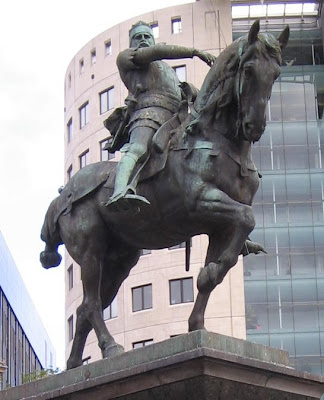 The Black Prince was the son of Edward III, the victor of the Battle of Crécy, where a small English army destroyed a large French one by the use of the medieval equivalent of the tactical nuclear weapon: the longbow.
  The prince ‘won his spurs’ (became a knight) at the age of 16 at that battle. There is a passage in Froissart that tells us something about the way the prince won his spurs and the sang froid and hard love of Edward III.
 And such was Edward III in a time when a good king could bring glory and prosperity to his people and a bad king utter ruin. Soon the powers of kings would be curtailed by parliament, which is in effect an insurance policy against the consequences of having a bad king. Looking at the economic mess we are in today, some might prefer taking their chances with a king.
 David Green (in his book The Black Prince) notes that the tomb undoubtedly retained an aura many years after the prince’s death, for Shakespeare/De Vere has the archbishop of Canterbury say to Henry V:
 When I visit England, my (half) brother Nigel and I usually visit an historic town. We have been to Lincoln and Durham before and this time we visited Chester, all old Roman towns. In England, a lot of towns are old Roman towns for that matter, but these are among the major ones, with York and London of course and Leicester I think.
  Chester used to be the huge Roman legionary fortress and naval base of Deva, built on a sandstone ridge in a loop of the River Dee. It is not hard to see why they chose the site strategically as it is close to Wales, Northern England and the Midlands, full of those pesky local tribes. The XX Valeria Victrix Legion was based here for 200 years. 200 years! Think of it. No doubt those last Romans would look at a stone plaque of the beautifully-engraved names of the previous commanders of the fortress going back 2 centuries and think that there would always be a Roman fortress at Chester. Are we looking around at our 200 year-old industrial-technological society and thinking it will always be like this...?
  We visited the old walls that completely encircle the city (no other city in Britain can claim as much), the old (14C and later) Tudor shopping arcades called ‘the Rows’, and the great cathedral, parts of which date back to Norman times (1066 and all that).

 After family reunions, my first excursion was a trip to Whitby. I last went there 6 years ago (see my post
  I returned to the lighthouse on the pier and the little plaque that made such an impression on me those 6 years ago.
 Nothing has changed on this pier. But there has been a lot of investment and renovation in the town. Now the beautifully restored little cobbled streets are lined with shops: jewellery, crafts, cafes and restaurants, and, how could I forget, pubs.
  I climbed the 199 steps that lead up to the Norman church of St. Mary on the cliff top, adjacent to the monastery. The view of the sea and the town here can never be forgotten, if one only sees it once.
 Below, a small harbour protected by a mole, a headland opposite with an old monastery, the old fishing village huddled on both sides of the harbour and then, beyond, filling the horizon, the longed-for sea.
 I walked along the pier to a kind of round battlement made of immense blocks of stone with the lighthouse in the centre. It was a blustery September day and the sea was choppy. The waves came crashing against the battlements like the furious assaults of some unknown enemy, only to recede before trying again.