Showing posts with label Leadership. Show all posts

Thursday, February 3, 2011

Bill Gross: America requires more than a makeover or a facelift. It needs a heart transplant

Bill Gross dons armour and sword  again and cuts a bloody swathe through the rotten financial and political system of America. We like Bill Gross.

Fifty years ago, the highest paid and most prestigious professions were that of a doctor or a 707 airline pilot who flew the “golden” route from Los Angeles to Honolulu. Today the yellow brick road begins on Wall Street or the City. Aside from supernova innovators such as Steve Jobs or Mark Zuckerberg, the money is made from securitizing things instead of booting and rebuilding America. The tallest buildings in almost every major city are banks, with tens of thousands of people shuffling and trading paper for a living. One of this country’s premier investment banks paid each of its 26,000 employees an average of $370,000 in 2010, nearly ten times the take-home pay of other American workers. Almost a quarter of the 400 wealthiest people on Forbes annual richest list make their money from money, whereas only 8% could make that claim in its first issue in 1982, and probably close to 0% when I first read my economic primer in 1966.

Financiers have lost their high ground and, if truth be told, we began to lose it a long time ago when we figured out that money was more than a medium of exchange or a poor substitute for a store of value. We figured out a turbocharged way to make money with money and proclaimed ourselves geniuses in the process. Well, we’re not. We may be categorized as “opportunists,” to be generous, but society’s “paragons” and a legitimate destination for a significant percentage of college graduates? Hardly.

This country desperately requires a rebalancing of priorities. After readjusting the compensation scales via regulation and/or free market common sense, America needs to anoint a new set of Mensans who can create something more than a cash machine and make this country competitive again in the global marketplace. We need to find a new economic Keynes or at least elect a chastened Congress that can take our structurally unemployed and give them a chance to be productive workers again. We must have a President whose idea of “centrist” policy is not to hand out presents to the right and the left and then altruistically proclaim the benefits of bipartisanship. We need a President who does more than propose “Win The Future” at annual State of the Union addresses without policy follow-up. America requires more than a makeover or a facelift. It needs a heart transplant absent the contagious antibodies of money and finance filtering through the system. It needs a Congress that cannot be bought and sold by lobbyists on K Street, whose pockets in turn are stuffed with corporate and special interest group payola. Are record corporate profits a fair price for America’s soul? A devil’s bargain more than likely.

Read the full article.

Tuesday, November 23, 2010

Quantitative Easing Explained in 6 minutes

I came across this video at Juggling Dynamite. It has ‘gone viral’ reaching 2 million views in the last week. Pass it on to your friends, you can’t make this up.

Tuesday, March 16, 2010

Dark clouds over America - 3 million poor souls not worth counting

I came across the following video at one of my regular financial haunts, Danielle Park’s Juggling Dynamite. You may remember Danielle as the ethical financial advisor.

The interviewee is economist Stephen Roach. (That reminds me of a joke about economists, but I digress). Mr. Roach works for Morgan Stanley and after listening to him in this interview my opinion of Morgan Stanley has gone up a couple of notches. Mr. Roach rightly points out that the unemployment figures released recently of 9.7% take no account of the three million U.S. citizens who have given up looking for a job. “For some bizarre reason,” says Mr. Roach, “the U.S. statisticians do not count these poor souls as unemployed.” The actual unemployment rate is 11.5%.

So not only are detainees ‘not persons’, neither are the discouraged jobless. What happened to equality and justice?

Speaking of justice, Mr. Roach ironically ends his analysis with the injunction that, because of the ‘noise’ in the unemployment data, “It’s important for your viewers to keep watching the pithy commentators you get on your show for clarity, truth and justice.”

In other words, don’t expect it from your administration’s statisticians. Damn, I like that guy.

OK, here is my economist joke, but in honour to Mr. Roach, let’s make it a statistician joke instead, it’s much more à propos:

There are three kinds of government statisticians: those who can count, and those who can’t.


Friday, February 12, 2010

Mending the World

Let’s take a break from the dark clouds and the doom and gloom. ‘Why are you writing about that stuff here anyway?’ you ask. ‘This is supposed to be a blog about philosophy and healing for goodness sake, I come here to get away from all that crazy stuff.’ Yep, you may have a point. But I talk about that crazy stuff because it is a consequence of bad philosophy. Just like for an individual, when a country and an economy are governed by short-term selfish immoral goals, bad consequences arise and suffering ensues. Eventually.
We have talked about this before: the swamp plant may grow fast and do well for a time, but it will not last. Only growth based on the firm soil of integrity is lasting and beneficial to all. What has happened in recent years is unacceptable to reasoning people and I feel winds of change are blowing and I feel a desire to give those winds of change a little help. So bear with me if I rant about bad philosophy in the world. I am reminded of this quote of many centuries ago:

Do you know, my son, with what little understanding the world is ruled? Pope Julius III (1487 – 1555)

Not many people see this blog but if only one person reads this post, who knows what tiny ripples of change may be set in motion?

So let us return to philosophy again for a moment and let me share with you a passage from an important little book I have discovered recently: Life’s Daily Blessings – Inspiring Reflections on Gratitude and Joy for Every Day, based on Jewish Wisdom by Rabbi Kerry M. Orlitzky. From compiling quotes for the blog, I have come across several Jewish proverbs and I always found them very succinct powerful and true. So when I fell on this book I was eager to learn more about the Jewish tradition. I was not disappointed. I share with you here a very appropriate passage for this blog and for this world today.

Mending the World

Blessed are You, Adonai our God, Ruler of the universe, for giving us the opportunity to mend the world. Rabbi Ron Klotz

While this is not a traditional blessing – that is, not one of the lists of blessings penned by the Rabbis to be among the one hundred that are to be said each day – it certainly contains what might be called traditional sentiments. We are each obligated to help repair the brokenness in the world, and in others. Of course, we may be simply motivated to do so because it is the right thing to do. But we also want to recognize that when we do so, we are contributing to God’s work in the world. In repairing what is broken and working to bring perfection back to the world by healing it and those who inhabit it, we are acting as channels through which God’s presence flows into the world.
The blessing that Rabbi Klotz wrote acknowledges the sacredness of such an act. It is a privilege to join with God in order to fix what is broken in the world. But the world is not alone in its need of repair. When we contribute to fixing the world, we often end up healing what may be broken in ourselves.

Friday, February 5, 2010

Dark clouds over America - Captain Bernanke and the Navy Rule

I recently read Paul B. Farrell’s article Warning: Captain Bernanke sinking the USS Titanic just before the reconfirmation of Ben Bernanke as Federal Reserve Chairman. Farrell compares Bernanke to Captain Queeg in the film ‘The Caine Mutiny’. I’m not familiar with the film but I can imagine Captain Queeg has some issues.

Worse, Obama's giving ol' Capt. Ben a second chance to pilot into new icebergs dead ahead. The Economist calls them "asset bubbles." Problem? Capt. Ben can't see through his ideological Greenspan/Reaganomics goggles, clouded by his obsessive allegiance to Wall Street's "fat cat bankers."
Nothing new: He failed to see warnings of "icebergs" back in 2007. Yes, and he'll miss any new icebergs, sink the global economy and plunge the world into the eerie depths of the Great Depression 2.

Farrell goes on to quote Jeremy Grantham in his recent letter to investors ‘Lessons Not Learned: On Redesigning Our Current Financial System.’

"Imagine the company representatives on the Titanic II design committee repeatedly pointing out that the Titanic I tragedy was a black swan event: utterly unpredictable and completely, emphatically, not caused by any failures of the ship's construction, of the company's policy, or of the captain's competence. 'No one could have seen this coming' would have been their constant refrain.'"
Sound familiar? You bet. Capt. Ben's "Titanic II design committee" would include his ol' buddies, Alan Greenspan, Henry Paulson, Lawrence Summers and Tim Geithner. "Their response would have been to spend their time pushing for more and improved lifeboats," says Grantham.

I have liked Jeremy Grantham ever since I saw him in this far-reaching interview at Wealthtrack after the meltdown last year (which I encourage you to watch in its entirety to get valuable insight into what has happened in this crisis, including utter condemnation of Greenspan and his protégé Bernanke). My favourite Grantham quote from the interview is this:

Interviewer: New rules of investing: is permanent bullishness about equities out?

I certainly hope it’s out. I like to say that in the short term we learn an enormous amount from these crises, and in the intermediate term we learn a little, and in the long term we learn absolutely nothing.

So a ‘nearly dysfunctional Congress’ dominated by special interests has plucked the Captain of the Titanic from the sea and has promptly given him command of a new ship. ‘Is that wise?’ you may ask. By pure coincidence I came across the following from (Warren Buffet’s partner) Charlie Munger’s book ‘Poor Charlie’s Almanac’:

I like the Navy’s system. If you’re a captain in the Navy and you’ve been up for twenty-four hours straight and have to go to sleep and you turn the ship over to a competent first mate in tough conditions and he takes the ship aground – clearly through no fault of yours – they don’t court-martial you, but your naval career is over.
You can say, ‘That’s too tough. That’s not law school. That’s not due process.’ Well, the Navy model is better in its context than would be the law school model. The Navy model really forces people to pay attention when conditions are tough – because they know that there’s no excuse.
It doesn’t matter why your ship goes aground, your career is over. Nobody’s interested in your fault. It’s just a rule that we happen to have – for the good of all, all effects considered.
I like some rules like that. I think that civilization works better with some of these no-fault rules. But that stuff tends to be anathema around law schools. ‘It’s not due process. You’re not really searching for justice.’
Well, I am searching for justice when I argue for the Navy rule – for the justice of fewer ships going aground.

Well, in the case of Captain Bernanke the Navy rule would doubly apply: the Captain was at the helm of his ship the whole time and was fully responsible for running the ship aground. The Captain would have been court-martialed, found guilty and dismissed the service. Next case. Instead, here we are again with the same captain, doomed to live through the whole scenario again. As Grantham points out, in the long term we learn absolutely nothing.


Image from Jeremy Gilby.com

Saturday, January 16, 2010

Dark clouds over America - the annual tribute

I have been reading ‘The Essays of Warren Buffet: Lessons for Corporate America’. There is much gold to be mined here by the moral philosopher. Here is one important theme: the transfer of wealth from the US to the rest of the world.

In 2003 Buffet wrote:

(I)n recent years our country’s trade deficit has been force-feeding huge amounts of claims on, and ownership in, America to the rest of the world. For a time, foreign appetite for these assets readily absorbed the supply. Late in 2002, however, the world started choking on this diet, and the dollar’s value began to slide against the major currencies.

In 2004:

Last year we had $1.15 trillion of such honest–to-God trade and the more of this, the better. But, as noted, our country also purchased an additional $618 billion in goods and services from the rest of the world that was unreciprocated. This is a staggering figure and one that has important consequences.
The balancing item to this one-way pseudo-trade … is a transfer of wealth from the US to the rest of the world. … This force-feeding of American wealth to the rest of the world is now proceeding at the rate of $1.8 billion daily, an increase of 20% since I wrote to you last year. Consequently, other countries and their citizens now own a net of about $3 trillion of the US. A decade ago their net ownership was negligible.

Buffet goes on to project that a decade from now (in 2014) net foreign ownership of the US would amount to about $11 trillion and at 5% interest, the US would need to spend $.55 trillion annually to ‘service’ this foreign investment. With a GDP of about $18 trillion, 3% of GDP would go to the rest of the world as 'annual tribute’ for financing Americans’ overindulgences.

If the US were running a $.6 trillion current-account (trade) surplus, commentators worldwide would violently condemn our policy, viewing it as an extreme form of ‘mercantilism’…
Our spendthrift behaviour won’t, however, be tolerated indefinitely. And though it's impossible to forecast just when and how the trade problem will be resolved, it’s improbable that the resolution will foster an increase in the value of our currency relative to that of our trading partners.

In 2005 the situation continued to worsen and in 2006 Buffet notes another ‘milestone' in the deteriorating financial health of the US:

Already the prediction I made last year about one fall-out from our spending binge has come true: The ‘investment income' account of our country – positive in every previous year since 1915 – turned negative in 2006. Foreigners earned more on their US investments than we do on our investments abroad. In effect, we’ve used up our bank account and turned to our credit card. And, like everyone who gets in hock, the US will now experience ‘reverse compounding’ as we pay ever-increasing amounts of interest on interest.

This situation will only change if the US ‘massively under consumes and begins to run consistent and large trade surpluses’.

Buffet points out that the huge US budget deficits do not transfer wealth. Only when we buy more than we sell is wealth transferred to the net seller.

However, when we also borrow money to buy more than we sell, we are hastening our financial demise, and that is what we see today.

And let us not even mention what road we are taking if we don’t even borrow but merely print the money out of thin air…

I leave you with this video about the opening of the world’s tallest skyscraper in Dubai, the ‘Burj Dubai’. It is an impressive architectural achievement and a proud symbol of Dubai’s economic power. But while I watched in awe, I couldn’t help thinking that I was witnessing possibly the most spectacular manifestation of the transfer of wealth out of the US.

Friday, January 8, 2010

Dark clouds over America - Bill Gross: What has become of the American nation?

Thank you to Shocked Investor for the heads up on the publication of Bill Gross’s new Economic Outlook for 2010.
Bill Gross is managing director of Pimco ‘a leading global investment management firm with more than 1,200 employees in offices in Newport Beach, New York, Amsterdam, Singapore, Tokyo, London, Sydney, Munich, Toronto and Hong Kong.’
This is the same Pimco that recently announced it would be a net seller of UK Government bonds this year and that it would reduce its holdings of American treasury debt (see this post at The Market Ticker).

Shocked Investor comments ‘You’d think something is about to give.’ Since being so shocked, he’s so cool about everything now.

Here is the beginning of Bill Gross’s Economic Outlook 2010 (my bold letters):

Quixotic journeys often make for great literature, but by definition are rarely productive. I am, after all, referring to windmills here - not their 21st century creation, but their 17th century chasing. Futility, not productivity, was the ultimate fate of Cervantes' man from La Mancha. So it is with hesitation, although quixotic obsession, that I plunge headlong into a discussion of American politics, healthcare legislation, resultant budget deficits and - finally - their potential effect on financial markets. There will be windmills aplenty in the next few pages and not much good can come of these opinions or my tilting in their direction. Still, I mount my steed, lance in hand, and ride forward.

Question: What has become of the American nation? Conceived with the vision of liberty and justice for all, we have descended in the clutches of corporate and other special interests to a second world state defined by K Street instead of Independence Square. Our government doesn't work anymore, or perhaps more accurately, when it does, it works for special interests and not the American people. Washington consistently stoops to legislate 10,000-page perversions of healthcare, regulatory reform, defence, and budgetary mandates overflowing with earmarks that serve a monied minority as opposed to an all-too-silent majority. You don't have to be Don Quixote to believe that legislators - and Presidents - often do not work for the benefit of their constituents: A recent NBC News/Wall Street Journal poll reported that over 65% of Americans trust their government to do the right thing "only some of the time" and a stunning 19% said "never." What most politicians apparently are working for is to perpetuate their power - first via district gerrymandering, and then second by around-the-clock campaigning financed by special interest groups. If, by chance, they're ever voted out of office, they have a home just down the street - at K Street - with six-figure incomes as a starting wage.

Read the full report here.

Thursday, January 7, 2010

Dark clouds over America - what happened to the Vision?

You have to go deeper than the mainstream media to get an idea of what is really going on in the US. If you listen to the mainstream media you may think that now is the time to get back into the market, the recession is behind us, the government has handled the crisis well and has the situation in hand and things are looking up. If you believe all this I urge you to visit some of the blogs and sites that I follow.

Remember my post last year, A Vision for America , about President Obama’s inaugural speech? Remember these lines?

As we stand at this crossroads of history, the eyes of all people in all nations are once again upon us, watching to see what we do with this moment, waiting for us to lead.
(…)
It is time to put in place tough, new commonsense rules of the road so that our financial market rewards drive and innovation and punishes shortcuts and abuse…

What happened? Via Danielle Park’s Juggling Dynamite I found this article at Rolling Stone by Matt Taibbi:

Barack Obama ran for president as a man of the people, standing up to Wall Street as the global economy melted down in that fateful fall of 2008. He pushed a tax plan to soak the rich, ripped NAFTA for hurting the middle class and tore into John McCain for supporting a bankruptcy bill that sided with wealthy bankers "at the expense of hardworking Americans." (…)What inspired supporters who pushed him to his historic win was the sense that a genuine outsider was finally breaking into an exclusive club, that walls were being torn down, that things were, for lack of a better or more specific term, changing.

Then he got elected.

What's taken place in the year since Obama won the presidency has turned out to be one of the most dramatic political about-faces in our history. Elected in the midst of a crushing economic crisis brought on by a decade of orgiastic deregulation and unchecked greed, Obama had a clear mandate to rein in Wall Street and remake the entire structure of the American economy. What he did instead was ship even his most marginally progressive campaign advisers off to various bureaucratic Siberias, while packing the key economic positions in his White House with the very people who caused the crisis in the first place. This new team of bubble-fattened ex-bankers and laissez-faire intellectuals then proceeded to sell us all out, instituting a massive, trickle-up bailout and systematically gutting regulatory reform from the inside.


Read the full article Obama’s Big Sellout.

For knowledgeable and detailed information and no punches pulled commentary and insight on the financial crisis and government’s action and non action in the face of it, you must read Karl Denninger’s The Market Ticker. For a great overview of 2009 and what 2010 holds (not pretty) do yourself a favour and read Where we are, where we’re heading 2010. Here is an excerpt:

If you take nothing else away from this Year in Review Ticker, it should be that singular chart above and a decent understanding of what it means:

To come back into equilibrium, assuming we do not decrease debt in the system at all, we would have to shrink GDP by about 20%. But shrinking GDP means that money available to pay down debt would also decrease which would generate even more defaults.

This is how deflationary depressions happen - years, even decades of playing Ponzi by layering debt upon debt. Bernanke and Geithner, along with President Obama, are well-aware of these facts which is why they are all pounding the table demanding that banks "loan more."

The problem with such a prescription is that the wise person won't borrow, for he knows what's coming. The unwise has no collateral to pledge, and thus can't borrow.

If the government forces (either by persuasion or legislation) lending to those who can't pay they only extend the Ponzi and in doing so make the inevitable collapse WORSE.

Before you get a headache, I will just leave you with a video I found through this post at Shocked Investor. It closes the loop on the opportunity that existed for Obama and that he seemed poised to seize in his inaugural address to reform the banking industry. Instead we are simply back where we started but when this bubble bursts there will be no more stimulus, no more money and no more bubbles to save us.

The eyes of all people in all nations are upon the US alright but what they see, including these eyes, is not good.

Bill Moyers speaking to Simon Johnson of the Peterson Institute for International Finance and representative Marcy Kaptur:


Sunday, January 3, 2010

Dark clouds over America - the Supreme Court rules detainees are not persons

One of the blogs I read for insight into the economy is Humble Student of the Markets by Cam Hui. Here I read of an alarming development in his post Two more steps toward Argentina. The original story is this, as told by Chris Floyd at Empire burlesque:

While we were all out doing our Christmas shopping, the highest court in the land quietly put the kibosh on a few more of the remaining shards of human liberty.

It happened earlier this week, in a discreet ruling that attracted almost no notice and took little time. In fact, our most august defenders of the Constitution did not have to exert themselves in the slightest to eviscerate not merely 220 years of Constitutional jurisprudence but also centuries of agonizing effort to lift civilization a few inches out of the blood-soaked mire that is our common human legacy. They just had to write a single sentence.

Here's how the bad deal went down. After hearing passionate arguments from the Obama Administration, the Supreme Court acquiesced to the president's fervent request and, in a one-line ruling, let stand a lower court decision that declared torture an ordinary, expected consequence of military detention, while introducing a shocking new precedent for all future courts to follow: anyone who is arbitrarily declared a "suspected enemy combatant" by the president or his designated minions is no longer a "person." They will simply cease to exist as a legal entity. They will have no inherent rights, no human rights, no legal standing whatsoever -- save whatever modicum of process the government arbitrarily deigns to grant them from time to time, with its ever-shifting tribunals and show trials.

Cam Hui asks what happened to ‘inalienable rights’ and compares the road that the US is now taking to that taken by Argentina:

This Supreme Court ruling sets up the preconditions for a Dirty War that Argentina saw in the late 1970s and early 1980s, where government forces made suspected left-wing guerrillas and their sympathizers “disappear”. Just as the repeal of the Glass-Steagall did not result in immediate consequences, I don’t believe that we will see the effects of this ruling overnight but the long term effects are potentially disastrous.

What about ‘Land of the free, home of the brave’? What about the Constitution?

This ruling tramples on the Constitution and one of the most powerful symbols of America. Just understand this - that Constitution was paid for by blood, not only of the Founding Fathers, but by every American soldier. Every G.I. that ever enlisted swore an oath, not to the president of the day, but to the Constitution of the United States.

When the Supreme Court of the nation that champions freedom and justice in the world comes out with a ruling like this, at the fervent request of the President of the nation, one has to take note and wonder where this is all going to lead.
Some may say that in war there are no rules. Certainly Churchill made it clear to Hitler that if he invaded Britain, the British would use all means available to them to defend themselves, the implication being biological weapons would be used. But where is the threat to the US today that faced Britain in her darkest hour?
I would say this: war can be waged without rules but the nations that wage war without rules always lose in the end. War can be waged without rules but philosophy teaches that life cannot. Such victors sow the seeds of their own ultimate destruction. Remember: sincerity is the treasure of a land and by sincerity we also understand integrity and the moral life. The US has a proud record of going to war to defend those values, now it must look in the mirror. The US does not need such a ruling, it is an act of weakness, an act of fear, and it is a shame and a disgrace to all the American men and women who have given their lives so we can enjoy freedom and justice, not just Americans but the whole world.

Yves Smith at Naked Capitalism points out that Romans of 2,000 years ago now enjoyed more rights than Americans today:

Roman citizens enjoyed a right to a trial, a right of appeal, and could not be tortured, whipped, or executed except if found guilty of treason, and anyone charged with treason could demand a trial in Rome. We have regressed more than 2000 years with this appalling ruling.

I am reminded of my recent reading of ‘The Peloponnesian War’ by Donald Kagan. The Athenians were blessed with a noble and capable leader in the form of Pericles of whom Plutarch says:

For whereas all sorts of distempers, as was to be expected, were rife in a rabble which possessed such a vast empire, he alone was so endowed by nature that he could manage each one of these cases suitably, and more than anything else he used the people's hopes and fears, like rudders, so to speak, giving timely check to their arrogance, and allaying and comforting their despair. Plutarch

While Pericles lived the Athenians kept to the noble path and could hope for victory. When he died, the war became more desperate, more brutal and hope receded. I can’t help but think that the US is in need of a Pericles today.

Sunday, November 22, 2009

Courage - Pericles' funeral speech

I am reading Donald Kagan’s book The Peloponnesian War which tells the story of the long death struggle between Sparta and Athens and their respective allies in the fifth century BC. It is a gripping read as is Livy’s tale of the similar struggle to come between Rome and Carthage (see Roman fortitude). The participants are evenly matched: Sparta is the greatest military power on land, but Athens is the greatest military power on the sea. (In this the war resembles the struggle between Napoleonic France and maritime Britain).

Athens is fortunate in having a great leader in the form of Pericles, ‘son of Xanthippus (a victorious general in the Persian war), the leading man in Athens at that time, and the ablest in speech and in action.’ From Thucydides, a historian and participant in the war, we learn that Pericles’ teacher, Anaxagoras, had instilled in him

…a lofty spirit and an elevated mode of speech, free from the vulgar and knavish tricks of mob-orators, but also a composed countenance that never gave way to laughter, a dignity of carriage and restraint in the arrangement of his clothing which no emotion was allowed to disturb while he was speaking, a voice that was evenly controlled, and all the other characteristics of this sort which so impressed his hearers.

Pericles persuades the Athenians that if they avoid a decisive land battle but wait patiently behind their city walls, relying on supply from the sea which they control, Sparta will realise that they are powerless and will sue for peace. It is a wise strategy but it goes against the grain of the time, especially with the impetuous young. When a Spartan army lays waste the bountiful Athenian countryside while the Athenians watch from the walls, Pericles has to (bravely) bear their accusations of timidity and cowardice. Only he can hold the Athenians in check from certain disaster.

And yet there were times when they were sorely vexed with him, and then he tightened the reins and forced them into the way of their advantage with a master's hand, for all the world like a wise physician, who treats a complicated disease of long standing occasionally with harmless indulgences to please his patient, and occasionally, too, with caustics and bitter drugs which work salvation. For whereas all sorts of distempers, as was to be expected, were rife in a rabble which possessed such a vast empire, he alone was so endowed by nature that he could manage each one of these cases suitably, and more than anything else he used the people's hopes and fears, like rudders, so to speak, giving timely check to their arrogance, and allaying and comforting their despair. Plutarch

Pericles holds back the Athenians from doing what the Spartans want them to do: come out and fight a decisive battle on their terms - on land - where they are the stronger. In this wise but ungrateful and unpopular task he reminds us of Fabius Maximus who, after Rome’s crushing defeat at Cannae, refuses all battle with the seemingly invincible Hannibal. He only shadows him with his army, a constant threat to be guarded against, letting the advantage of time in favour of the Romans do its work. (This resemblance was clear to Plutarch also: I found that he pairs Pericles and Fabius Maximus together in his Parallel Lives, see here).

Pericles bides his time and events prove him right. When funeral rights are held for those who have perished in the first year of war, the Athenians call upon him to give the eulogy as their foremost leader. His speech is not only a eulogy to the fallen Athenian brave but to all brave men. It is a tribute to courage, which puts something higher, something more important, above personal interest and personal safety: freedom and the common good.

You must every day look upon the power of your city and become her lovers, and when you have understood her greatness consider that the men who achieved it were brave and honourable and knew what was necessary when the time came for action. If they ever failed in some attempt, they were determined that, at least, their city should not be deprived of their courage and gave her the most beautiful of all offerings. For they gave their lives for the common good and thereby won for themselves the praise that never grows old and the most distinguished of all graves, not those in which they lie, but where their glory remains in eternal memory, always there at the right time to inspire speech and action. For the whole world is the burial place for brave men; not only does the epitaph inscribed on monuments in their native country commemorate them, but in lands not their own the unwritten memory; more of their spirit even than of what they have done, lives on within each person. Now it is for you to emulate them; knowing that happiness requires freedom and freedom requires courage, do not shrink from the dangers of war.

*****

Courage is what preserves our liberty, safety, life, and our homes and parents, our country and children. Courage comprises all things. Plautus

So, as you go into battle, remember your ancestors and remember your descendants. Tacitus

Happy the man who ventures boldly to defend what he holds dear. Ovid

So when the crisis is upon you, remember that God, like a trainer of wrestlers, has matched you with a tough and stalwart antagonist... that you may prove a victor at the Great Games. Epictetus

Things never go so well that one should have no fear, and never so ill that one should have no hope. Turkish proverb

To persevere, trusting in what hopes he has, is courage. The coward despairs. Euripedes

It is the bold man who every time does best, at home or abroad. Homer

In times of stress, be bold and valiant. Horace

In difficult situations, when hope seems feeble, the boldest plans are safest. Livy

He shall fare well who confronts circumstances aright. Plutarch

Image: Discurso funebre Pericles by Von Folz, from Wikipedia

Friday, November 20, 2009

Courage - never give up

To listen to all my talk of the courage of the ancients one would think there were no examples worthy of note closer to hand. But of course there are. We baby boomers are but one or two generations away from the last world war when another seemingly invincible foe threatened to conquer the free world. Another Battle of Thermopylae took place only 70 years ago. A few men again stood against many. The defending heroes numbered about the same as that Greek advance guard long ago, but instead of spears and short swords they wielded Hurricanes and Spitfires.
Their battle would be called the Battle of Britain, but their story begins before that. Here is an excerpt of Churchill’s address to the House of Commons on 4 June 1940 following the evacuation of 335,000 allied troops from Dunkirk

A miracle of deliverance, achieved by valour, by perseverance, by perfect discipline, by faultless service, by resource, by skill, by unconquerable fidelity, is manifest to us all. The enemy was hurled back by the retreating British troops. He was so roughly handled that he did not hurry their departure seriously. The Royal Air Force engaged the main strength of the German Air Force, and inflicted upon them losses of at least four to one; and the Navy, using nearly 1,000 ships of all kinds, carried over 335,000 men, French and British, out of the jaws of death and shame, to their native land and to the tasks which lie immediately ahead. We must be very careful not to assign to this deliverance the attributes of a victory. Wars are not won by evacuations. But there was a victory inside this deliverance, which should be noted. It was gained by the Air Force….

This was a great trial of strength between the British and German Air Forces. Can you conceive a greater objective for the Germans in the air than to make evacuation from these beaches impossible, and to sink all these ships which were displayed, almost to the extent of thousands? Could there have been an objective of greater military importance and significance for the whole purpose of the war than this? They tried hard, and they were beaten back; they were frustrated in their task. We got the Army away; and they have paid fourfold for any losses which they have inflicted. Very large formations of German aeroplanes - and we know that they are a very brave race - have turned on several occasions from the attack of one quarter of their number of the Royal Air Force, and have dispersed in different directions….


When we consider how much greater would be our advantage in defending the air above this Island against an overseas attack, I must say that I find in these facts a sure basis upon which practical and reassuring thoughts may rest. I will pay my tribute to these young airmen. The great French Army was very largely, for the time being, cast back and disturbed by the onrush of a few thousands of armoured vehicles. May it not also be that the cause of civilization itself will be defended by the skill and devotion of a few thousand airmen?

*******

The greatest test of courage on earth is to bear defeat without losing heart. Robert G. Ingersoll

Courage is going from failure to failure without losing enthusiasm. Winston Churchill

Who hath not known ill fortune, never knew himself, or his own virtue. David Mallett

Everyone will be taxed according to his means. Johann Friedrich Von Schiller

Optimism is essential to achievement and it is also the foundation of courage and true progress. Nicholas Murray Butler

Optimism is the foundation of courage. Nicholas Murray Butler

Stand upright, speak thy thoughts, declare the truth thou hast, that all may share; be bold, proclaim it everywhere. They only live who dare. Voltaire

Courage, in the final analysis, is nothing but an affirmative answer to the shocks of existence. Kurt Goldstein

Where life is more terrible than death, it is the truest valour to dare to live. Sir Thomas Brown

Often the test of courage is not to die, but to live. Conte Vittorio Alfienri

Courage is generosity of the highest order, for the brave are prodigal of the most precious things. Charles Caleb Colton

The bravest are the tenderest. The loving are the daring. Henry Wadsworth Longfellow

Courage is grace under pressure. Ernest Hemingway

Avoiding danger is no safer in the long run than outright exposure. Life is either a daring adventure, or nothing. Helen Keller

Courage is the price that life exacts for granting peace. Amelia Earhart

Freedom is not for the timid. Vijaya Lakshmi Pandit


Image by Molock67


Thursday, November 19, 2009

Courage - what Leonidas said

Leonidas, the son of Anaxandridas and brother to Cleomenes, when one said to him, Abating that you are king, you are no better than we, replied, But unless I had been better than you, I had not been king.

His wife Gorgo, when he went forth to Thermopylae to fight the Persian, asked him what command he left with her; and he replied, Marry brave men, and bear them brave children.

The Ephors saying, You lead but few to Thermopylae; They are many, said he, considering on what design we go.

And when they again asked him whether he had any other enterprise in his thought, he replied, I pretend to go to hinder the barbarians’ passage, but really to die fighting for the Greeks.

When he was at Thermopylae, he said to his soldiers: They report the enemy is at hand, and we lose time; for we must either beat the barbarian or die ourselves.

And to another saying, What, the flights of the Persian arrows will darken the very sun, he said, Therefore it will be pleasant for us to fight in the shade.

And another saying, What, Leonidas, do you come to fight so great a number with so few? — he returned: If you esteem number, all Greece is not able to match a small part of that army; if courage, this number is sufficient.

And to another discoursing after the same manner he said, I have enough, since they are to be killed.

When Xerxes wrote to him thus, Sir, you may forbear to fight against the Gods, but may follow my interest and be lord of all Greece, he answered: If you understood wherein consisted the happiness of life, you would not covet other men’s; but know that I would rather die for the liberty of Greece than be a monarch over my countrymen.

And Xerxes writing to him again thus, Send me thy arms, he returned, Come and take them.

When he resolved to fall upon the enemy, and his captains of the war told him he must stay till the forces of the allies had joined him, he said: Do you think all those that intend to fight are not here already? Or do you not understand that those only fight who fear and reverence their kings?

And he ordered his soldiers so to dine, as if they were to sup in another world.

And being asked why the bravest men prefer an honourable death before an inglorious life, he replied, Because they believe one is the gift of Nature, while the other is peculiarly their own.

Being desirous to save the striplings that were with him, and knowing very well that if he dealt openly with them none would accept his kindness, he gave each of them privately letters to carry to the Ephors. He desired likewise to save three of those that were grown men; but they having some notice of his design refused the letters. And one of them said, I came, sir, to be a soldier, and not a courier; and the second, I shall be a better man if here than if away; and the third, I will not be behind these, but the first in the fight.

From Plutarch’s Laconic Apophthegms; or remarkable sayings of the Spartans
Image derived from a photo from Wikimedia

Sunday, November 15, 2009

Courage - Alexander the Great

I recently came across the site of The Online Library of Liberty which has among others the text of Plutarch’s The Morals. Here I found Plutarch’s commentary about the life of Alexander the Great. In it he shows how Alexander exemplified virtue in his life and won his successes by sweat and blood and without the help of Fortune, or rather in spite of ill Fortune.

I studied Alexander’s life story some years ago. I could happily write a blog about Alexander alone. There are many striking examples of personal courage in Alexander’s life but one in particular made a deep impression on me. Hollywood could find no more dramatic moment of courage in history than this one but has so far chosen to ignore it.

So I was very gratified to read Plutarch’s eloquent account of the incident. I think you will find it gratifying also, for it is something god-like, hardly to be believed and reveals the essence of Alexander’s life and how he inspired awe and admiration in all, friend and foe alike.

First we must set the stage. Alexander is the most charismatic general in history and his men love him. It is said he can greet 3,000 of them by their name. Alexander and his small army have conquered all of Persia. They are now advancing laboriously through India, conquering small tribes and cities as they go, as Alexander’s ambition drives him to seek a way to the Ocean. They are not a happy band of brothers at this time. In fact the army is close to mutiny. As Peter Green puts it, ‘They were sick of glory and honour. They had endured more in 8 years than most men are called upon to face in a lifetime. Now all they wanted was a quick, safe journey home.’ When Alexander calls upon them to storm the walls of yet another Oxydracian tribal stronghold, they refuse. Alexander is furious and climbs up a ladder himself to shame them, cutting down the defenders on the wall. There he stands, the enemies’ arrows whistling about his ears. His men shout up at him to come back down. He looks at them for a moment and then jumps down… into the stronghold.

Brasidas advanced his fame all over Greece, by breaking through the enemy’s army lying encamped by the seaside near Methone; but when you read of that daring jump of Alexander’s (so astonishing to the hearers, much more to them that beheld it) when he threw himself from the walls of the Oxydracian metropolis among the thickest of the enemy, assailing him on every side with spears, darts, and swords, tell me where you meet with such an example of matchless prowess, or to what you can compare it but to a gleam of lightning violently flashing from a cloud, and impetuously driven by the wind? Such was the appearance of Alexander, as he leaped like an apparition to the earth, glittering in his flaming armour. The enemy, at first amazed and struck with horror, retreated and fell back; till seeing him single they came on again with redoubled force.

Now was not this a great and splendid testimony of Fortune’s kindness, to throw him into an inconsiderable and barbarous town, and there to enclose and immure him a prey to worthless enemies? And when his friends made haste to his assistance, to break the scaling-ladders, and to overthrow and cast them down? Of three that got upon the walls and flung themselves down in his defence, endearing Fortune presently despatched one; the other, pierced and struck with a shower of darts, could only be said to live. Without, the Macedonians foamed and filled the air with helpless cries, having no engines at hand. All they could do was to dig down the walls with their swords, tear out the stones with their nails, and almost to rend them out with their teeth. All this while, Alexander, Fortune’s favourite, whom she always covered with her protection, like a wild beast entangled in a snare, stood deserted and destitute of all assistance, not labouring for Susa, Babylon, Bactria, or to vanquish the mighty Porus. For to miscarry in great and glorious attempts is no reproach; but so malicious was Fortune, so kind to the barbarians, such a hater of Alexander, that she aimed not only at his life and body, but at bereaving him of his honour and sullying his renown. For Alexander’s fall had never been so much lamented had he perished near Euphrates or Hydaspes by the hand of Darius, or by the horses, swords, and axes of the Persians fighting with all their might and main in defence of their king, or had he tumbled from the walls of Babylon, and all his hopes together. Thus Pelopidas and Epaminondas fell; whose death was to be ascribed to their virtue, not to such a poor misfortune as this.

But what was the singular act of Fortune’s favour which we are now enquiring into? What indeed, but in the farthest nook of a barbarous country, on the farther side of a river, within the walls of a miserable village, to pen up and hide the lord and king of the world, that he might there perish shamefully at the hands of barbarians, who should knock him down and pelt him with whatever came next to hand? There the first blow he received with a battle-axe cleft his helmet and entered his skull; at the same time another shot him with an Indian arrow in the breast near one of his paps, the head being four fingers broad and five in length, which, together with the weight of the shaft which projected from the wound, did not a little torment him. But, what was worst of all, while he was thus defending himself from his enemies before him, when he had laid a bold attempter that approached his person sprawling upon the earth with his sword, a fellow from a mill close by came behind him, and with a great iron pestle gave him such a bang upon the neck as deprived him for the present both of his senses and his sight. However, his virtue did not yet forsake him, but supplied him still with courage, infusing strength withal and speed into those about him. For Ptolemy, Limnaeus, and Leonnatus, and some others who had mounted or broken through the wall, made to his succour, and stood about him like so many bulwarks of his virtue; out of mere affection and kindness to their sovereign exposing their bodies, their faces, and their lives in his defence. For it is not Fortune that overrules men to run the hazard of death for brave princes; but the love of virtue allures them - as natural affection charms and entice bees – to surround and guard their chief commander.


From The Second Oration of Plutarch concerning the Fortune or Virtue of Alexander the Great, Plutarch, The Morals, Vol. 1

We have seen that courage is not recklessness; courage is not courage unless guided by prudence. Alexander’s jump was not recklessness but a calculated risk of his life in the cause of a greater goal. He knew his men would follow him. What he miscalculated was the lack of means. His men, on seeing him disappear beyond the wall, surged up the few ladders available like men possessed and overburdened them so that they broke. Others threw themselves like demons against the gates with axes and it was finally the breaking open of the gates which saved Alexander. In a blind rage of revenge and grief his men killed everyone in the stronghold. Alexander survived his wounds, but only just.

If you want to know more about the incredible life of Alexander, I highly recommend Peter Green’s book Alexander of Macedon.

With audacity one can undertake anything. Napoleon

He who fears being conquered is sure of defeat. Napoleon

The battle is not to the strong alone; it is to the vigilant, the active, the brave. Patrick Henry

No great thing comes to any man unless he has courage. Cardinal James Gibbons

Courage is almost a contradiction in terms. It means a strong desire to live taking the form of readiness to die. G.K. Chesterton

One man with courage makes a majority. Andrew Jackson


Image: Statue of Alexander and Bucephalus at Thessaloniki, Greece by Rippedangelwings

Saturday, October 3, 2009

The Black Prince

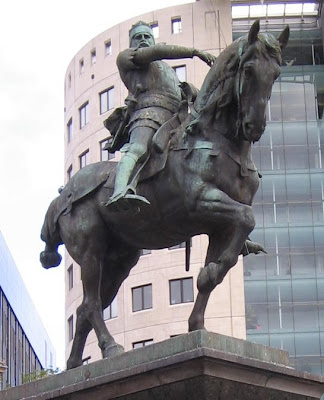
As I crossed the street from Leeds Station my eye fell on a striking equestrian statue some distance on the left. I went over to have a look at it. Now I must have crossed that street a dozen times in all my trips to England but never once did I seem to notice this statue, an amazing lack of observation on my part that I cannot explain. It was a statue of the Black Prince, no less.

The Black Prince was the son of Edward III, the victor of the Battle of Crécy, where a small English army destroyed a large French one by the use of the medieval equivalent of the tactical nuclear weapon: the longbow.

The prince ‘won his spurs’ (became a knight) at the age of 16 at that battle. There is a passage in Froissart that tells us something about the way the prince won his spurs and the sang froid and hard love of Edward III.

In the morning, the day of the battle, certain Frenchmen and Germans perforce broke through the archers of the prince’s battalion, and came and fought with the men-of-arms hand to hand. Then the second battalion of the Englishmen came to succour the prince’s battalion, the which was time, for they had then much ado; and those with the prince sent a messenger to the king, who was on the little windmill hill.
Then the knight said to the king, “Sir, the Earl of Warwick and the Earl of Stafford, Sir Reginald Cobham, and other such as be about the prince your son, are fiercely fought withal, and are sore handled: wherefore they desire you that you and your battalion will come and aid them, for if the Frenchmen increase, as they doubt they will, your son and they shall have much ado.”
Then the king said, “Is my son dead, or hurt, or on the earth felled?”
“No, Sir,” said the knight, “but he is hardly matched; wherefore he hath need of your aid.”
“Well,” said the king, “return to him and to them that sent you hither, and say to them that they send no more to me, whatever adventure befalleth, as long as my son is alive; and also say to them, that they suffer him this day to win his spurs, for if God be pleased, I will that this day’s work be his, and the honour thereof, and to them that be about him.”
Then the knight returned again to them, and showed the king’s words, the which greatly encouraged them; and they repented in that they had sent to the king as they did.


Thus the Black Prince won his spurs that day and went on to defeat the French himself at the Battle at Poitiers, fulfilling all his father’s hopes for him.

And such was Edward III in a time when a good king could bring glory and prosperity to his people and a bad king utter ruin. Soon the powers of kings would be curtailed by parliament, which is in effect an insurance policy against the consequences of having a bad king. Looking at the economic mess we are in today, some might prefer taking their chances with a king.

The Black Prince is buried in Canterbury Cathedral and what seems to be (I have not been there) a magnificent gilded copper effigy rests above his tomb, portraying the prince as the epitome of the chivalric knight.

David Green (in his book The Black Prince) notes that the tomb undoubtedly retained an aura many years after the prince’s death, for Shakespeare/De Vere has the archbishop of Canterbury say to Henry V:

Look back into your mighty ancestors:
Go, my dread lord, to your great-grandsire’s tomb,
From whom you claim; invoke his warlike spirit,
And your great-uncle’s, Edward the Black Prince,
Who on the French ground play’d a tragedy,
Making defeat on the full power of France,
While his most mighty father on a hill
Stood smiling to behold his lion’s whelp
Forage in blood of French nobility.

Photo of tomb effigy from Wikimedia

Monday, August 17, 2009

'Sir Nigel'

In The White Company I told you how much I liked Conan Doyle’s wonderful little tale of chivalry set during the wars between England and France in the fourteenth century. I am now reading Sir Nigel which is set slightly earlier and tells us the story of the knight of that name who we met in 'The White Company'.
Conan Doyle, like that great historical writer Patrick O’Brian, is thoroughly steeped in his period and brings vividly to life the notions and morals of those distant times. I thought I would share one such insight with you because it has to do with the notion of the gentleman, which is a popular theme on this blog.
The young Nigel, not yet a knight - a mere squire – yet of noble birth and brought up in the old ways, is travelling to the wars with Aylward, a longbowman and Nigel’s own squire.

That night they slept in a sordid inn, overrun with rats and with fleas, one mile south of the hamlet of Mayfield. Aylward scratched vigorously and cursed with fervour. Nigel lay without movement or sound. To the man who had learned the old rule of chivalry there were no small ills in life. It was beneath the dignity of his soul to stoop to observe them. Cold and heat, hunger and thirst, such things did not exist for the gentleman. The armour of his soul was so complete that it was proof not only against the great ills of life but even against the small ones; so the flea-bitten Nigel lay grimly still while Aylward writhed upon his couch.

Conan Doyle does not expand upon the subject more than that. It is for those who are receptive to take note. How the insight rings true. How petty are most of our discomforts and complaints, and how we undermine the nobility of our spirits by dwelling on them.
Is this not a characteristic of the gentleman that he accepts hardships without complaint, that he accepts what he finds and adapts himself readily to it? His mind is focused on what is required of him as a gentleman, that is, what he must do for honour and for right and for those weaker than himself. And for these reasons he is a natural born leader and is considered of a finer essence by those who can only complain or dwell on petty things.

It is to be regretted if a party of people are together for a whole day without their conversation touching on what is right and wrong and if they take pleasure merely in shallow talk. Confucius

There is no such thing as being a gentleman at important moments; it is at unimportant moments that a man is a gentleman. At important moments he ought to be something better. G.K. Chesterton

Wednesday, August 12, 2009

The Bailout Bubble

In my last post Amy Luft’s question on Answers I said ‘the lack of morality in the financial system has brought us to the brink of disaster.’ I was speaking from the generally accepted viewpoint that the worst of the credit crisis is over. But perhaps the worst is still to come.

My view of the present financial crisis, as conceived by my being a regular reader of certain financial sites, compelled me to move from equities to cash in my retirement plan many weeks ago (since the TSX reached 10,200 and the Dow 9,000). So I was already very sceptical about the strong recovery priced into the market at this level and expected a pullback. But the last few days (just as the mainstream media is getting lathered up about ‘the end of the recession’) I have come across some articles that frankly give me the willies.

First there was this post at Danielle Park's Juggling Dynamite, Risk aversion is back on :

At present levels, the S&P 500 is pricing in a significant earnings rebound for 2010 and emerging markets have been pricing a hearty resumption of western consumption. Both of these assumptions are seriously in doubt.
Today the Singapore Minister of Trade and Industry threw a blanket again on resurgent decoupling hopes, saying there were "few signs of a decisive turnaround in final demand in Singapore's key export markets." (…)
This time, thanks to the massive credit overhang, rate cuts alone are not able to revive the housing sector. Without the housing catalyst to kick-start and lever renewed consumption, growth has a massive headwind.

Danielle includes a clip, ‘Housing Mess is not over’, which gives a sobering update on US housing.

Then it was Marketwatch’s Paul B. Farrell and his article New bull, new bubble, new meltdown by 2012.

Yes, folks, a new bubble cycle is already in motion. You can feel the energy building, the kind that fuelled the meltdowns of 1998, 2000 and 2007. We never resolved the problems fuelling the dot-com insanity. We made matters worse feeding the subprime credit-derivatives disaster with cheap money, Reaganomics ideology and two costly wars. Lessons were never learned, nothing was resolved. Today matters continue deteriorating.
Behind the hoopla, the Wall Street conspiracy has dumped $23.7 trillion new bailout debt on taxpayers. The bill will come due.

What we are seeing is a new market bubble in the making fuelled by bailout-money. Instead of lending, banks are putting the money into the stock market. (I read that 75% of trades since the March low have come from the desks of Goldman Sachs). When this bubble bursts, it will be ugly.

Expect a major house-cleaning, a second American Revolution. We predicted the "Great Depression 2" around 2012. Well, we doubt taxpayers will passively sit one more time, like in the 1930s, in 2000, and the past few years. Next time voters will take a page from the history books about past revolutions in the American Colonies, France and Russia. A perfect storm will erupt in a massive global credit meltdown, bringing down Wall Street and the clandestine $670 trillion shadow central banking system.

But the article that really gave me the willies was this one from Global Research, Entering the greatest depression in history, by Andrew Gavin Marshall.

While there is much talk of a recovery on the horizon, commentators are forgetting some crucial aspects of the financial crisis. The crisis is not simply composed of one bubble, the housing real estate bubble, which has already burst. The crisis has many bubbles, all of which dwarf the housing bubble burst of 2008. Indicators show that the next possible burst is the commercial real estate bubble. However, the main event on the horizon is the “bailout bubble” and the general world debt bubble, which will plunge the world into a Great Depression the likes of which have never before been seen.

Marshall ties together many threads and introduces us to Gerald Celente, head of the Trends Research Institute, the major trend-forecasting agency in the world.

Celente’s forecasts are not to be taken lightly, as he accurately predicted the 1987 stock market crash, the fall of the Soviet Union, the 1998 Russian economic collapse, the 1997 East Asian economic crisis, the 2000 Dot-Com bubble burst, the 2001 recession, the start of a recession in 2007 and the housing market collapse of 2008, among other things.

And what is Gerald Celente predicting will happen in the present financial/economic/moral crisis?

Phantom dollars, printed out of thin air, backed by nothing ... and producing next to nothing ... defines the ‘Bailout Bubble.’ Just as with the other bubbles, so too will this one burst. But unlike Dot-com and Real Estate, when the "Bailout Bubble" pops, neither the President nor the Federal Reserve will have the fiscal fixes or monetary policies available to inflate another.

And just when you thought it couldn’t possibly get any worse. Guess what? It gets worse:

Given the pattern of governments to parlay egregious failures into mega-failures, the classic trend they follow, when all else fails, is to take their nation to war... While we cannot pinpoint precisely when the 'Bailout Bubble' will burst, we are certain it will. When it does, it should be understood that a major war could follow.

You can watch a video of Gerald Celente embedded in the above article, and at the end of the video there is a selection of related videos.

I know all this has very little to do with my blog about Healing Philosophy, but I felt I had to share it with you since we are facing very challenging times and the more we can all be forewarned the better chance we have of getting through it.

And then again, perhaps it has a lot to do with philosophy and, eventually, healing.

Friday, June 19, 2009

Twitter and The Iranian Presidential Election

It is not the role of this blog to discuss politics, although you will find references to Obama and sincerity, the new era of responsibility and moral hazard, where politics is intertwined with philosophy as it should be. But Loaded Web has come up with an interesting way to help support the struggle of the Iranians to have their voice heard in the Iranian Presidential election. As of today, and until it is no longer necessary, you can see Loaded Web’s green triangle in the top left corner of the screen. It links to blogs and news carriers covering events in Iran and you can also get the code to put a similar green triangle on your own blog if you have one. It’s a small gesture of encouragement for the Iranian people who voted for a reformist president in their country and are protesting the alleged rigging of the ballots.
The Iranian people are using the web and Twitter on hand-held devices to communicate and organize their protests. I am sure the inventors of Twitter never imagined that they would one day be at the centre of a people’s struggle for reform and democracy. As barriers to communication fall, people widen their horizons and become harder to mislead. Let us hope that the truth prevails in Iran, sooner than later, because the writing is on the wall. Or rather, on Twitter.

See a good overview of the situation at Wikipedia: The Iranian Presidential Election

Wednesday, June 10, 2009

HMS Victory - Britain's 'Ship of Theseus'

I remember as a youth reading about the legend of Theseus. As a young boy, the future King of Athens volunteered to be one of the seven youths sent as a sacrifice every seven years to King Minos of Crete to be devoured by the Minotaur that lived there in the labyrinth. Theseus hides a sword in his tunic and slays the beast. On the return journey to Athens he forgets to change the black sail of his ship to a white one as agreed with his father to signify his success. His father Aegeus believes his son dead and commits suicide by throwing himself into the sea, giving his name to the Aegean.

According to Plutarch’s Life of Theseus, the ship Theseus used on his return to Athens was kept in the Athenian harbor as a memorial for several centuries.


The ship wherein Theseus and the youth of Athens returned had thirty oars, and was preserved by the Athenians down even to the time of Demetrius Phalereus for they took away the old planks as they decayed, putting in new and stronger timber in their place...


The ship had to be maintained in a seaworthy state, for it annually carried the Athenian envoys to the festival of Apollo at Delos.
As the wood of the ship wore out or rotted and was replaced, it was unclear to philosophers how much of the original ship actually remained, giving rise to the philosophical question whether it should be considered "the same" ship or not. Such philosophical questions about the nature of identity are sometimes referred to as the Ship of Theseus Paradox.


For Athenians, the preserved ship kept fresh their understanding that Theseus had been an actual, historic figure, which none then doubted.


From Wikipedia

Reading about the ship of Theseus brought to mind my trip to England in 2005 and my visit to HMS Victory. The Victory was the flagship of Admiral Nelson at the Battle of Trafalgar in 1805 where the British Fleet virtually destroyed an equivalent French fleet thus eliminating the threat of invasion of Britain by Napoleon.
My visit to this ship merits a post or ten of itself. Over 6,000 trees went to build it, all by hand. The photo does not do justice to the size of the ship. This was at the time the largest man-made moveable object ever made. Going aboard you feel small, insignificant, humbled. Some of the ropes are so thick you probably couldn’t get your arms around them. The masts are about 4 feet in diameter at deck level. The ship, like the ship of Theseus, has been restored and inevitably some parts have been replaced by ‘new and stronger timber’, mainly on the upper decks. The lower decks are largely original and you can walk the same planks that Nelson and his crew walked 200 years ago.
The Victory is all that remains of the Royal Navy of the Age of Fighting Sail and we would not have even that but for the pleadings of a wife of a First Lord (of the Admiralty) that it should be preserved. (The Admiralty of the period had no sentimental qualms about sending famous ships to the breaker’s yard).

Like the ship of Theseus for the Athenians, Britain’s Victory ‘keeps fresh their understanding’ of Nelson and his navy and what they did at Trafalgar and in other battles in that critical and historic period. Personally, it makes no difference to me that only 30% of the ship is ‘original’. Like the Gold Pavilion, the spirit and intention of the original builders is what survives and that is what we want to see.
.

Tuesday, March 3, 2009

Philosophy - an essential luxury good

I read an interesting article Is philosophy a luxury good? at the Economist’s Free Exchange blog. The author notes that according to Maslow (of heirarchy of needs pyramid fame) ‘you can only ponder the state of your soul when your most basic physical and material needs have been met’. In a downturn students tend to choose programs with more practical job prospects, and universities and governements tend to cut back on the humanities.

But cutting back on humanities could be a false economy. Studying subjects like philosophy does impact critical thinking and communication skills. Intellectually diverse societies often are the very ones that tend to thrive. Amar Bhide argues that India did itself a great economic disservice by producing too many engineers. Also, law professor Anthony T. Kronman argues that economic and social upheaval only highlights the need to re-examine moral issues. But “the need for my older view of the humanities is, if anything, more urgent today,” he added, referring to the widespread indictment of greed, irresponsibility and fraud that led to the financial meltdown. In his view this is the time to re-examine “what we care about and what we value,” a problem the humanities “are extremely well-equipped to address.”

I’m with him. Of course, with someone who is hungry it is difficult to discuss anything more than the next meal. But in modern-day society hunger is not a problem, basic needs are not a problem. Philosophy is a luxury good that everyone can afford. Philosophy matters. I find it impossible to think of a time and a place where philosophy would not matter. Certainly it matters today more than ever, in the new era of responsibility.
.
Image from Wikimedia: Maslow's hierarchy of needs

Sunday, March 1, 2009

A Vision for America

As we stand at this crossroads of history, the eyes of all people in all nations are once again upon us, watching to see what we do with this moment, waiting for us to lead.

Among the eyes of all people of all nations watching President Obama’s first address to Congress were my eyes. And they saw an inspiring, charismatic leader, leading. Of course, he is a product of the times. He not only has ‘the Mandate of Heaven’, he has the mandate of an angry American people who want action and a more enlightened and effective government.

Those qualities that have made America the greatest force of progress and prosperity in human history we still possess in ample measure. What is required now is for this country to pull together, confront boldly the challenges we face, and take responsibility for our future once more… Now, if we're honest with ourselves, we'll admit that for too long we have not always met these responsibilities, as a government or as a people. I say this not to lay blame or to look backwards, but because it is only by understanding how we arrived at this moment that we'll be able to lift ourselves out of this predicament… The fact is, our economy did not fall into decline overnight. Nor did all of our problems begin when the housing market collapsed or the stock market sank.

My italics. Straight talk, honest words, sincerity! Compare Obama’s words with this from the I Ching 41st hexagram: ‘What matters here is to understand the time and not to try to cover up poverty with empty pretence’. Only when you recognize and accept the truth of a situation can you hope to correct it.

Now, I understand that when the last administration asked this Congress to provide assistance for struggling banks, Democrats and Republicans alike were infuriated by the mismanagement and the results that followed. So were the American taxpayers; so was I.
So I know how unpopular it is to be seen as helping banks right now, especially when everyone is suffering in part from their bad decisions. I promise you: I get it.
But I also know that, in a time of crisis, we cannot afford to govern out of anger or yield to the politics of the moment.

Ah yes, anger; we know about the evils of anger on this blog, but what about the politics of the moment? I am put in mind of a quote by Joseph Campbell: ‘Economics and politics are the governing powers of life today, and that’s why everything is screwy’. The governing powers of life should be universal truths, spiritual values. Of course there is need of economic discipline. But is the present method of 4-year terms of office propitious to a wise, consistent, impartial, enlightened approach to public finance? Someone said that a nation is too important to be run by politicians (maybe it was me). I don’t know the answer, but a kind of politically independent ‘Supreme Court’ of Economic Planning might be worth considering.

It is time to put in place tough, new commonsense rules of the road so that our financial market rewards drive and innovation and punishes shortcuts and abuse…

Yes, the way of the swamp plant will not be tolerated any more. A pity that we had to look over the brink into the abyss of financial meltdown to admit the problem and to gather the political resolve to do something about it. Still, we are there now. Every crisis brings its opportunity. Perhaps this recognition of the swamp plants in the system will be the positive development out of this financial crisis, the tipping point that allows us to weed out the problem. Whenever I have a personal Waterloo, I always try to look at what the lesson is and I even tell myself ‘This was a cheap lesson’. In other words, the lesson, though expensive, will allow me to avoid even costlier mistakes in the future.

The only way this century will be another American century is if we confront at last the price of our dependence on oil and the high cost of health care, the schools that aren't preparing our children and the mountain of debt they stand to inherit. That is our responsibility… I see this document differently. I see it as a vision for America, as a blueprint for our future.

Could it be that Big Oil and Big Pharma lobbyists stood in the way of energy and health care reform? Could it be that a nation as technologically advanced as the United States could not have developed advanced biofuels 10 years ago? Could not have developed electric cars 10 or 20 years ago? Could not have been the leader in solar and clean energy use decades ago? Could not have implemented universal health care reform and efficiency? ‘Economics and politics are the governing powers of life today…’

History reminds us that, at every moment of economic upheaval and transformation, this nation has responded with bold action and big ideas… Now, none of this will come without cost, nor will it be easy. But this is America. We don't do what's easy. We do what's necessary to move this country forward.

The sleeping bear has gotten a wake up call. Whether Big Oil, Big Pharma, Big whatever-you-care-to-name like it or not, there will be changes around here, oh dearie me yes. That swamp-plant special-interest mentality has bankrupted America. Energy, health care and education reform will go forward now. How sweet it is.

Finally, because we're also suffering from a deficit of trust, I am committed to restoring a sense of honesty and accountability to our budget. That is why this budget looks ahead 10 years and accounts for spending that was left out under the old rules and, for the first time, that includes the full cost of fighting in Iraq and Afghanistan.

A deficit of trust. What a telling phrase. Such a deficit is worse than a budget deficit because it undermines the moral fabric of the nation. Sincerity is the treasure of a land.

To overcome extremism, we must also be vigilant in upholding the values our troops defend, because there is no force in the world more powerful than the example of America…Those of us gathered here tonight have been called to govern in extraordinary times. It is a tremendous burden, but also a great privilege, one that has been entrusted to few generations of Americans, for in our hands lies the ability to shape our world, for good or for ill.

For all its faults, I still feel that the United States is the closest thing to a utopia that we have on earth (perhaps with the exception of Canada!) The people are generous, hard working, tolerant and courageous. It only needs a leader and a government to harness those values, that strength and channel it in an enlightened way.

These words and these stories tell us something about the spirit of the people who sent us here. They tell us that, even in the most trying times, amid the most difficult circumstances, there is a generosity, a resilience, a decency, and a determination that perseveres, a willingness to take responsibility for our future and for posterity.

Here are echoes of the I Ching again: ‘If a time of scanty resources brings out an inner truth, one must not feel ashamed of simplicity. For simplicity is then the very thing needed to provide inner strength for further undertakings’. Churchill said the same thing: ‘We shall draw from the heart of suffering itself the means of inspiration and survival.’

Obama closes his address in a charismatic appeal to a simple, basic truth and common interest: love of country.

There are surely times in the future where we will part ways. But I also know that every American who is sitting here tonight loves this country and wants it to succeed…That must be the starting point for every debate we have in the coming months and where we return after those debates are done. That is the foundation on which the American people expect us to build common ground. And if we do, if we come together and lift this nation from the depths of this crisis, if we put our people back to work and restart the engine of our prosperity, if we confront without fear the challenges of our time and summon that enduring spirit of an America that does not quit, then some day, years from now, our children can tell their children that this was the time when we performed, in the words that are carved into this very chamber, "something worthy to be remembered."

Something worthy indeed. The stakes are high. Failure is not an option. Time to roll up the sleeves and work, sincerely, for a new vision.
.
Photo from Wikimedia

Discover The Tale of Genji, the 11th Century classic of Japan (click image)

Discover The Tale of Genji, the 11th Century classic of Japan (click image)
Kiyomizudera Temple has a large veranda looking out over Kyoto and beyond