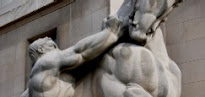

I came across this quote the other day, which reminds me of my grandmother’s saying ‘What cannot be cured, must be endured’ but rephrased in a more positive way:
What cannot be avoided, t'were childish weakness to lament or fear. Shakespeare/De Vere
Here we have acceptance in a nutshell: to be a man is to face the inevitable bravely without complaining that it should be otherwise. Shake-speare always has the knack of putting his finger on the crux of the matter, doesn’t he?
When we don’t face up to what can’t be avoided, we are in resistance mode. We are wasting energy bewailing our fate. We are hanging on to an idea of reality that doesn’t exist any more, if it ever did. We are not adapting to the situation at hand and we are not considering what the situation at hand demands of us. We are being childish instead of being men, or women. The feeling of a weight falling off your shoulders when you accept something is nothing more than the relaxing, the abandoning, of this effort of false resistance.
We saw the value of seeing clearly in Decrease and other posts about sincerity:
Decrease does not under all circumstances mean something bad. Increase and decrease come in their own time. What matters here is to understand the time and not to try to cover up poverty with empty pretence. If a time of scanty resources brings out an inner truth, one must not feel ashamed of simplicity. For simplicity is then the very thing needed to provide inner strength for further undertakings. I Ching
We tried complicated. We thought we had complicated covered. We were wrong. We got hurt. Now we have to face simple, even though we don’t want to. But the funny thing is that simple is what we need. Simple was staring us in the face all along but we didn’t want to see it. Now we have no choice but to face it - but its OK. Simple is how we move on from here. So let’s get over it. Let’s embrace it. Let’s accept it.
The survival of the fittest is the ageless law of nature, but the fittest are rarely the strong. The fittest are those endowed with the qualifications for adaptation, the ability to accept the inevitable and conform to the unavoidable, to harmonize with existing or changing conditions. Dave E. Smalley
A man shares his days with hunger, thirst, and cold, with the good times and the bad, and the first part of being a man is to understand that. Louis L’Amour
Attitude is your acceptance of the natural laws, or your rejection of the natural laws. Stuart Chase
A flower falls even though we love it. A weed grows even though we don't love it. Dogen
Nature, to be commanded, must be obeyed. Francis Bacon
Adapt or perish, now as ever, is nature's inexorable imperative. H. G. Wells
All that is necessary is to accept the impossible, do without the indispensable, and bear the intolerable. Kathleen Norris
The quickest way to change your attitude toward pain is to accept the fact that everything that happens to us has been designed for our spiritual growth. M. Scott Peck
Almost any event will put on a new face when received with cheerful acceptance. Henry S. Haskins
Everything in life that we really accept undergoes a change. So suffering must become love. That is the mystery. Katherine Mansfield
Anything in life that we don't accept will simply make trouble for us until we make peace with it. Shakti Gawain
The resistance to the unpleasant situation is the root of suffering. Ram Dass
The chief pang of most trials is not so much the actual suffering itself as our own spirit of resistance to it. Jean Nicolas Grou
To oppose something is to maintain it. Ursula K. LeGuin
If you can't fight, and you can't flee, flow. Robert Eliot
Often the prudent, far from making their destinies, succumb to them. Voltaire
The mind which renounces, once and forever, a futile hope, has its compensations in ever-growing calm. George R. Gissing
Peace of mind is that mental condition in which you have accepted the worst. Lin Yutang
Everything has its wonders, even darkness and silence, and I learn, whatever state I may be in, therein to be content. Helen Keller
Don't be sad, don't be angry, if life deceives you! Submit to your grief; your time for joy will come, believe me. Aleksandr Pushkin
The greatest evil which fortune can inflict on men is to endow them with small talents and great ambitions. Vauvenargues
The English know how to make the best of things. Their so-called muddling through is simply skill at dealing with the inevitable. Winston Churchill
Things past redress are now with me past care. Shakespeare/De Vere
I not only bow to the inevitable, I am fortified by it. Thornton Wilder
Showing posts with label Shakespeare. Show all posts
Showing posts with label Shakespeare. Show all posts
Saturday, July 25, 2009


Saturday, April 25, 2009
Love at the edge of doom
Let me not to the marriage of true minds
Admit impediments. Love is not love
Which alters when it alteration finds,
Or bends with the remover to remove:
O no! it is an ever-fixed mark
That looks on tempests and is never shaken;
It is the star to every wandering bark,
Whose worth's unknown, although his height be taken.
Love's not Time's fool, though rosy lips and cheeks
Within his bending sickle's compass come:
Love alters not with his brief hours and weeks,
But bears it out even to the edge of doom.
If this be error and upon me proved,
I never writ, nor no man ever loved.
Shake-speare (De Vere) - Sonnet 116
If you are suffering from the loss of a love, you may have found little solace in my last post Love (lost). Your reasoning mind may have found it mildly interesting but your heart will have dismissed it in an instant with a 'But you don't understand'. I quote this powerful verse from Shake-speare (De Vere) by way of saying that I do understand.
When we are in love, and lose that love, there can be no solace for the heart in the short term. This has been my experience anyway. Perhaps it is a psycho-physiological trick of nature to keep couples together to ensure the survival of the species. In my case, only time (many years) has faded the memory without erasing it completely.
But there is nothing bad but thinking makes it so, the bard also said. And if you are a regular reader you are familiar with the Taoist philosophy of facing up sincerely to the times and learning its lessons. There is also the Taoist philosophy that everything we are living now we created ourselves by our past actions. We are responsible for manifesting everything around us. There is the philosophy that everything we are living now is exactly appropriate for us at this moment and is exactly what we need to experience now in order to grow. There is also the philosophy that we already have everything we need here and now (gratitude) and wishing for things to be exactly the way they are now allows us to appreciate them. These are important ideas for they can help us in changing our viewpoint from that of a victim of other people’s actions to active engineers of our own experience.
To activate that change of viewpoint, one of the best ways is to use affirmations. Yes, I know your heart is groaning ‘Is that all you’ve got?’ But there is untold power in the word as it becomes true for the subconscious. For the subconscious creates for us what we believe to be true and cannot tell the difference between what we experience in reality and what we concentrate on in our mind. Concentrate on sorrow or concentrate on transformation, and your subconscious will create it. Here are some powerful affirmations from ‘Manifesto’ by my favourite modern-day Taoist master, Stephen Russel.
All internal psycho-emotional discomfort evaporates now and I find myself at peace.
I acknowledge myself for having the courage and endurance to carry on.
I am cheerful no matter what.
I determine what kind of life I have – no one and nothing else.
I create my own reality according to which set of beliefs I subscribe to now. I now alter the very foundations of my reality and thus build myself a different and more useful belief structure that even now is producing magnificent results.
I take full responsibility for myself and my moment-by-moment experience of life from this moment on.
I am alive.
Admit impediments. Love is not love
Which alters when it alteration finds,
Or bends with the remover to remove:
O no! it is an ever-fixed mark
That looks on tempests and is never shaken;
It is the star to every wandering bark,
Whose worth's unknown, although his height be taken.
Love's not Time's fool, though rosy lips and cheeks
Within his bending sickle's compass come:
Love alters not with his brief hours and weeks,
But bears it out even to the edge of doom.
If this be error and upon me proved,
I never writ, nor no man ever loved.
Shake-speare (De Vere) - Sonnet 116
If you are suffering from the loss of a love, you may have found little solace in my last post Love (lost). Your reasoning mind may have found it mildly interesting but your heart will have dismissed it in an instant with a 'But you don't understand'. I quote this powerful verse from Shake-speare (De Vere) by way of saying that I do understand.
When we are in love, and lose that love, there can be no solace for the heart in the short term. This has been my experience anyway. Perhaps it is a psycho-physiological trick of nature to keep couples together to ensure the survival of the species. In my case, only time (many years) has faded the memory without erasing it completely.
But there is nothing bad but thinking makes it so, the bard also said. And if you are a regular reader you are familiar with the Taoist philosophy of facing up sincerely to the times and learning its lessons. There is also the Taoist philosophy that everything we are living now we created ourselves by our past actions. We are responsible for manifesting everything around us. There is the philosophy that everything we are living now is exactly appropriate for us at this moment and is exactly what we need to experience now in order to grow. There is also the philosophy that we already have everything we need here and now (gratitude) and wishing for things to be exactly the way they are now allows us to appreciate them. These are important ideas for they can help us in changing our viewpoint from that of a victim of other people’s actions to active engineers of our own experience.
To activate that change of viewpoint, one of the best ways is to use affirmations. Yes, I know your heart is groaning ‘Is that all you’ve got?’ But there is untold power in the word as it becomes true for the subconscious. For the subconscious creates for us what we believe to be true and cannot tell the difference between what we experience in reality and what we concentrate on in our mind. Concentrate on sorrow or concentrate on transformation, and your subconscious will create it. Here are some powerful affirmations from ‘Manifesto’ by my favourite modern-day Taoist master, Stephen Russel.
All internal psycho-emotional discomfort evaporates now and I find myself at peace.
I acknowledge myself for having the courage and endurance to carry on.
I am cheerful no matter what.
I determine what kind of life I have – no one and nothing else.
I create my own reality according to which set of beliefs I subscribe to now. I now alter the very foundations of my reality and thus build myself a different and more useful belief structure that even now is producing magnificent results.
I take full responsibility for myself and my moment-by-moment experience of life from this moment on.
I am alive.
Tuesday, February 24, 2009
Shakespeare's royal son - The Prince Tudor Theory
 If you have been keeping up with the groundbreaking revelations on this site live as they happen (or rather other people’s groundbreaking revelations live as this philosophy blogger gets around to discovering them after everyone else) you will know whom I mean by ‘Shakespeare'. I do not mean a vague local chap from Stratford who was the best-educated man of all time, a political, military and legal expert and a prolific, creative literary genius whilst at the same time managing to leave almost no corresponding physical or historical trace of his life. I mean rather Edward De Vere, 17th Earl of Oxford who wrote anonymously under the name of Shakespeare for political and social reasons (see my post The real Shakespeare).
After this post, Jim Hammond, whose noteworthy site is at the origin of my recent posts (see his essay Who was Shakespeare?), pointed me to this site: Shake-speare’s Treason. At this point my head was reeling. With time only for a brief look, I couldn’t make out what the heck was going on here. Then Jim, commenting on my last post Edward De Vere Google search, nudged me to discover 'The Prince Tudor Theory'. I would have gotten around to it, eventually. So today I read Jim’s excellent essay Shakespeare’s Secret Son: The Prince Tudor Theory and all the pieces fell into place.
In a nutshell, Edward De Vere, Earl of Oxford, was a favourite at Queen Elizabeth’s court. And, according to the theory, perhaps at one point he was more than a favourite. They have a secret affair and Elizabeth gives birth secretly to their son who of course is prince and heir to the throne but Elizabeth does not recognize him publicly as such. Their son, Henry Wriothesley, 3rd Earl of Southampton, later takes part in the Essex Rebellion and is captured and imprisoned for treason in the Tower of London. He is released after two years. (You can’t make this up, truth is stranger than fiction). Jim gives us a good overview of the development of the Prince Tudor Theory over time up until today where it is taken to another level by Hank Whittemore who has discovered a ‘code’ in the bard’s sonnets.
Hank has discovered a numerical structure in Shakespeare’s Sonnets; he has discovered what may be called The Rosetta Stone that makes it possible to understand the Sonnets. T. S. Eliot said of the Sonnets, “This autobiography is written by a foreign man in a foreign tongue, which can never be translated.” Hank’s work allows us to translate this “foreign language,” it allows us to understand the Sonnets for the first time…
Hank argues that the Sonnets deal almost entirely with Queen Elizabeth and Southampton. They deal with the poet’s love for his son — not with a homosexual passion, as many have supposed, nor with a heterosexual passion, as earlier Tudorites believed. Hank argues that the famous Dark Lady of the Sonnets is Elizabeth…
Hank argues that the Sonnets express the poet’s anguish over his son’s predicament … They also express the poet’s anguish that his connection to Elizabeth will never be made public, that his son will never become King (even if he’s fortunate enough to avoid execution), and that his own career as a writer will be buried in secrecy and silence.
Jim goes on to give an absolutely fascinating exposé of the arguments in favour of the Prince Tudor Theory, citing verses from the sonnets which become clear once one knows how to unlock them using Hank’s key.
Hank has written a book on his discovery, 'The Monument: Shake-Speare’s Sonnets by Edward de Vere, 17th Earl of Oxford', which has its own site here. If you want to know more you can also visit Hank Whittemore’s Shakespeare Blog. And if you are in the Boston area you can go to Hank’s 28 March solo show on the subject Shake-speare’s Treason – The True Story of King Henry IX, Last of the Tudors.
This is a truly amazing subject for further study and I look forward to getting my teeth into it. A big thank you to Jim for the nudge. I was getting around to it though.
.
P.S. Click on the 'comments' link below to read a message from Hank Whittemore. That's right, the man himself, live as it happens...
.
Image: Book cover of ‘The Monument: Shake-Speare’s Sonnets by Edward de Vere, 17th Earl of Oxford’ by Hank Whittemore
Saturday, February 21, 2009
Edward De Vere Google search
 Since my last post The real Shakespeare where I revealed to a shocked world that William Shakespeare was the pen name of Edward De Vere, 17th Earl of Oxford, I have done some more research on the subject. And it now appears that me and a guy in northeastern Nepal are the only two people in the world who didn’t know this already.
I found this out by doing a search on Google for ‘Edward De Vere’. I may have imagined it, but it seemed to me that the lights dimmed a little as Google took the strain of searching the six million gazillion web pages, blogs, book sites, associations, and societies of all the people who have written extensively on the subject. I think I even saw the hourglass symbol appear on the screen for a fraction of a second. I had a flash of the Google search engine saying to itself “He wants a search of what? Holy mother of RAM, that’s gonna take us 150 milliseconds, maybe more. Do we have to? Geez, what a life…Forget about that multi-lingual Bible reference search, they’ll have to wait... Call Google.ru ask them if they can give us a hand…Boy, some people ought to get out more...”
I haven’t time now to give you even the broad headings of what is out there on the web. But reader Magusdee kindly commented (probably with an inward sigh) on my last post:
The best single source for the Oxfordian case is Mark Anderson's "'Shakespeare' by Another Name: The Life of Edward De Vere, Earl of Oxford, the Man Who Was Shakespeare" (in softcover, Gotham Books 2005). Scintillating reading--one has no doubt, after finishing the book, that, yes, De Vere wrote the plays, poems, and sonnets. Game, set, match, Oxford.
I have now ordered this book and in time I will let you know my impressions. As I commented back to Magus, the great thing about this whole thing is that little was known about the traditional ‘Stratford’ Shakespeare whereas quite a lot is known about Edward De Vere. This means that we now get to ‘know Shakespeare’ much better, or rather we get to know him for the first time. But I was forgetting, you guys already knew that.
.
Image: Beautiful De Vere-inspired Elizabethan music by Mignarda
Image: Beautiful De Vere-inspired Elizabethan music by Mignarda
Thursday, February 19, 2009
The real Shakespeare
 Whilst Stumbling around philosophic cyberspace I came across a very worthy site called Philosophy and Literature: Nietzsche, Shakespeare and Hammond belonging to published author L. James Hammond. There is a goldmine of wisdom to discover here, but what jumped out of the page and bit me was Hammond’s essay Who was Shakespeare? After reading this fascinating exposé of literary detective work, I am here to tell you that William Shakespeare was the pen name of Edward De Vere, Earl of Oxford.
* moment of stunned silence*
That is all very well and good you say, after picking yourself up from the floor, but what has it got to do with healing philosophy?
First of all, Shakespeare’s knowledge of the human soul places him among the great philosophers of all time, quite apart from his writing genius. Secondly, how is it that all my life until now, I did not know who the real Shakespeare was? And if all my life I ‘laboured under this mistaken belief’, what other mistaken beliefs am I labouring under? All of us, since I am sure 99% of the world is not aware of the truth.
The conventional view is that Shakespeare was a man from the small, country town of Stratford. Many people, however, reject the conventional view, and argue that Shakespeare was the pen name of Edward de Vere, Earl of Oxford, and that the Earl of Oxford had to conceal his authorship for social and political reasons.
The social and political reasons being that all artistic work was considered at that time not much better than manual labour and so was beneath Oxford’s station as a Lord. Hammond’s essay exposes many convincing arguments of which I quote here those I thought the most obviously true:
Shakespeare's works contain a vast amount of knowledge, knowledge that the Stratford man could scarcely have acquired. Shakespeare knew the Greek and Roman classics; his works refer to the tragedies of Sophocles, the dialogues of Plato, and many other ancient classics … Shakespeare also had a firm grasp of politics … a deep knowledge of legal matters … understood naval and military matters ... He was thoroughly versed in the pastimes of the nobility, such as falconry; he often uses images borrowed from falconry. How could the Stratford man have acquired such knowledge? …those who adhere to the Oxford theory describe the poet as one of the best educated people of his time, or of any time.
In short, Oxford’s education was of the first order, he moved in high political circles, he travelled extensively, he was a soldier-sportsman-athlete, a scholar and a gifted writer from an early age. In short he was everything that the Stratford man was not and that the Shakespeare as revealed in his works certainly was. Hammond ties many threads together drawing on the research of many people, such that one is left in no doubt as to the conclusion.
But no need to take my word for it: read the essay and judge for yourself. We must thank Jim Hammond for this belief-shattering essay and not least for passing on to us what is certainly a description of the real Shakespeare:
While traveling on the Continent, Oxford may have encountered the poet George Chapman. In one of his plays, Chapman has a character say that he encountered Oxford in Germany, and that he found him to be .
.
...the most goodly fashion'd man
I ever saw: from head to foot in form
Rare and most absolute...
He was beside of spirit passing great
Valiant and learn'd, and liberal as the sun,
Spoke and writ sweetly, or of learned subjects,
Or of the discipline of public weals.[17]
.
.
Image from Wikimedia: Edward De Vere, 17th Earl of Oxford from an engraving by J. Brown after G.P. Harding 1575
P.S. You can add your name to a Declaration of reasonable doubt about the identity of William Shakespeare at the Shakespeare Authorship Coalition
Subscribe to:
Posts (Atom)
Discover The Tale of Genji, the 11th Century classic of Japan (click image)

Kiyomizudera Temple has a large veranda looking out over Kyoto and beyond